Watch: SpaceX lands Starship next to camera placed in middle of Indian Ocean
Far out in the Indian Ocean, floating cameras captured a fiery moment that revealed how SpaceX is changing not just rockets, but the way the world watches spaceflight.
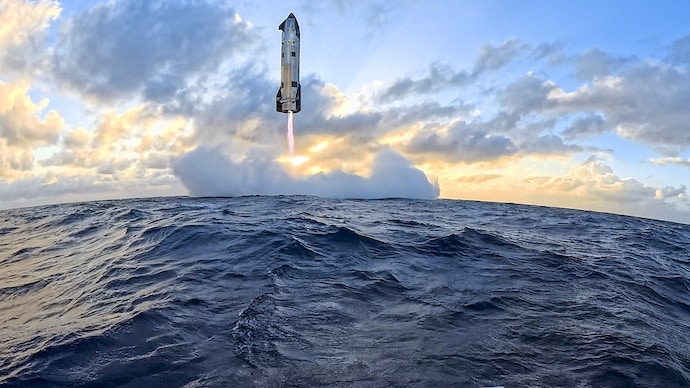
SpaceX's giant Starship rocket, designed to carry people and cargo to the Moon, Mars, and beyond, took another major step forward during its twelfth test flight.
On Saturday, May 23, the uncrewed upper stage of the vehicle launched from Texas, US, flew a high-speed suborbital path around part of the Earth, and returned for a planned splashdown in the remote Indian Ocean.
What made this test stand out was not just the rocket's performance, but how the everyday satellite internet helped bring the moment live to viewers worldwide.
AN ENGINEERING WONDER
Starship stands nearly as tall as a 20-story building and relies on powerful Raptor engines for controlled flight. During re-entry, it uses a "belly flop" manoeuvre to manage heat and speed, then flips upright for a final landing burn.
In earlier tests, capturing clear footage from the open ocean was extremely difficult due to distance, waves, and lack of reliable connections.
For Flight 12, SpaceX placed specialised buoys in the target zone. These floating platforms carried cameras and Starlink terminals, the same technology that provides high-speed internet to ships, planes, and remote homes on Earth.
Stabilised by gyroscopes, the cameras stayed remarkably steady despite constant wave motion, delivering smooth, real-time video of the giant spacecraft descending on pillars of engine flame.
A SCENIC SPLASH
Viewers watched Starship climb down from the bright, blue sky, slow down, hover briefly with engines firing, then touch the ocean surface.
When it made contact with the calm ocean surface, a massive plume of steam erupted. The vehicle spun slightly at the end before the expected post-splashdown explosion, which is normal for these early tests where the focus is on controlled descent rather than recovery.
The buoys, positioned with accuracy, captured it all from a safe distance and streamed it instantly via Starlink satellites overhead.
This achievement highlighted two growing capabilities for SpaceX.
One was Starship's improving ability to hit precise ocean targets at orbital speeds, and the other was Starlink's expanding role in enabling connectivity anywhere.
Previously, such remote maritime views relied on expensive ships or aircraft with limited range. Now, simple floating sensors turn the world's oceans into live broadcast studios.
For a company aiming for rapid reusability and deep-space missions, every clear data point and public view counts. Flight 12's ocean spectacle, streamed live from buoys floating in the Indian Ocean, showed how SpaceX is steadily turning innovative concepts into reality.
SpaceX's giant Starship rocket, designed to carry people and cargo to the Moon, Mars, and beyond, took another major step forward during its twelfth test flight.
On Saturday, May 23, the uncrewed upper stage of the vehicle launched from Texas, US, flew a high-speed suborbital path around part of the Earth, and returned for a planned splashdown in the remote Indian Ocean.
What made this test stand out was not just the rocket's performance, but how the everyday satellite internet helped bring the moment live to viewers worldwide.
AN ENGINEERING WONDER
Starship stands nearly as tall as a 20-story building and relies on powerful Raptor engines for controlled flight. During re-entry, it uses a "belly flop" manoeuvre to manage heat and speed, then flips upright for a final landing burn.
In earlier tests, capturing clear footage from the open ocean was extremely difficult due to distance, waves, and lack of reliable connections.
For Flight 12, SpaceX placed specialised buoys in the target zone. These floating platforms carried cameras and Starlink terminals, the same technology that provides high-speed internet to ships, planes, and remote homes on Earth.
Stabilised by gyroscopes, the cameras stayed remarkably steady despite constant wave motion, delivering smooth, real-time video of the giant spacecraft descending on pillars of engine flame.
A SCENIC SPLASH
Viewers watched Starship climb down from the bright, blue sky, slow down, hover briefly with engines firing, then touch the ocean surface.
When it made contact with the calm ocean surface, a massive plume of steam erupted. The vehicle spun slightly at the end before the expected post-splashdown explosion, which is normal for these early tests where the focus is on controlled descent rather than recovery.
The buoys, positioned with accuracy, captured it all from a safe distance and streamed it instantly via Starlink satellites overhead.
This achievement highlighted two growing capabilities for SpaceX.
One was Starship's improving ability to hit precise ocean targets at orbital speeds, and the other was Starlink's expanding role in enabling connectivity anywhere.
Previously, such remote maritime views relied on expensive ships or aircraft with limited range. Now, simple floating sensors turn the world's oceans into live broadcast studios.
For a company aiming for rapid reusability and deep-space missions, every clear data point and public view counts. Flight 12's ocean spectacle, streamed live from buoys floating in the Indian Ocean, showed how SpaceX is steadily turning innovative concepts into reality.

