
What Albert Einstein's viral marksheet teaches us about marks and success
A resurfaced image of Albert Einstein's marksheet has renewed discussion about how student ability is judged. The attention on his uneven grades underscores that exam scores may not capture a person's full potential.
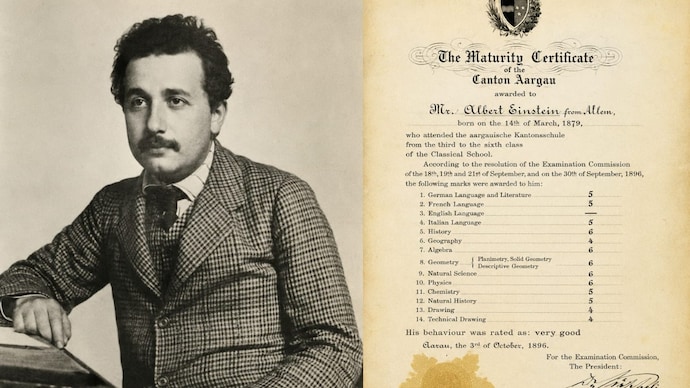
A resurfaced image of Albert Einstein's marksheet has renewed discussion about how student ability is judged. (AI-translated marksheet, original inside)

A degree often becomes the first thing people look at when judging academic success. Marks, percentages and grades find a place on resumes, applications and in conversations. They tell us how a student performed in examinations. Yet they rarely capture the full picture of what a person learns, questions and eventually achieves.
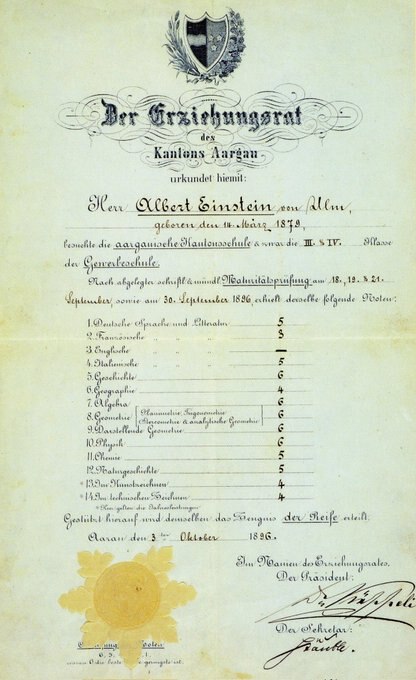
A photograph that has recently resurfaced on social media platform X has once again sparked this discussion. The image shows the marksheet of physicist Albert Einstein, one of the most recognised scientists in history.
The document has attracted attention because his scores were not uniformly high across all subjects.
According to the marksheet, Einstein secured several top grades in Physics and Mathematics. He received multiple 6s, the highest grade under the Swiss grading system used at the time, including in Physics, Algebra, Geometry and Natural Science. However, he did not score equally well in every subject.
His marks in Geography, English, Drawing and Technical Drawing were comparatively lower, with some subjects carrying grades of 4 out of 6.
The marksheet in question is not a university degree. It is Einstein's Swiss Matura certificate, awarded on October 3, 1896, after he completed his studies at the Aargau Cantonal School (Aargauische Kantonsschule) in Aarau, Switzerland.
The Swiss Matura is roughly equivalent to today's Class 12 or higher secondary school-leaving qualification and serves as the credential required for admission to universities.
A journalist, Walter Sullivan, writes about Einstein's marksheet in a 1984 piece in The New York Times:
"With 1 as the highest grade and 6 the lowest, the principal reported, Einstein’s marks in Greek, Latin and mathematics oscillated between 1 and 2 until, toward the end, he invariably scored 1 in math."
THE MANY SCHOOL CHALLENGES THAT EINSTEIN FACED
It is difficult to imagine, especially in India, a genius whose marksheet does not display perfect scores across all subjects. Yet Einstein's 4s out of 6 did not determine his future. Those grades did not prevent him from becoming one of the most influential scientists in history.
As a child, Einstein displayed a strong interest in mathematics and science.
By the age of 12, he had independently worked out a proof of the Pythagorean theorem. Before turning 15, he had taught himself differential and integral calculus. At the same time, he struggled with the rigid structure of formal schooling.
He attended the Luitpold Gymnasium in Munich, Germany, where he frequently clashed with teachers. One teacher reportedly told him that he would never amount to much in life. Eventually, Einstein left the school before graduating and joined his family in Italy.
Seeking admission to the Swiss Federal Polytechnic School in Zurich, now known as ETH Zurich, Einstein sat for its entrance examination at the age of 16.
He performed exceptionally well in Physics and Mathematics but fell short in several other subjects. The institution advised him to complete his schooling at Aarau first.
The move proved significant. Einstein later described Aarau's educational environment as more open and encouraging of independent thought. After earning his Matura certificate, he gained admission to ETH Zurich, where he studied mathematics and physics and graduated in 1900.
The viral image has prompted a familiar question: do marks alone define ability? Academic performance remains an important measure in schools and universities.
- Ends