
Why India is a promising investment destination for Japanese companies
India's growth potential and digital capabilities complement Japan's quality and manufacturing expertise, said the India chairman of the Japan Chamber of Commerce and Industry at the Indo-Japan Conclave
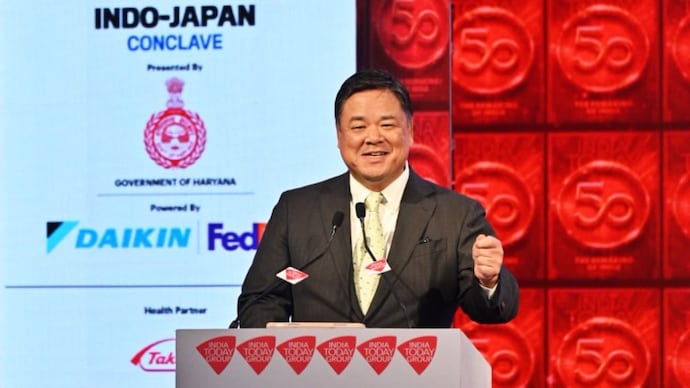

 For the last three years in a row, India has ranked among the most promising investment destinations for Japanese businesses, noted Takeshi Seo, India Chairman of the Japan Chamber of Commerce and Industry (JCCI) at the third edition of the India Today India-Japan Conclave in New Delhi on May 22.
This holds true even in a global environment that has turned increasingly uncertain for companies looking to expand overseas. “While Japanese companies’ overseas production and sales ratio remain high, the willingness to further expand overseas has started to decline,” said Seo, adding that companies have become more cautious and selective. “At the same time, India stands out.”
According to him, the growing interest of Japanese companies in India is also reflected in the increase in JCCI’s membership which now stands at 680 compared to 450 member companies in 2020. Over the past year, JCCI has added 120 new members. “This clearly demonstrates the strong expectations Japanese companies have for India,” said Seo.
Delivering a keynote on ‘Make in India Meets Monozukuri: The Winning Formula’, Seo said, “When we see the India-Japan relationship based on combining Make in India and Monozukuri, Japan and India appear like pieces of a puzzle that complement each other.” While India has huge growth potential and digital capabilities, Japan brings in quality management, operational excellence and decades of manufacturing expertise, he added.
Monozukuri is the Japanese philosophy for perfecting the art of creation, which also includes production, explained Himanshu Srivastava, Head, Japan Practice, Baker Tills ASA India LLP. “And this is not an outcome. It’s a continuous process which goes through the life cycle, the production chains of all Japanese companies,” he said.
However, while India is an attractive destination for Japanese companies, it still ranked eighth in terms of Japanese outward foreign direct investment in 2024, meaning there is still untapped potential. “The key challenges identified by Japanese companies include lack of regulatory transparency, insufficient infrastructure and the complexity of the tax system. Improvement in these parts is extremely essential for potential companies which try to start business in India,” he said.
According to Hemant Pimplikar, Managing Director, Sales, FedEx, the key sectors witnessing momentum include electronics, automotive semiconductors, healthcare and advanced manufacturing. This is also supported by policy initiatives rolled out in recent years. Connectivity and technology, he said, would be key to India becoming a global manufacturing hub.
Seo outlined three areas to strengthen the mutually complementary relationship between India and Japan. These include moving beyond a one-side technology transfer to a co-creation model; increasing localisation; and long-term commitment by going beyond short-term transactions to continuous value creation over the long term, including nurturing talent and building capability within India.
“India has one of the largest domestic markets in the world. In addition, India has strong potential as an export hub to regions further west, including Middle east and Africa. In this context, by combining Japan’s technology and spirit with India’s workforce and cost competitiveness it is possible to create products with exceptionally high value that cannot easily be matched by other countries.”
EXPERT-SPEAK
Takeshi Seo, India Chairman, Japan Chamber of Commerce and Industry
* “By combining Japan’s technology and spirit with India’s workforce and cost competitiveness, it is possible to create products with exceptionally high value that cannot easily be matched by other countries.”
* “When we see the India-Japan relationship based on combining Make in India and Monozukuri, Japan and India appear like pieces of a puzzle that complement each other.”
* “In Japan, India has been selected as a most promising investment destination for the last three consecutive years.”
Himanshu Srivastava, Head, Japan Practice, Baker Tills ASA India LLP
* “India is a hungry tiger and Japan is a very experienced tiger. So, what we need to do is walk together There are now classic examples of how India is shaping some of the Japanese companies.”
* “Monozukuri is a continuous process which goes through the life cycle, the production chains of all Japanese companies because you will see that they constantly strive to create the perfect product, the most relevant and the most sustainable product.”
Hemant Pimplikar, Managing Director, Sales, FedEx
* “India is increasingly emerging as one of the world’s most promising manufacturing locations, and when we look at the overall momentum, the key sectors are electronics, automotive, semiconductors, healthcare and advanced manufacturing Japan has played a very pivotal role in this entire growth story in terms of their engineering expertise, technology partnerships and industrial investments.”
* “India is definitely becoming a global manufacturing hub. So, from a logistics point of view, what is very critical is how we move trade across the globe, and one very critical part of this entire ecosystem is our connectivity into the country.”
Subscribe to India Today Magazine