

Trump to launch Op Fury 2.0? What Rubio said as US, Iran work towards peace deal
As hopes grow for a breakthrough in US-Iran talks and amid President Donald Trump's tough messaging towards Tehran, US Secretary of State Marco Rubio said Washington remains committed to diplomacy, while signalling that military options would remain on the table if talks fail.
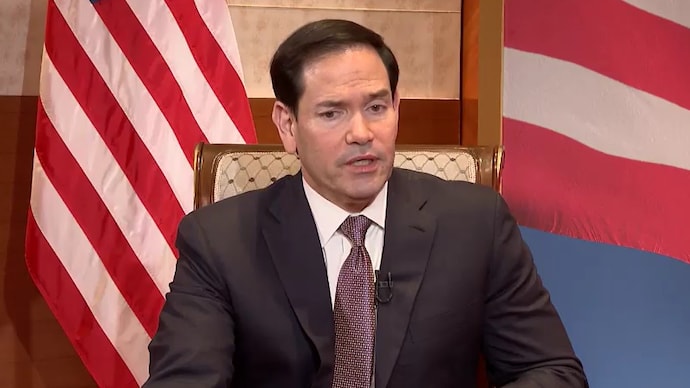


As expectations of a breakthrough in US-Iran talks rise and amid President Donald Trump’s warnings to Tehran, US Secretary of State Marco Rubio said Washington’s first choice remains diplomacy, but made clear that military options remain available if negotiations collapse.
In an interview with India Today TV, Rubio said the Trump administration’s preferred route was negotiations but stressed that the President’s core objective remained unchanged: Iran must never acquire a nuclear weapon.
“The President wants to make sure that Iran never has a nuclear weapon. He would prefer to address it through negotiated diplomatic means, and we’re going to exhaust every opportunity to do that,” he said.
Asked whether that could mean a return to a military option or 'Operation Fury 2.0', Rubio declined to describe any specific operational plan but indicated that force remained an available option.
“But ultimately, that option exists there for the President if that doesn’t work out. That is not our preference. Our first choice is to do this through a negotiated agreement and that’s what we’re working towards,” he said.
Rubio's remarks came as Trump said the US and Iran had “largely negotiated” a deal that would reopen the Strait of Hormuz – the strategic shipping route whose disruption has fuelled a global energy shock since the US and Israel launched military operations against Iran in February.
“As long as Donald Trump is President of the US, it will always be our preference to settle our differences with other countries diplomatically, through engagement, through negotiation,” Rubio said.
The US Secretary of State also sought to frame the current moment as an opportunity for Tehran, while warning that responsibility for any collapse in diplomacy would rest with Iran. “If these efforts don’t work out, it will not be the fault of the US or our allies in the Gulf. It will be 100 per cent Iran’s fault,” he said.
Iran has long denied it is pursuing nuclear weapons and says it has a right to enrich uranium for civilian purposes.
Any agreement that cements the current fragile ceasefire since April 8 could offer relief to global markets, but analysts warn it would not immediately end the wider energy crisis.
RUBIO ON HORMUZ CRISIS
Calling Iran’s actions on the Hormuz “illegal, unlawful, reckless, dangerous and unacceptable”, Rubio argued that the international community must push back against any attempt to control access to global trade routes.
Rubio rejected the idea that any state could dominate international waterways or impose conditions on commercial shipping. “There can't be a system in which a country takes over an international waterway, blows up ships that don't agree to pay them a toll. That cannot happen. That cannot be normalised,” he said.
He added that concerns about freedom of navigation extended beyond traditional US allies. “India is saying that. The US is saying that. Even the Chinese told us last week when we were over there that there can't be a system like this,” he stressed.
According to Rubio, reopening the Strait of Hormuz is the immediate priority before moving towards broader negotiations. “The Strait needs to be open immediately and fully. We cannot allow a system in which they charge tolls and threaten to blow up commercial ships,” he said.
The US Secretary of State then outlined what he described as the three essential components of any future agreement with Iran.
First, Tehran must never commit to pursuing nuclear weapons. Second, there must be long-term restrictions on uranium enrichment. Third, both sides must agree on what happens to Iran’s existing stockpile of highly enriched uranium, he said.
“There’s no reason to have 60 per cent enriched uranium unless you want to turn it into 90 per cent enriched uranium and weaponise it,” he added.
Rubio acknowledged that negotiations would be difficult and highly technical, but said Iran could receive benefits if it reached an agreement. “Those are highly technical issues. It'll take time to work through those. And obviously, there’ll be benefits for Iran if they agree in those negotiations,” he said.
'INDIA ONE OF OUR STRATEGIC ALLIES'
Rubio described India as one of the US’s most important strategic partners and said the relationship has moved beyond routine diplomacy into a long-term alliance built around shared interests and complementary strengths.
Calling India a country the US works closely with across multiple fronts, Rubio said both nations are entering a phase where global shifts are creating fresh opportunities and challenges.
“It’s a strategic alliance. We have a lot of alliances around the world. But we have a handful of really important strategic alliances. And India is one of them,” Rubio said.
He also said Prime Minister Narendra Modi is expected to visit the US for a standalone bilateral engagement apart from the G20 meeting scheduled later this year.
“We want it to be a separate one. We want it to be a standalone visit,” Rubio said, adding that the timing would depend on schedules, but Washington would like it to happen “as soon as possible”.
RUBIO ON INDIA TRADE DEAL, QUAD
Rubio struck an optimistic note on the long-awaited India-US trade agreement, suggesting the two sides are close to finalising the deal. “We hope to have it even next week or the week after we’re down to very final details,” he said.
While tariffs often dominate public attention, Rubio said the agreement is about much more than customs duties. “It’s not just tariffs. It’s access to products. Every trade agreement requires modernisation because new sectors emerge and new imbalances emerge,” he added.
On the Quad grouping, Rubio said the forum must move beyond symbolic meetings and produce tangible outcomes. “We don’t want to be a semi-annual meeting of like-minded countries. We want it to actually be a forum on which we can begin to partner on things,” he said.
The US Secretary of State said Quad members are exploring stronger coordination to address evolving security challenges at sea. He also identified critical minerals and supply chains as a major area for future cooperation.
“All four countries involved in the Quad are very interested in and have capabilities to bring to that,” he said.
RUBIO ON PAKISTAN AND TERRORISM
Asked about state-sponsored terrorism by Pakistan, which is also acting as a mediator's role in ending the US-Iran war, Rubio said Washington’s position remains consistent: terrorism must be tackled wherever it emerges. “We want to deal with terrorism no matter where it’s emanating from,” he added.
He said extremist groups operating within any country’s territory ultimately become a threat not only to neighbours but also to the host country itself. “I would hope that we would be able to work with Pakistani authorities to go after these very dangerous groups,” he added.
He added that such cooperation serves both regional stability and US security interests.