
Securing India's energy future: The global strategy behind PM Modi's 5-nation tour
Prime Minister Narendra Modi's five-nation tour linked talks in the UAE, Europe and the Nordics to energy, technology and trade deals. The visit underscored how India is tying diplomacy more closely to long-term economic and strategic security.

India’s diplomacy under Prime Minister Narendra Modi has undergone a visible transformation over the last decade. What was once often viewed as cautious and reactive is now increasingly assertive, strategic, and deeply linked to India’s long-term economic interests.
PM Modi’s five-nation visit between May 15 and May 20 — covering the UAE, the Netherlands, Sweden, Norway, and Italy — was not simply another high-profile diplomatic tour. It was a calculated exercise in securing India’s future in an uncertain global environment marked by geopolitical instability, energy insecurity, supply-chain disruptions, and technological competition.
At a time when several economies are struggling with slowing growth, inflationary pressure, and political fragmentation, India continues to stand out as the world’s fastest-growing major economy. With a GDP now crossing $4 trillion, forex reserves above $700 billion, and exports touching record highs, India is no longer approaching the world as a hesitant developing country seeking accommodation. It is engaging as an emerging power attempting to shape global conversations around energy, manufacturing, technology, and trade.
The importance of the UAE visit becomes clearer when viewed against the backdrop of rising tensions in West Asia and fears surrounding disruptions in the Strait of Hormuz, through which nearly one-fifth of global oil supply passes every day. India imports close to 85 percent of its crude oil requirement, making energy security one of the country’s most critical vulnerabilities.
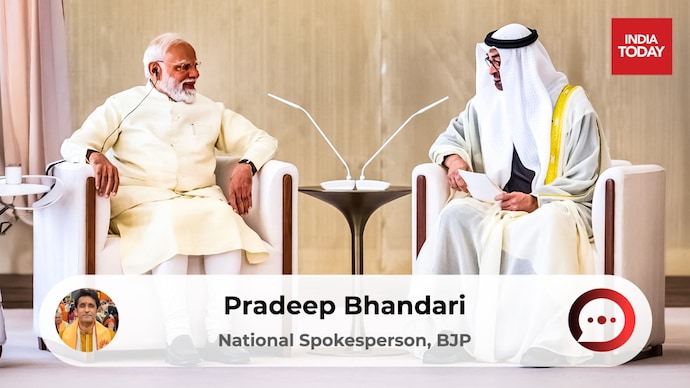
In Abu Dhabi, PM Modi secured commitments that directly address this challenge. The agreement to establish 30 million barrels of Strategic Petroleum Reserves on Indian soil gives India a stronger cushion against sudden global supply shocks and volatile crude prices. This is not merely a diplomatic headline. Every spike in crude oil prices impacts transport costs, inflation, food prices, and household budgets across India. Strategic reserves are therefore not just energy assets; they are economic stabilisers.
Alongside this, the UAE committed nearly $5 billion in investments across sectors ranging from energy and logistics to infrastructure and defence cooperation. India-UAE bilateral trade has already crossed $85 billion in recent years, and the relationship has evolved far beyond oil purchases and remittances. The Gulf increasingly sees India as a strategic economic partner with long-term relevance in the emerging global order.
If the UAE leg focused on energy security, the Netherlands visit focused on technological sovereignty. The most consequential outcome of the tour arguably came in The Hague, where Tata Electronics and ASML signed a landmark agreement connected to India’s first commercial 300-millimetre semiconductor fabrication facility in Dholera, Gujarat.
With investments estimated at over $11 billion, this project could become one of the defining pillars of India’s manufacturing ambitions. The global semiconductor shortage during and after the pandemic exposed how deeply the modern economy depends on chips — whether in smartphones, automobiles, defence systems, artificial intelligence, or advanced computing.
Countries across the world realised that dependence on a handful of supply chains had become a strategic risk. India’s semiconductor push is therefore not simply about manufacturing electronics; it is about reducing vulnerability and creating long-term technological capacity.
India’s electronics manufacturing ecosystem has already expanded dramatically over the last decade. Mobile phone exports, which were negligible not long ago, now exceed 1.5 lakh crore annually. India has become one of the world’s largest smartphone manufacturing hubs.
The Tata-ASML partnership marks the next phase of this industrial evolution — moving India higher up the global technology value chain.
The Nordic leg of the tour reflected another important shift in India’s foreign policy priorities: deeper engagement with innovation-driven economies. India and Sweden elevated ties to a Strategic Partnership focused on advanced manufacturing, green technologies, digital innovation, and startup collaboration.
Nordic countries consistently rank among the world’s most innovative economies, and their expertise in sustainability, clean technology, and industrial efficiency aligns naturally with India’s developmental priorities.
India today has more than 1.6 lakh recognised startups and over 100 unicorns. Access to Nordic technology, research ecosystems, and investment capital can significantly accelerate India’s ambitions in emerging sectors.
The symbolism of PM Modi receiving Sweden’s Royal Order of the Polar Star Commander Grand Cross reflected the growing recognition India commands globally as both an economic and geopolitical force.
Norway carried both symbolic and strategic importance. This was the first visit by an Indian Prime Minister to Norway in over four decades. During the India-Norway Business and Research Summit, PM Modi outlined an ambitious vision of attracting $100 billion in investments and generating one million jobs through deeper India-EFTA economic engagement.
Trade agreements are often discussed in technical language, but their implications are enormous. India’s long-term goal of becoming a global manufacturing and export hub cannot be achieved without deeper access to advanced technologies, capital, logistics, and markets.
The India-Nordic engagements reflected precisely this approach. Cooperation with Finland focused on areas such as 6G, quantum technologies, and artificial intelligence — sectors that will define the next technological revolution. Denmark expanded collaboration in offshore wind, green shipping, and sustainable urban infrastructure. Iceland partnered with India in geothermal energy and the blue economy.
These are not peripheral sectors; they are industries central to the future global economy.
The Italy leg of the visit perhaps demonstrated the widest strategic breadth. India and Italy elevated bilateral ties to a Special Strategic Partnership spanning defence manufacturing, critical minerals, scientific research, education, maritime cooperation, clean energy, and mobility partnerships.
India and Italy have now set an ambitious target of expanding bilateral trade to nearly $29 billion, reflecting the rapidly deepening strategic and economic partnership between the two nations. Bilateral trade between India and Italy has already crossed $17 billion in recent years.
Particularly significant was the India-Italy Defence Industrial Roadmap, which aligns closely with India’s push for defence indigenisation. Defence exports from India have risen sharply over the last decade — from roughly worth Rs 1,500 crore in 2014 to well above Rs 24,000 crore today.
Partnerships with advanced European economies can further accelerate India’s ambitions to emerge not only as a defence consumer but also as a defence manufacturing power.
Equally important was the agreement on critical minerals cooperation. The global transition toward electric mobility, battery storage, renewable energy, and advanced technologies has made access to strategic minerals a geopolitical priority. Nations that secure these supply chains today will shape industrial competitiveness tomorrow.
What stands out across the entire five-nation tour is the coherence of the larger vision. The agreements were not random diplomatic announcements designed for headlines. Almost every major outcome was tied directly to India’s long-term strategic priorities — energy security, semiconductor manufacturing, technological partnerships, critical minerals, defence production, green energy, innovation ecosystems, logistics, and employment generation.
(Disclaimer: The article has been authored by Pradeep Bhandari, National Spokesperson, BJP. Views expressed are personal.)