
Cockroach Janta Party is a sequel. Cockroaches first left India 2,000 years ago
A genomic study has traced the German cockroach back to human settlements in India or Myanmar around 2,100 years ago. The findings link its global spread to trade and colonial shipping, recasting a familiar urban pest as an accidental South Asian export.
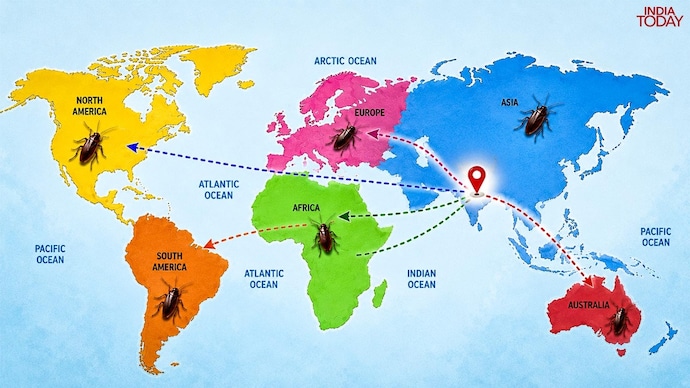
The species evolved from the Asian cockroach, Blattella asahinai, native to eastern India, Myanmar. (Photo: India Today)

New Delhi,UPDATED: May 22, 2026 19:31 IST
From the virality of the Cockroach Janta Party to jokes about the insect surviving nuclear war, India’s social media platforms are flooded with videos of the tiny pest outliving humans, governments and even apocalypses.
But behind the humour lies a remarkable scientific story, one that begins not in Boston but in the humid settlements surrounding the Bay of Bengal nearly 2,100 years ago.
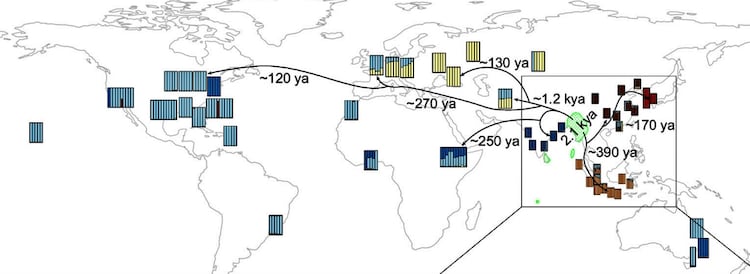
In May 2024, scientists published the largest genomic study ever conducted on the German cockroach, tracing its DNA across 17 countries and six continents. The study finally solved a 250-year-old biological mystery: the German cockroach, Blattella germanica, did not originate in Germany at all.
Instead, researchers found that the species evolved from the Asian cockroach, Blattella asahinai, native to eastern India, Myanmar and the nearby Bay of Bengal regions.
Through genome-wide analysis of 281 cockroach samples collected globally, scientists reconstructed how the insect transformed from a forest-dwelling species into the world’s most successful urban pest.
The findings suggest that around 2,100 years ago, some Asian cockroaches began adapting to human settlements in India or Myanmar. Unlike their outdoor relatives, these cockroaches increasingly depended on warm human-built environments for food and survival. Over generations, they evolved into a completely urban species incapable of surviving in natural habitats.
That adaptation changed everything.
The study identified two major migration waves that carried the insect across the planet. The first was a westward expansion around 1,200 years ago, likely linked to trade networks and Islamic dynasties connecting South Asia with the Middle East. The second and far more explosive spread came roughly 390 years ago during the European colonial era.
Scientists believe colonial maritime trade, particularly routes operated by powers such as the East India Company, unintentionally became perfect transport systems for the insect. Cockroaches hid inside food cargo, wooden crates and ships travelling between Asia, Africa and Europe.
Ironically, Europe later gave the insect its name after it appeared in central European records around 250 years ago. Swedish taxonomist Carl Linnaeus formally described the species in 1776, shortly after the Seven Years’ War, leading many to assume the pest originated there.
But genomic evidence now paints a different picture, one where the insect’s roots lie firmly in South Asia.
Researchers also found that modern German cockroach populations closely follow geopolitical and commercial boundaries, suggesting that global trade networks helped establish regional “bridgehead” populations that later spread locally.
Today, the German cockroach is among the world’s most resilient pests, thriving in apartments, restaurants, hospitals and metros worldwide. Its extraordinary resistance to insecticides and its ability to adapt rapidly to urban environments have made it nearly impossible to eradicate completely.
From the Bay of Bengal to skyscrapers across the world, the cockroach’s journey may be one of humanity’s oldest accidental exports.
- Ends