
Science took over bars for three nights, and an ex-Isro chief stole the show
Pint of Science 2026 ran from May 18 to 20 across bars in Indian cities, mixing cold beer with rocket science, tattoo immunology, and pandemic prediction. Former Isro chief Dr S Somanath, who led Chandrayaan-3 and Aditya-L1, headlined the Delhi edition and nobody in those rooms left early.
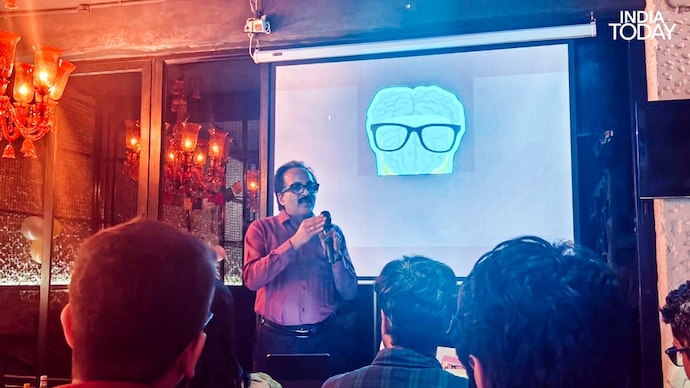
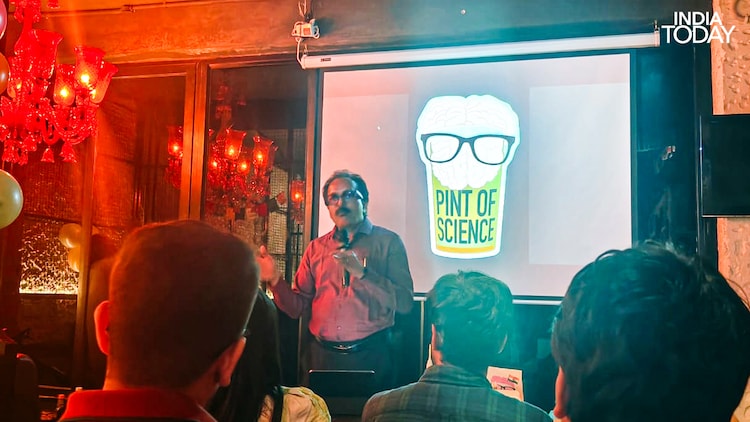
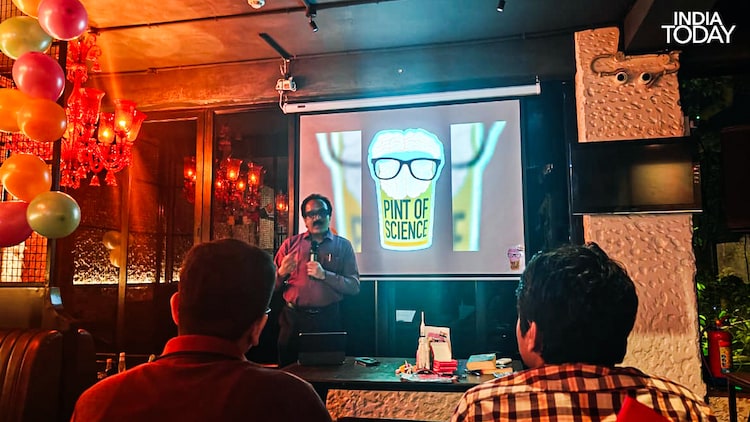
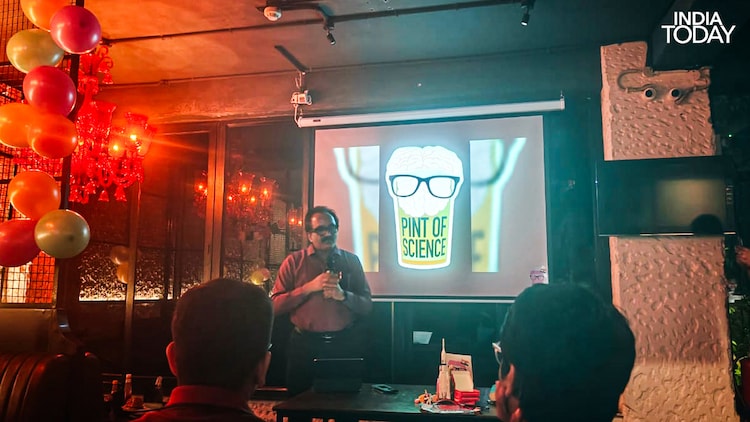
Dr S Somanath, former Isro chief, addresses a packed bar at Pint of Science 2026, Delhi. The man who landed India on the Moon had a lot to say. (Photo: Radifah Kabir/India Today)

New Delhi,UPDATED: May 24, 2026 19:35 IST
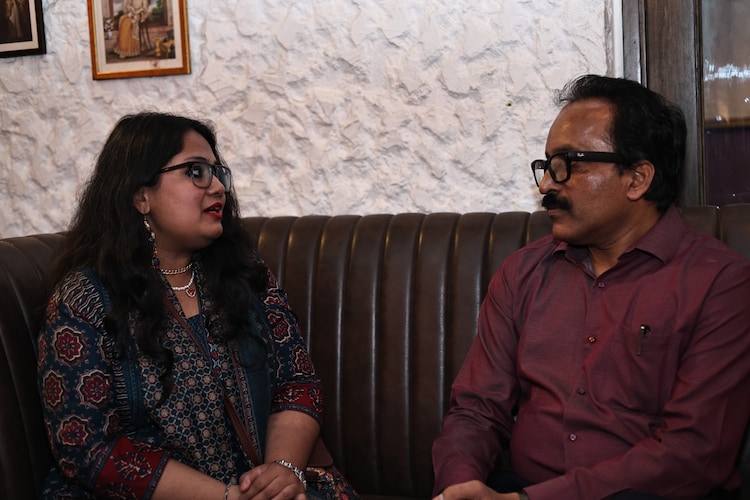
A quirky bar in Hauz Khas was still filling up when I found myself asking a former Isro chief about rockets.
On a Wednesday evening in May, the pub had not yet settled into the particular hum it would find later in the night, when the room was packed, and questions from the audience were coming faster than anyone anticipated.
Right then, it was quiet enough to talk. So we did, about my engineering degree, about his research on vibrations, about the specific way that a background in how materials behave under stress turns out to be surprisingly useful preparation for a conversation about aerospace.
Dr S Somanath, who led the Chandrayaan-3 and Aditya-L1 missions, was unhurried. He was genuinely interested. He asked me as many questions as I did.
When I walked away from that exchange, before the evening had properly begun, I felt something I had not experienced before. It was more exciting than meeting any celebrity I had ever interviewed. Not slightly but considerably.
That feeling, it turned out, was the theme of the entire week.
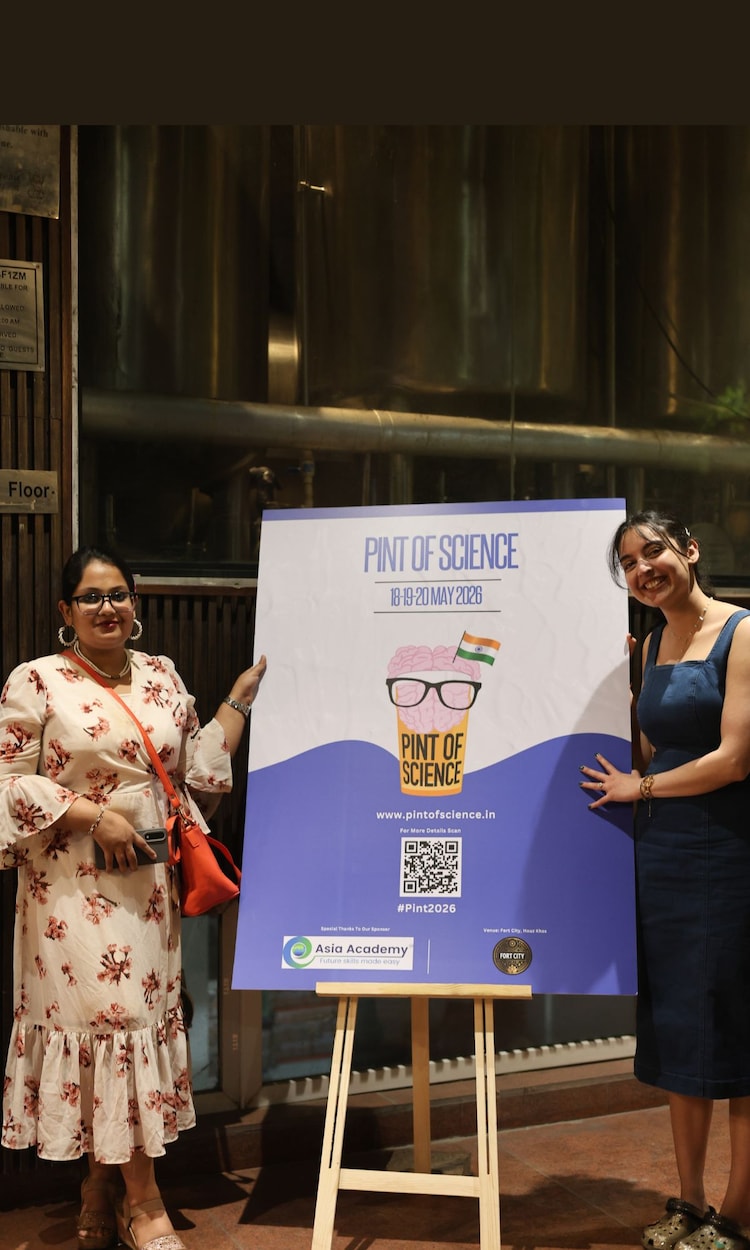
Pint of Science 2026 ran from May 18 to May 20, across several venues in Indian cities. This year it came to Pune, Bengaluru, Mumbai, New Delhi and, for the first time, Guwahati, marking the festival's debut in India's Northeast.
It is the kind of festival that sounds, on paper, like it should not work: scientists in bars, talking to whoever showed up, about whatever they happen to spend their lives thinking about. And yet it does work, year after year, because of people like Professor Debarati Chatterjee.
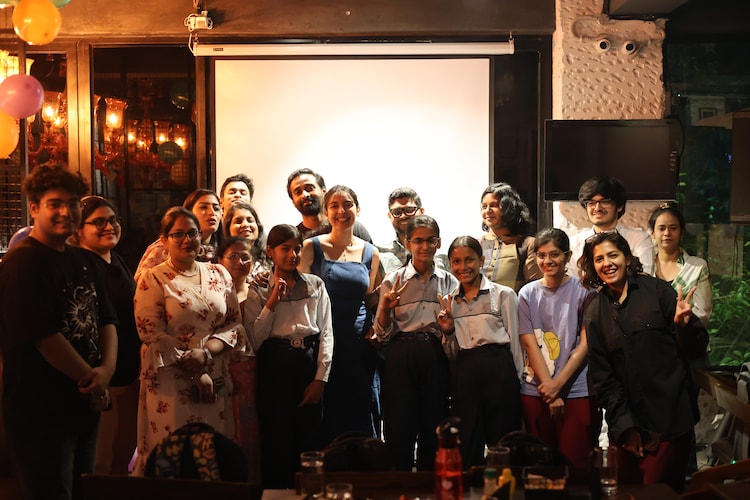
Professor Debarati Chatterjee, a theoretical astrophysicist at the Inter-University Centre for Astronomy and Astrophysics (IUCAA) in Pune and Director of Pint of Science India, is largely responsible for the fact that an ex-Isro chairman and five other scientists spent several evenings in bars across multiple cities explaining complex ideas to curious strangers, who paid to be there.
She has been building this quietly and determinedly, and the results, across three nights this year, were extraordinary. On the ground in Delhi, that work was carried out by Vishaka Ranjan, the festival's Delhi coordinator, who made sure the right rooms were found, the right people were in them, and the whole thing ran with the kind of ease that only comes from a very great deal of invisible effort.
The Delhi chapter saw six scientists walk into a bar, and stopped sounding like jargonised professors.
Audiences stopped faking interest and started actually feeling it. They asked questions that nobody present had the complete answer to, and the admission of that fact produced, reliably, the best moments of each night.
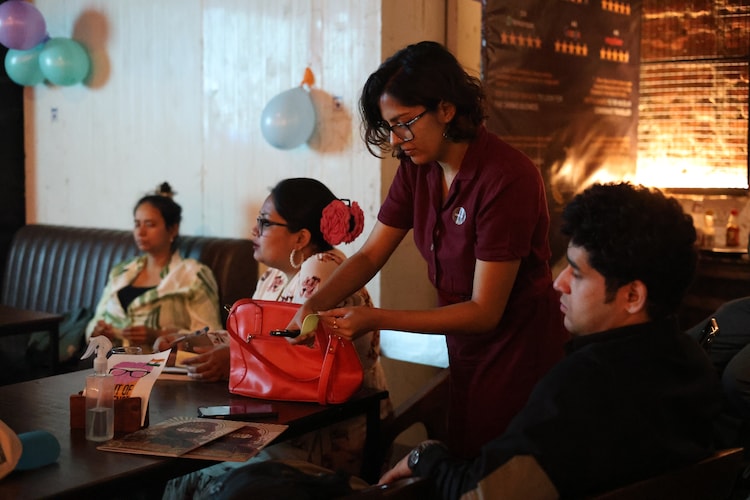
The crowds were wonderfully miscellaneous. Students sat beside retired engineers.
A woman in a saree compared notes with a man in a band T-shirt. A table of friends who had come for the drinks found themselves leaning forward when the science started.
It was an amalgamation of nightlife, pop culture, urban curiosity and genuine intellectual hunger, and it was entirely unforced.
One of those scientists was Dr Somanath, who stood up on Wednesday and explained, pleasantly and without fanfare, that rockets invent their own problems mid-flight.
That the best engineers in the country sometimes just build things more robust than necessary and accept, with remarkable equanimity, that certainty is not always available.
Another was a homeopath who tracks cow lactation curves to predict the next pandemic.
A third was a researcher who explained, with quiet authority, why the tattoo on your arm is held there not by your skin but by your immune system.
A fourth was a mathematician who regarded the suggestion that his work might be useful the way a concert pianist regards a request to play Happy Birthday: technically possible, deeply beneath the point.
A fifth was a mycologist who introduced a hospital pathogen using Game of Thrones.
A sixth was an astrophysics scholar from University College London who read the history of galaxies through the chemistry of dying stars.
The audience was up for their explanations.
MONDAY NIGHT: THE NIGHT KING CHECKS IN
The first night was at a bar that had not quite decided whether it was a pub or a cafe, which felt appropriate.
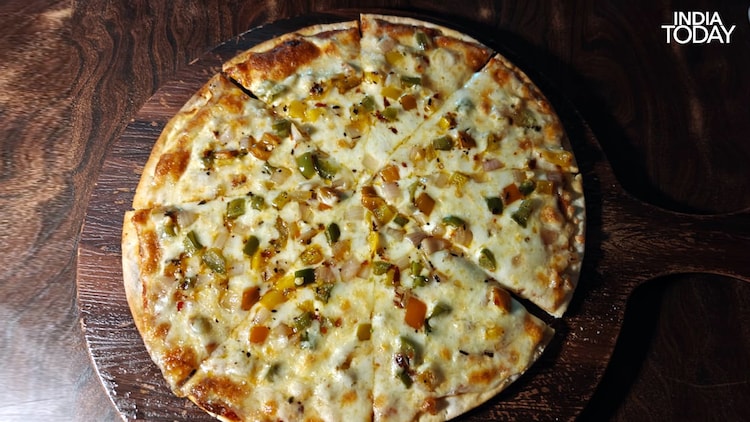
I ordered a Margherita pizza and found a seat near the front. Around me, a group of college students were sharing nachos and taking selfies.
Two men in suits were deep in conversation at the bar. A woman was reading something on her phone.
By the time the first speaker took the floor, the room had the particular energy of people who have no idea they are about to be genuinely surprised.
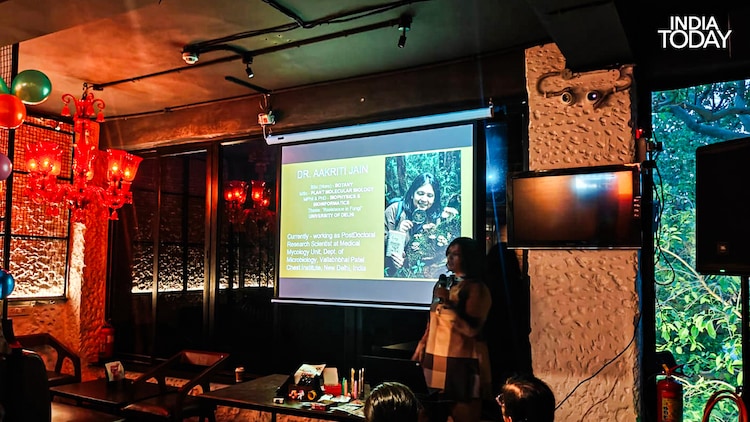
Dr Aakriti Jain walks to the front of a room with the manner of someone who has completely stopped worrying about whether the audience is ready for what she is about to say.
A post-doctoral researcher at the Vallabhbhai Patel Chest Institute in New Delhi, she received her doctorate in Biophysics and Bioinformatics from the University of Delhi.
Her subject that Monday night was a global health crisis that has spent decades hiding in plain sight.
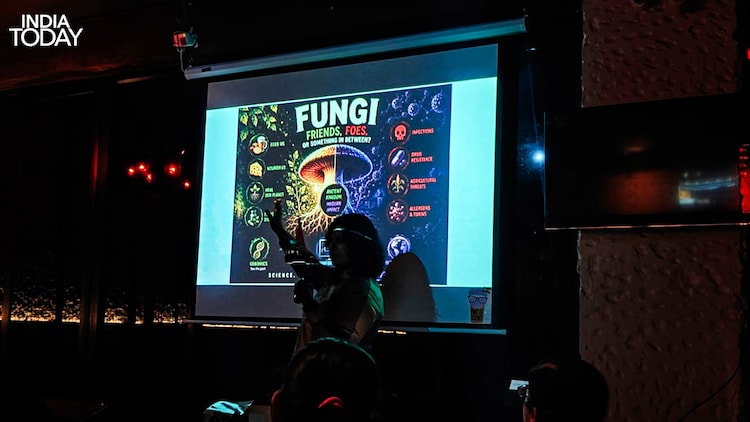
She opened by calling a drug-resistant fungal pathogen the Night King of hospitals.
The room, carrying the particular tiredness of a Monday, came immediately and completely alive.
For anyone who has watched Game of Thrones, the analogy is exact, and she knew it.
The Night King spreads silently, converts everything he touches, and laughs at conventional weapons. So does Candida auris. The Wall that was supposed to stop him fell. So did hospital infection control.
A fungal pathogen is spreading silently through wards. Surviving for weeks on clinical surfaces. Resisting multiple drug classes. Persisting despite everything a hospital's cleaning protocols throw at it.
The researchers mapping the fungus's genome are Bran Stark. The bioinformaticians are the Ravens.
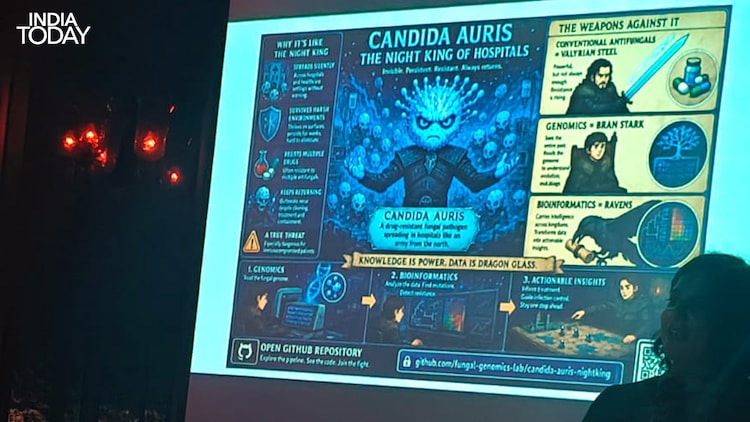
The antifungal drugs growing useless in real time are Valyrian Steel. And the data the world is still scrambling to build is Dragonglass.
The one thing that might actually work, if enough of it can be found in time.
I put down my pizza. I noticed several other people around me doing the same thing with their drinks.
The underlying science is frustratingly structural. Fungi are eukaryotes, cells with a membrane-bound nucleus.
Their cellular machinery closely resembles ours. Most targets worth attacking in a fungal cell also exist in human cells.
Design a drug to destroy the pathogen, and you risk harming the patient alongside it.
Only four drug classes exist globally for fungal infections. The first class, azoles, has already been largely defeated by fungal evolution. The others are following.
Fungal infections kill approximately 3.8 million people every year worldwide. The World Health Organization (WHO) published its first fungal priority pathogen list only in 2022.
India has played a significant role in generating the standardised dosage data that the international research community depends on. Those standards are still being collated. The pathogen is not waiting.
When asked about artificial intelligence, Dr Jain was direct.
"Machine learning models for fungal resistance do not yet exist in clinical practice in India because the underlying data is not labelled, curated or sorted adequately to train them," Dr Jain told indiatoday.tech.
"If a doctor cannot understand why the machine flagged a resistance pattern, the model is not ready. The human stays in charge of the decision. The machine helps. It does not substitute," she added.
The pandemic, she explained, did not create the fungal crisis. It created conditions for catastrophic acceleration. COVID-19 filled every ICU in India with immunocompromised patients simultaneously for months.
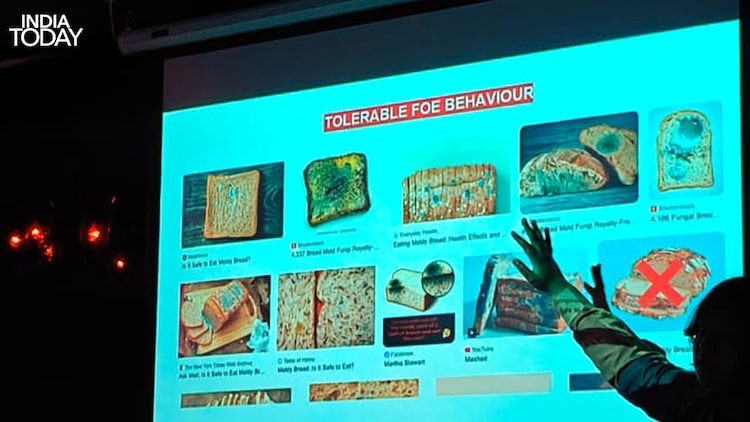
People admitted for liver transplants, for respiratory illness, or for entirely unrelated primary conditions developed secondary fungal infections that became the actual cause of death.
Black Fungus, also known as Mucormycosis, entered the national vocabulary during the Delta wave of SARS-CoV-2, and then quietly disappeared from public attention. It did not disappear from hospitals.
She ended on a line calibrated for exactly this kind of room.
We may like fungi, or we may hate them. But we cannot ignore them.
The Margherita pizza, I noticed, had gone completely cold. I did not mind at all.
THE HOMEOPATH WHO WATCHES COWS TO PREDICT PANDEMICS
Dr Pratiksha Nagar is a homeopath and a researcher at University College Dublin.
She is also, it turns out, one of the more compelling people in the room when the subject is pandemic prediction, which tells you something useful about the limits of disciplinary boundaries.
She works on early warning surveillance systems, specifically on the question of how to detect an incoming pandemic before it reaches humans.
Her answer, which she arrived at through an unlikely combination of medicine, veterinary science, ecology and data, is that you watch cows, but not metaphorically.
Most pathogens that cause human pandemics originate in animals. The interactions between animal and human populations allow those pathogens to cross over in the millions every single day.
The question her research tries to answer is not which of those interactions is dangerous.
The question is which signals, buried in the ordinary behaviour of animal populations, indicate that something is changing before it reaches us.
The signal she tracks is a 305-day lactation curve.
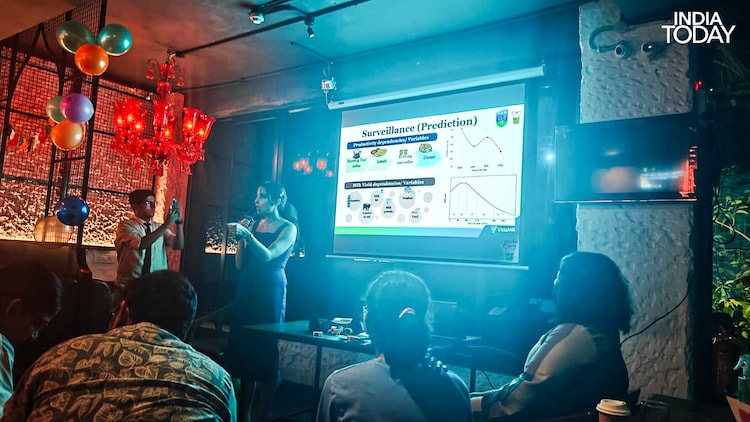
A healthy cow follows a predictable arc of milk production across her lactation cycle.
When that arc shifts, when the pattern changes in a way that cannot be explained by feed or breed or season, it is a signal.
Not necessarily of disease. It could be a signal of environmental change, of something spreading across farms, of a stress that has not yet declared itself as an infection. But something is happening.
The One Health framework, which treats human, animal and environmental health as a single interconnected system rather than three separate fields, is, as Dr Nagar is quite honest about, still finding its footing.
"One Health is a very naive concept. It's just getting its legs and hands, and it's moving," Dr Nagar told indiatoday.tech.
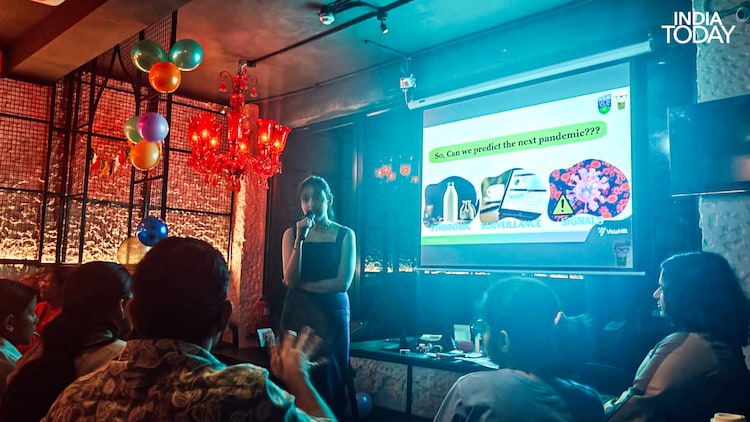
"Mitigating a pandemic is a relay race. You take the thing and you run with it. You give it to the next person, and they run with it. Not one person can do everything," Dr Nagar added.
When the subject turned to artificial intelligence, she was thoughtful rather than dismissive. AI helps, she said. But she drew a line clearly.
"It's really very important that we come to a stage where AI does not tame us, but we are taming it," Dr Nagar explained.
She reached for two examples. Newton, sitting under a tree, the apple falling, a mind making a connection that no pattern-recognition system would have made because the pattern had never existed before.
Alexander Fleming, noticing the mold on a Petri dish that everyone else would have discarded, and discovering penicillin in what looked like a mistake.
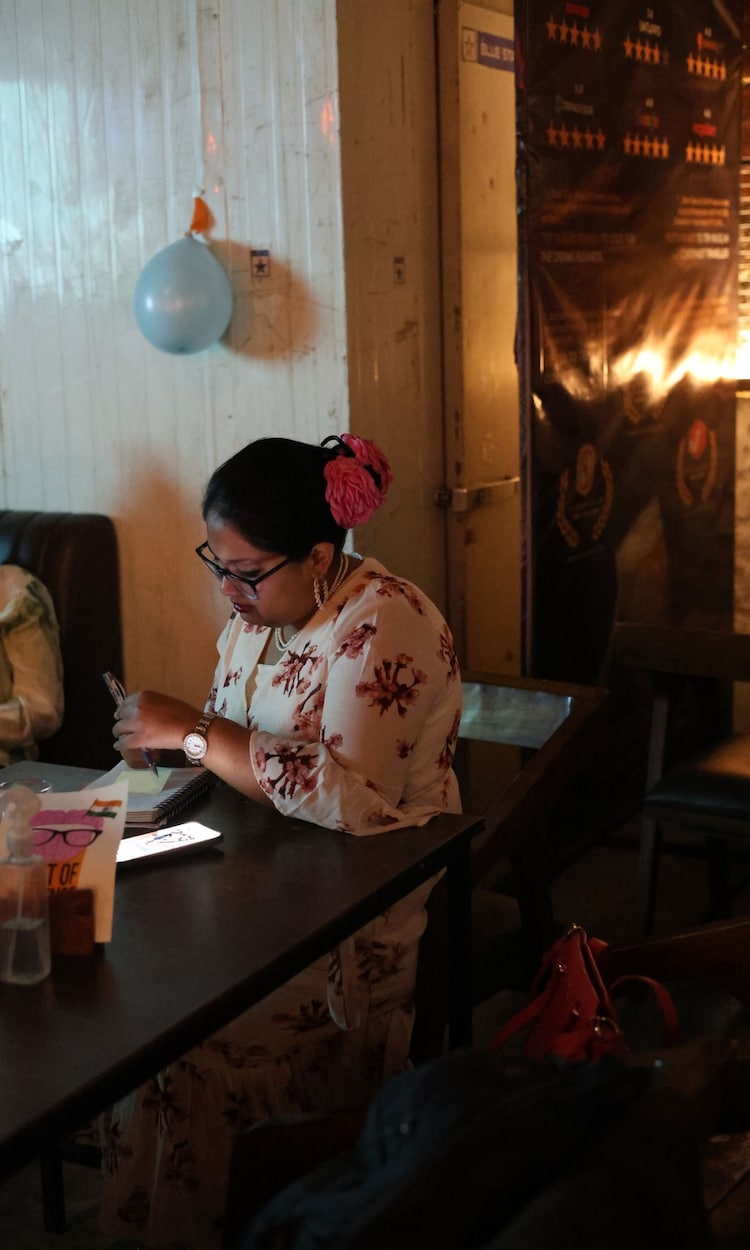
Neither discovery was the product of a system that learned from existing data. Both required a human mind paying attention to something the data said was irrelevant.
The audience, which had come to hear about cow milk and pandemic early warnings, found itself sitting with a much larger question about what human consciousness is actually for.
TUESDAY NIGHT: TATTOOS AS MEDICAL DEVICES
The second night of Pint of Science had a noticeably different energy. Tuesday's crowd was younger, louder, and visibly more tattooed. Friends with elaborate sleeve tattoos filled the front row, while the rest of the room ranged from PhD students to people who seemed to have wandered in from nearby gigs, still wearing concert wristbands.
That is one of the festival's quiet strengths. It does not curate its audience or demand credentials. It simply trusts whoever walks in.
Nishtha Bhargava, a molecular biologist at Plaksha University, opened her session with a photograph of a tattooed forearm. Almost immediately, people in the audience began glancing at their own tattoos.
The reason tattoos last, she explained, has little to do with ink depth and everything to do with the immune system.
When tattoo ink is injected into the dermis, immune cells called macrophages rush to the site. Their job is to destroy foreign material, but tattoo pigments are too large and inorganic to break down. The macrophages swallow the particles and simply hold them in place.
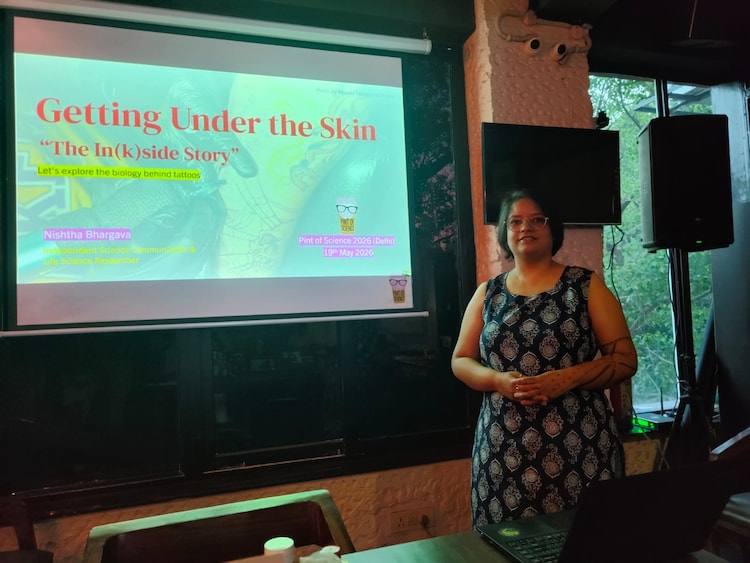
That is why tattoos remain visible.
Every few days, those macrophages die and release the ink. New macrophages arrive, consume the same particles, and hold them again. The cycle repeats continuously throughout life.
Bhargava showed a micrograph of an army veteran who had undergone a complete bone marrow transplant. Despite having an entirely new immune system, his tattoo remained unchanged. New macrophages from another person's bone marrow had seamlessly taken over the same process.
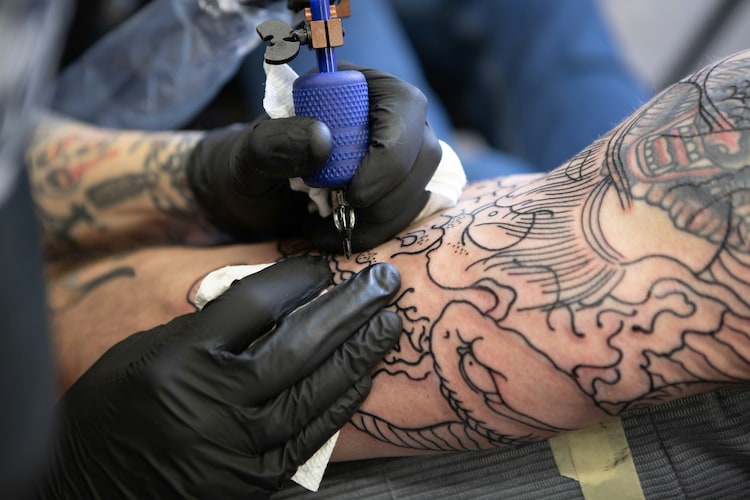
The session then turned more serious. Tattoo ink can travel through the lymphatic system and has been found in lymph nodes during surgeries. But Bhargava stressed the distinction between correlation and causation. Current research does not show tattoos cause cancer.
She ended on a hopeful note: the same tattooing technique could one day improve vaccine delivery by targeting immune-cell-rich layers of skin directly.
From tattoos to immunology, the leap turned out to be surprisingly small.
THE MATHEMATICIAN WHO HATES BEING USEFUL
The knot theory session had two things going for it. The science was genuinely extraordinary. And Souradeep Sengupta, a biophysicist at Ashoka University, had the singular quality of being funny without trying.
He opened with a confession. He was not, he clarified, a biologist by training. Some parts of biology he honestly did not know. He had done his best. The room liked him immediately.
Then he started talking, and the room forgot to keep liking him and simply started listening.
Your DNA is roughly two metres long. The nucleus it lives inside is roughly half a micrometre in diameter.
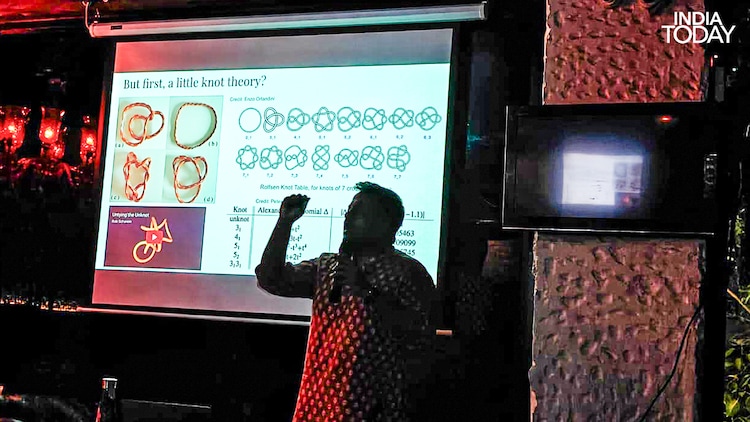
The DNA does not sit there tidily. It wraps around anchor proteins called histones, which compact it considerably.
And even with all that structural effort, it knots. Constantly.
Because long objects in tight spaces tangle. Because entropy applies to your genome with the same indifference it applies to everything else. Because disordered states are statistically more probable than ordered ones, and your biology is not an exception.
Think about your earphones stuffed into a pocket, he said. Now think about that, except it is your DNA, in every single cell in your body, right now, while you are sitting here. Someone in the front row looked briefly alarmed.
The enzymes that resolve these knots are called topoisomerases.
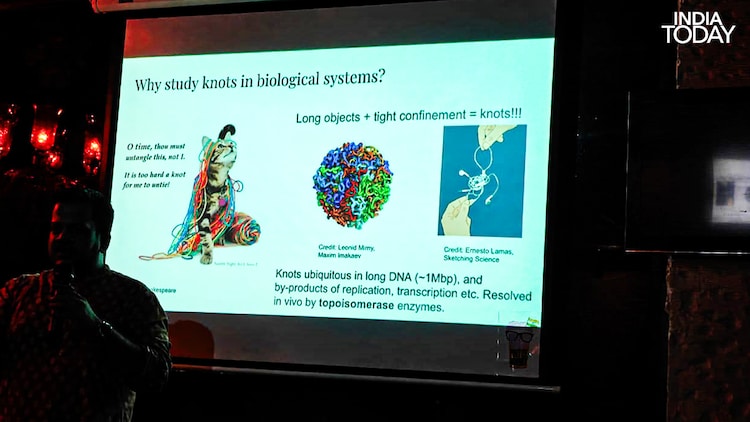
Asked whether they follow some mathematically elegant path when untangling, brute force, he said, without hesitation.
The enzyme sees only what is directly in front of it. It has no global awareness of the chain whatsoever.
"Mathematicians do not care. I think they genuinely do not care. Most mathematicians I know, if you tell them their work has real-world applications, they hate it. They are interested in mathematics for the mathematics," Dr Sengupta told indiatoday.tech.
Asked whether any knot can ever be truly impossible to untangle, he reached for Hercules and the Gordian knot, noted the resolution, and delivered the line of the festival.
"If you have scissors, all knots are untangled," Dr Sengupta said.
WEDNESDAY NIGHT: READING DEAD STARS
By Wednesday, Fort City Brewing in Hauz Khas had become something of a ritual.
I arrived early, found a table, ordered chicken malai tikka and watched the bar fill up with what had become, by the third night, a familiar kind of crowd: people who looked like they had come from work, from college, from other bars, from other conversations, and were now, all of them, here.
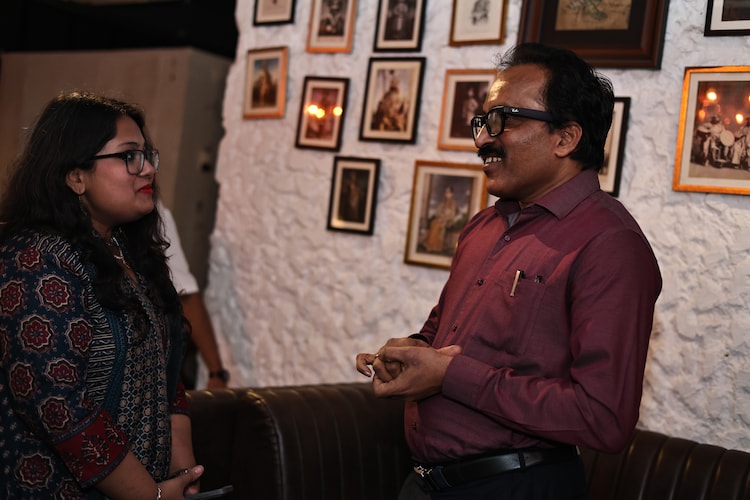
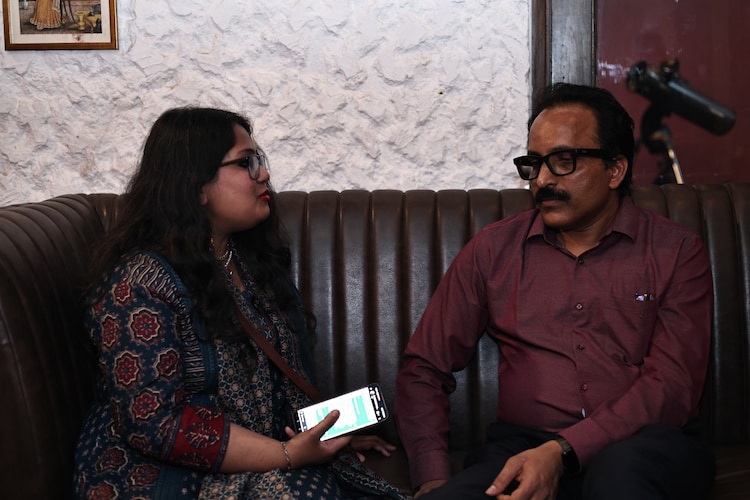
Before the session began, I managed to pull up a chair beside Dr Somanath.
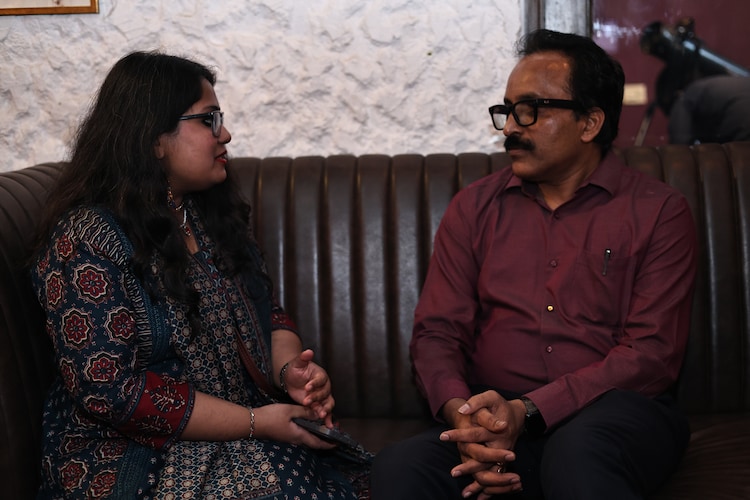
We spoke briefly about rockets and about the kind of engineering instinct that comes from years of designing against failure.
He was easy to talk to in the way that only genuinely confident people are: no performance, no impatience, no sense that he had somewhere more important to be.
I asked him a question about vibrations. He answered it and then asked me a question. "No, it's generally on vibrations," he said, when I suggested his talk would centre on rockets specifically. "Not maybe specifically on rockets, but generally." It was, I would discover over the next hour, a distinction that mattered enormously.
There is something specific about the demographic that Pint of Science attracts, and it resists easy summary.
It is not exclusively young. It is not exclusively English-speaking. It is not the usual crowd of a science communication event, which tends toward the already-converted.
It is something messier and more interesting: people who are curious without necessarily knowing what they are curious about yet.
Preksha Sethia, an astrophysics scholar from University College London who studies stellar populations, works on something she calls galactic archaeology, which is exactly what it sounds like and far stranger than the name suggests.
Stars are time capsules. Not metaphorically. Their elemental composition is a record, written in the physics of nuclear fusion, of everything that happened in the galaxy before they were born.
Every star carries inside it the chemical signature of its origins, the environment it formed in, the ancient collisions and mergers of galaxies that predate our solar system by billions of years.
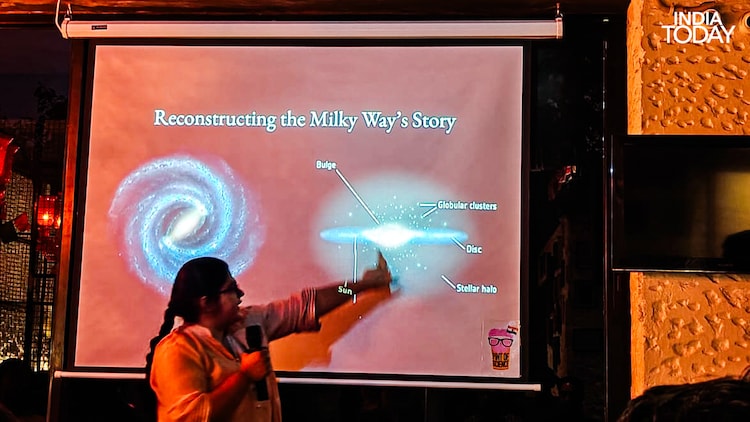
The Gaia satellite has been mapping stellar motion with enough precision to reconstruct one such event, a collision called Gaia-Enceladus, a galaxy absorbed by the Milky Way long before Earth existed.
A nitrogen-rich star almost certainly spent its early life inside a globular cluster. The presence of certain oxygen and nitrogen markers in a stellar core indicates a biography entirely unlike anything typical in our galaxy's present atmosphere.
Preksha Sethia put it simply. You can read a star, she said, the way you read a letter written before anyone knew there would be a reader.
The room went very quiet. Someone at the bar stopped mid-conversation. The chicken malai tikka arrived and I did not notice for a while.
THE MAN WHO LANDED INDIA ON THE MOON
Dr S Somanath has a PhD in vibrations from IIT Chennai.
He spent his career at an institution that landed India on the moon, put satellites in orbit and done it with budgets that should not have produced those results.
He had led Chandrayaan-3, which placed a lander near the lunar south pole for the first time in history. He had led Aditya-L1, which put an observatory at the first Sun-Earth Lagrange point.
"Yes, rockets generate vibrations during flight that nobody fully anticipated. This is a known problem. We work with it," Dr Somanath told indiatoday.tech.
His ease about this, the complete absence of defensiveness in admission, gave the session a quality none of the other evenings had quite matched.
This was not a researcher explaining a field from the outside. This was a man who had built things that left the Earth, and was now telling the honest version of what that involved.
"Rocket vibrations begin with acoustics. A rocket at Mach 10 is generating noise on a scale that is biologically lethal in proximity. The jet plume creates sound. The supersonic interaction of the body with air creates more. These sources are partly modelled, and partly understood," Dr Somanath said.
"Everything can fail under vibration," he said. "Because it excites them to a state where the stress will exceed the limit. Glasses can vibrate, window panes can vibrate, electronic connections can detach, fuel can break down," the former Isro chairman told me.
"When there is too much vibration, you need to isolate. You create barriers to not pass the sound or vibration to the other side. This is a very complex technology," he explained.
"That noise becomes vibration. And that vibration reaches every joint, connection, fuel line and electronic component on board. A joint that opens and leaks cannot be sealed. In a mission carrying a satellite to orbit, any single failure of this kind ends everything, permanently and without appeal," the former Isro chairman added.
The testing infrastructure he described carries the weight of a career spent inside it.
Reverberation chambers built from concrete are designed to generate acoustic loads on full rocket sections more severe than any actual launch. These have vibration shakers capable of generating 25 to 30 tons of force.
"Vibration failures are very, very common. Much of this is addressed on the ground. But sometimes when confidence is low, we overdo it," Dr Somanath said.
"Some joints can open and leak. Some connectors detach," he said quietly. "Possibly one of the failures of recent times could be attributed to that. I can't claim or talk about it."
The governing principle: test at least three decibels above the predicted flight environment. Three decibels means double the energy.
He compared the philosophy to the inside of a modern car. The silence of a well-built cabin, the complete absence of engine noise reaching the driver, is the product of decades of isolation engineering: polyolefins and silicones placed at structural joints specifically to prevent one form of energy from crossing into a space where it does not belong.
"Today's cars, you don't even hear them. There is a huge amount of engineering that goes into making cars. How the engine noise is not transmitted to the chassis, how the sound doesn't come to the cabin," Dr Somanath explained.
The satellite at the top of a rocket is the passenger in that car. Everything, the chambers, the shakers, the split pins, spring washers and wire locking, exists to ensure that passengers do not feel the journey.
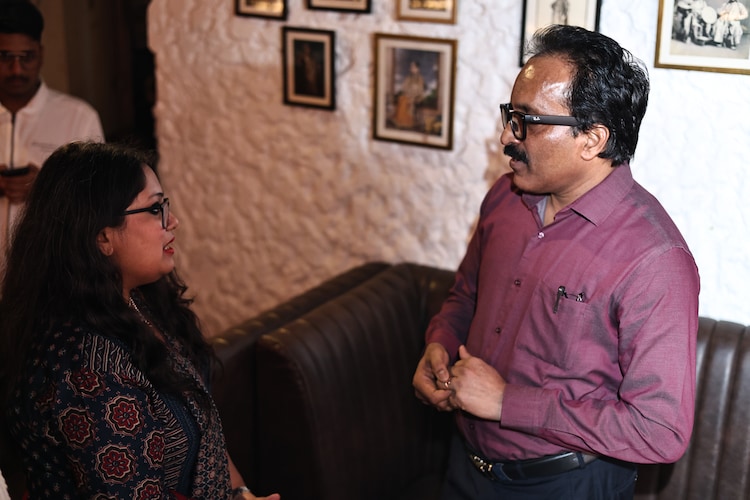
I asked Dr Somanath whether unpredictable in-flight vibration events were becoming less frequent as rocket technology advanced.
It was, by any reasonable count, three questions nested inside one.
Dr Somanath looked at me with something warm.
"You asked a lot of questions in that," he told me.
We laughed, easy and genuine.
THE CROWD THAT CHOSE THIS
Here is the question underneath all of it, and Pint of Science does not answer it directly, which is possibly why the answer keeps surfacing anyway.
Why are people here?
Not in the promotional or science communication sense.
Why, on a Monday, Tuesday and Wednesday in May, in Indian cities that offer every conceivable distraction, do people choose to sit in a room and think hard about hospital fungi and tattoo macrophages and DNA knots and pandemic surveillance and rocket acoustics and the chemistry of dying stars?
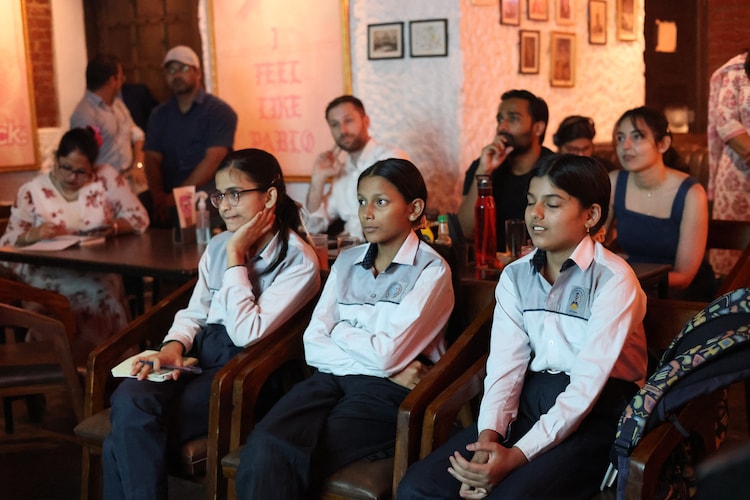
Why do they come in groups of friends, in couples, or alone? Why does the person who wandered in, still wearing a concert wristband, stay for the entire session?
The festival is not about making science accessible. It is about making it social. About putting curiosity in the same room as a cold beer and trusting what happens next.
Across three nights and six very different scientific disciplines, the answer that kept surfacing was not glamour, not relevance, not even entertainment in any conventional sense.
It was something older and harder to name. The pleasure of a real problem. The specific satisfaction of sitting with something genuinely difficult and finding that the difficulty is not a barrier but an invitation.
What Pint of Science does, and what no amount of formal science communication quite manages, is remind people that curiosity is social.
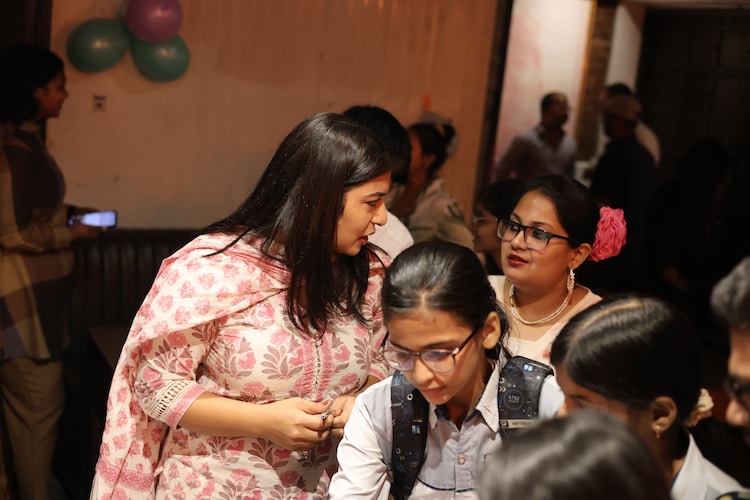
It is more fun in a room. That the question you were afraid to ask in school sounds perfectly reasonable in a bar, and that the person next to you, the one you have never met and will probably never meet again, is almost certainly wondering the same thing.
Six scientists across three evenings. Venues that were simply venues, not conference rooms or convention centre, just places where people happened to be with beer in hand, and where, for a few hours each night, something happened that is genuinely difficult to produce by design and impossible to fake.
The audiences at Pint of Science 2026 were not scientists. They were people who, for three consecutive evenings in May, chose to be.
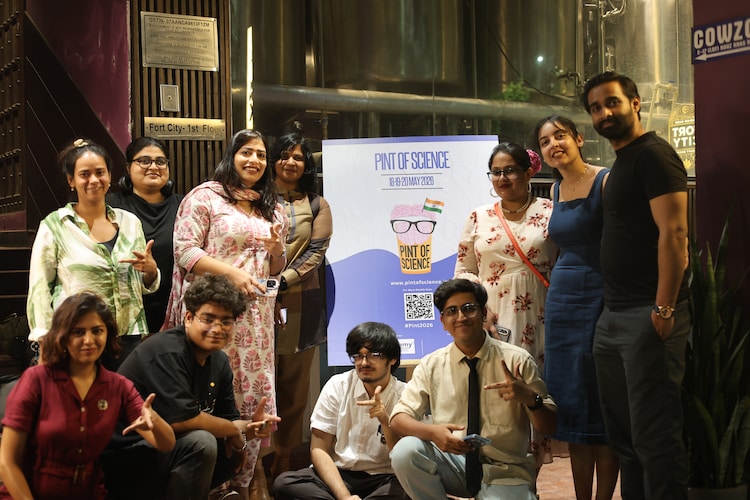
There is a particular kind of evening that does not announce itself. It arrives looking like any other Wednesday in May, with the traffic and the deadlines and the specific exhaustion of a city that has been going since seven in the morning, and then somewhere between the first drink and the second question from the audience, something shifts.
By the time Dr Somanath finished speaking, the chicken malai tikka on my table had gone cold, the clearest measure I know of how a single conversation can take over a room and time just flies.
- Ends