Madhya Pradesh | Faith, history & a verdict
The MP court order on the sensitive Bhojshala issue sees the Hindus celebrating and the Muslims planning to appeal

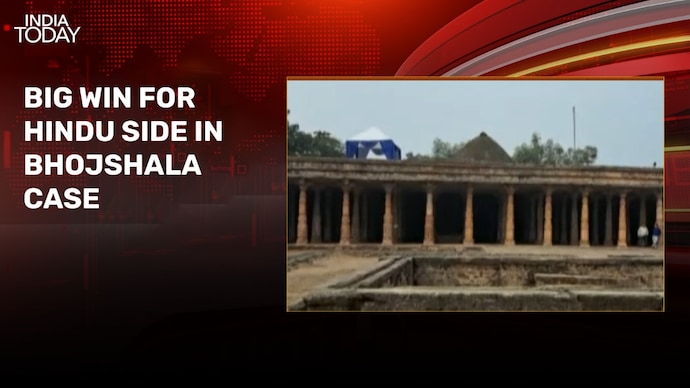
The Bhojshala dispute in Madhya Pradesh’s Dhar district is one of India’s longest-running religious and archaeological controversies, involving competing claims by Hindu, Muslim and Jain communities over a protected monument maintained by the Archaeological Survey of India (ASI).
The Hindu community considers Bhojshala to be an ancient temple dedicated to Goddess Vagdevi Saraswati and linked to the 11th-century Parmar king Raja Bhoj, who is credited with making Dhar a major centre of Sanskrit learning. The Muslim side identifies the structure as the Kamal Maula Mosque, while a Jain petitioner has claimed the complex was originally a Jain temple and gurukul.
The dispute intensified after the ASI issued an order on April 7, 2003, allowing Hindus to worship at the complex every Tuesday and Muslims to offer namaz on Fridays. Hindu petitioners later challenged this arrangement, demanding exclusive worship rights.
In March 2024, the Madhya Pradesh High Court ordered the ASI to conduct a scientific survey of the Bhojshala-Kamal Maula complex. After a 98-day exercise, the ASI submitted a 2,000-page report stating that a large structure from the Parmar era predated the mosque and that parts of the present structure were built using reused temple remains. Hindu groups cited sculptures, inscriptions and coins recovered during the survey as proof of a pre-existing temple, while the Muslim side alleged the report was biased.
On Friday, the High Court declared Bhojshala a temple dedicated to Goddess Saraswati, quashed the ASI’s 2003 order permitting namaz, and said the Centre and ASI could decide the future administration and management of the complex.
The government on Friday hiked fuel prices by Rs three per litre for petrol and diesel, and Rs two for CNG, driven by rising global crude prices and supply disruptions in the Strait of Hormuz.
The Madhya Pradesh High Court declared the disputed Bhojshala complex in Dhar as a Hindu temple dedicated to Goddess Saraswati and a historical center of Sanskrit learning.
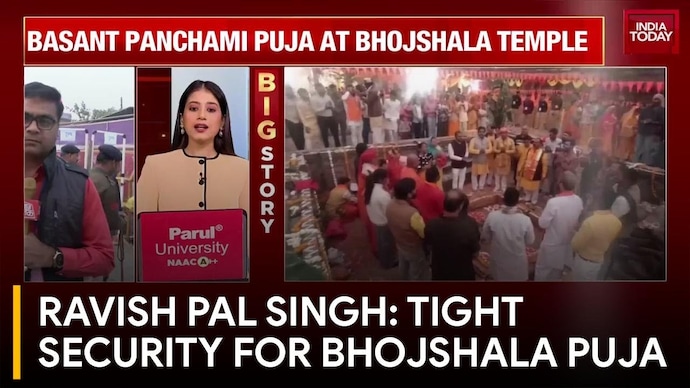
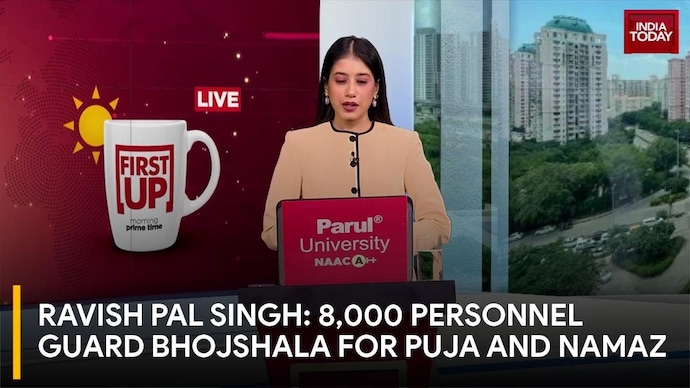
On this Special Report, Ravish Pal Singh provides an on-ground update from Dhar, Madhya Pradesh, regarding the security arrangements at the Bhojshala complex. As Saraswati Puja coincides with Friday prayers, the administration has deployed heavy security to maintain law and order. Ravish Pal Singh notes, 'पूरे शहर में थर्टी फोर से ज्यादा पॉइंट ऐसे पुलिस ने बनाए हैं जहां पर पुलिस और पैरा मिलिट्री फोर्सेस तैनात है' (More than 34 points have been created by the police across the city where police and paramilitary forces are deployed). The city has been divided into 13 sectors with 'Vajra' vehicles stationed at key locations. The reporter highlights that the area is a no-fly zone and construction materials have been cleared from roads to prevent misuse. While media entry is restricted, the administration has ensured that the Maha Aarti and Friday prayers can proceed according to the designated schedule under strict monitoring.
In this special report, India Today’s Ravish Pal Singh provides a ground update from Dhar, Madhya Pradesh, where the Bhojshala Temple-Kamal Maula Mosque complex is under heavy security. The situation is particularly sensitive as Basant Panchami and Friday prayers coincide this year. Ravish Pal Singh notes, 'Today, I am going to show you the barricades around Bhusala Parishar, so that no one can enter without an I-Card'. Following a Supreme Court intervention, specific time slots have been allocated to both communities to prevent any law and order issues. While Hindu devotees perform Saraswati Puja from sunrise to sunset, the Muslim side has been granted a window from 1 PM to 3 PM for Friday prayers. Over 8,000 security personnel, including the Rapid Action Force, have been deployed to ensure separate entry and exit points, aiming to avoid the communal violence witnessed during similar coincidences in 2003, 2013, and 2016.