Teachers feared AI would replace them. Now many say it made classes better
Indian schools are no longer treating AI as a futuristic concept. From ChatGPT-powered lesson planning to AI-supported assessments, teachers across institutions are being trained to use artificial intelligence in structured and responsible ways. The result is changing classrooms, teaching styles, and even how students think, question, and learn.
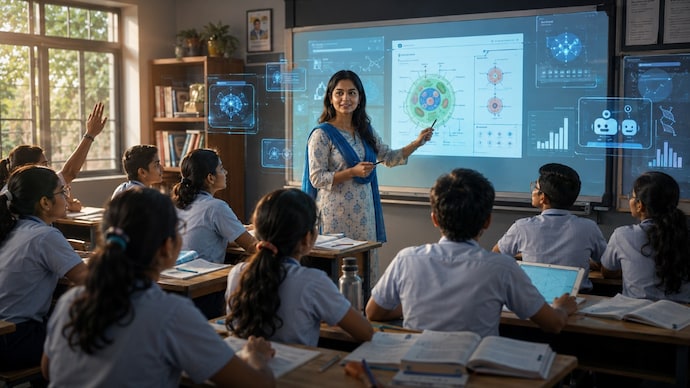
Inside many Indian classrooms today, something unusual is happening before the school bell even rings beginning the day. Teachers are opening ChatGPT before they open textbooks.
Some are using it to create lesson plans in minutes. Others are generating worksheets, simplifying difficult concepts, preparing classroom discussions, or building different versions of the same assignment for students with different learning levels.
Just a year ago, many educators were nervous about AI. Now, some schools in are actively training teachers to use it as part of everyday classroom work.
The shift is happening quietly but rapidly across urban schools in India, where AI is moving from experimental workshops into actual teaching practice.
And perhaps the most surprising part is this -- teachers say the technology is not replacing them. It is making them more human inside classrooms.
FROM FEAR TO FLUENCY
At Bodhi International School in Jodhpur, AI training began with a larger question about the future.
"At Bodhi, our AI training programme is anchored in a clear objective -- preparing students for a future where AI will shape how work, learning, and careers evolve," says Nitu Bothra, Executive Director of the school.
Teachers were trained on conversational AI platforms like OpenAI’s ChatGPT, along with modules from OpenAI Academy. The training focused on lesson design, differentiated instruction, assessments, research support, and even career-linked classroom projects.
But the first challenge was not technical.
It was emotional.
"Initial hesitation was natural largely driven by concerns that AI tools might replace certain teaching functions," Bothra admitted.
That anxiety appeared in other schools too.
At Delhi Public School Bangalore North, teachers were introduced to CBSE-led AI modules, sessions with FICCI ARISE, and access to ChatGPT Go.
"Our school introduced teachers to CBSE-led modules, sessions with FICCI ARISE, and access to ChatGPT Go," says Principal Manju Balasubramanyam.
Over time, the fear began fading.
"Teachers feel more confident after structured training," she says. "Teachers see AI as a professional growth opportunity and value how it supports lesson clarity and classroom engagement."
At Suncity World School, the approach was intentionally practical.
"The goal was to build confidence, not dependency," says Director Rupa Chakravarty.
Teachers explored AI tools for lesson outlines, question banks, explanations, worksheets, and differentiated learning material.
"AI was positioned as a support for clarity, structure, and preparation, while teachers continued to lead decisions, interpretation, and student engagement," she explains.
THE CLASSROOM IS STARTING TO LOOK DIFFERENT
The biggest transformation is not flashy robotics or futuristic gadgets.
It is preparation.
Teachers say they now walk into classrooms more ready than before.
At DPS Bangalore North, teachers use ChatGPT to test multiple ways of explaining concepts before class. Worksheets are more structured. Examples are sharper. Explanations are clearer.
"Teachers now prepare lessons faster and with more clarity," Balasubramanyam says.
At Bodhi International School, lesson planning has become more focused on real-world skills.
"Teachers now design learning experiences that mirror real-world tasks, research briefs, collaborative problem-solving, design-thinking challenges, and career-linked assignments," Bothra says.
The result, according to educators, is that classrooms are slowly moving away from rote memorisation.
Teachers are spending more time on discussion, feedback, and problem-solving because repetitive planning work takes less time now.
At Suncity World School, Chakravarty says the shift is especially visible in personalised learning.
"We have seen a shift toward more structured and personalised learning. Teachers are able to design differentiated tasks more efficiently and identify learning gaps earlier," she says.
Ironically, AI seems to be pushing some classrooms toward more human interaction, not less.
THE BIGGEST QUESTION: ARE STUDENTS THINKING LESS?
This is where schools become careful.
Every educator interviewed agreed that AI can become dangerous if students start outsourcing thinking itself.
The concern is no longer whether students are using AI. Most schools assume they already are.
The real question is whether students are still reasoning independently.
At Bodhi, teachers now insist on reflections, presentations, and evidence-based assignments.
"They emphasise verification of information, proper attribution, and stronger expectations for personal reasoning," says Bothra.
At Suncity, students are encouraged to treat AI answers as starting points, not final submissions.
"They are encouraged to question outputs, verify information, and explain their thinking," Chakravarty says.
Teachers claim this has actually improved classroom discussions in some cases because students compare viewpoints and challenge AI-generated responses.
But uncertainty still exists.
Many educators say they are still figuring out how to fairly evaluate AI-assisted work while ensuring genuine learning is taking place.
"Teachers are still navigating how to balance AI assistance with authentic student effort," Bothra says.
This remains one of the biggest unresolved questions in modern education.
CAN AI LEARNING WORK OUTSIDE ELITE SCHOOLS?
India’s education system still faces major digital gaps. Many schools struggle with internet access, smart classrooms, or even basic devices.
So can AI-led education really scale?
Surprisingly, educators say yes.
But not in the way most people imagine.
"Scalability is often seen as an infrastructure challenge, but it fundamentally begins with mindset," says Bothra.
Schools argue that AI adoption does not require expensive laboratories or advanced software at the beginning.
Even a shared device, limited internet access, or basic teacher training can help educators use AI for lesson planning, classroom ideas, and simplified explanations.
Balasubramanyam echoed the same idea.
"AI training becomes scalable when schools focus first on teacher readiness," she says.
Several educators stressed that the real divide may not be technology, but awareness.
Schools that begin early, even with modest resources, may give students an advantage in an economy increasingly shaped by AI.
And perhaps that is why this shift matters beyond classrooms.
India’s schools are no longer debating whether AI belongs in education.
They are trying to figure out how to use it before students enter a world where everyone else already is.
Inside many Indian classrooms today, something unusual is happening before the school bell even rings beginning the day. Teachers are opening ChatGPT before they open textbooks.
Some are using it to create lesson plans in minutes. Others are generating worksheets, simplifying difficult concepts, preparing classroom discussions, or building different versions of the same assignment for students with different learning levels.
Just a year ago, many educators were nervous about AI. Now, some schools in are actively training teachers to use it as part of everyday classroom work.
The shift is happening quietly but rapidly across urban schools in India, where AI is moving from experimental workshops into actual teaching practice.
And perhaps the most surprising part is this -- teachers say the technology is not replacing them. It is making them more human inside classrooms.
FROM FEAR TO FLUENCY
At Bodhi International School in Jodhpur, AI training began with a larger question about the future.
"At Bodhi, our AI training programme is anchored in a clear objective -- preparing students for a future where AI will shape how work, learning, and careers evolve," says Nitu Bothra, Executive Director of the school.
Teachers were trained on conversational AI platforms like OpenAI’s ChatGPT, along with modules from OpenAI Academy. The training focused on lesson design, differentiated instruction, assessments, research support, and even career-linked classroom projects.
But the first challenge was not technical.
It was emotional.
"Initial hesitation was natural largely driven by concerns that AI tools might replace certain teaching functions," Bothra admitted.
That anxiety appeared in other schools too.
At Delhi Public School Bangalore North, teachers were introduced to CBSE-led AI modules, sessions with FICCI ARISE, and access to ChatGPT Go.
"Our school introduced teachers to CBSE-led modules, sessions with FICCI ARISE, and access to ChatGPT Go," says Principal Manju Balasubramanyam.
Over time, the fear began fading.
"Teachers feel more confident after structured training," she says. "Teachers see AI as a professional growth opportunity and value how it supports lesson clarity and classroom engagement."
At Suncity World School, the approach was intentionally practical.
"The goal was to build confidence, not dependency," says Director Rupa Chakravarty.
Teachers explored AI tools for lesson outlines, question banks, explanations, worksheets, and differentiated learning material.
"AI was positioned as a support for clarity, structure, and preparation, while teachers continued to lead decisions, interpretation, and student engagement," she explains.
THE CLASSROOM IS STARTING TO LOOK DIFFERENT
The biggest transformation is not flashy robotics or futuristic gadgets.
It is preparation.
Teachers say they now walk into classrooms more ready than before.
At DPS Bangalore North, teachers use ChatGPT to test multiple ways of explaining concepts before class. Worksheets are more structured. Examples are sharper. Explanations are clearer.
"Teachers now prepare lessons faster and with more clarity," Balasubramanyam says.
At Bodhi International School, lesson planning has become more focused on real-world skills.
"Teachers now design learning experiences that mirror real-world tasks, research briefs, collaborative problem-solving, design-thinking challenges, and career-linked assignments," Bothra says.
The result, according to educators, is that classrooms are slowly moving away from rote memorisation.
Teachers are spending more time on discussion, feedback, and problem-solving because repetitive planning work takes less time now.
At Suncity World School, Chakravarty says the shift is especially visible in personalised learning.
"We have seen a shift toward more structured and personalised learning. Teachers are able to design differentiated tasks more efficiently and identify learning gaps earlier," she says.
Ironically, AI seems to be pushing some classrooms toward more human interaction, not less.
THE BIGGEST QUESTION: ARE STUDENTS THINKING LESS?
This is where schools become careful.
Every educator interviewed agreed that AI can become dangerous if students start outsourcing thinking itself.
The concern is no longer whether students are using AI. Most schools assume they already are.
The real question is whether students are still reasoning independently.
At Bodhi, teachers now insist on reflections, presentations, and evidence-based assignments.
"They emphasise verification of information, proper attribution, and stronger expectations for personal reasoning," says Bothra.
At Suncity, students are encouraged to treat AI answers as starting points, not final submissions.
"They are encouraged to question outputs, verify information, and explain their thinking," Chakravarty says.
Teachers claim this has actually improved classroom discussions in some cases because students compare viewpoints and challenge AI-generated responses.
But uncertainty still exists.
Many educators say they are still figuring out how to fairly evaluate AI-assisted work while ensuring genuine learning is taking place.
"Teachers are still navigating how to balance AI assistance with authentic student effort," Bothra says.
This remains one of the biggest unresolved questions in modern education.
CAN AI LEARNING WORK OUTSIDE ELITE SCHOOLS?
India’s education system still faces major digital gaps. Many schools struggle with internet access, smart classrooms, or even basic devices.
So can AI-led education really scale?
Surprisingly, educators say yes.
But not in the way most people imagine.
"Scalability is often seen as an infrastructure challenge, but it fundamentally begins with mindset," says Bothra.
Schools argue that AI adoption does not require expensive laboratories or advanced software at the beginning.
Even a shared device, limited internet access, or basic teacher training can help educators use AI for lesson planning, classroom ideas, and simplified explanations.
Balasubramanyam echoed the same idea.
"AI training becomes scalable when schools focus first on teacher readiness," she says.
Several educators stressed that the real divide may not be technology, but awareness.
Schools that begin early, even with modest resources, may give students an advantage in an economy increasingly shaped by AI.
And perhaps that is why this shift matters beyond classrooms.
India’s schools are no longer debating whether AI belongs in education.
They are trying to figure out how to use it before students enter a world where everyone else already is.

