AI talks, you debate: A new way to learn
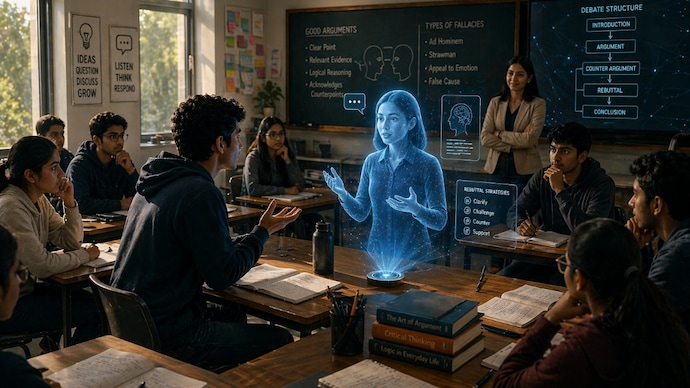
As artificial intelligence moves from answering questions to engaging in arguments, classrooms are beginning to change. Students are no longer limited to listening or memorising; learning is shifting towards one-on-one debates with AI, where they must respond, question, and defend their ideas in real time.
India at present is more enthusiastic about AI, as it has never been for any technological advancements in the past, and this enthusiasm no longer resides solely in policymaking but has begun, with slow persistence, to enter the routines of everyday life.
At the India Impact AI Summit 2026, the conversation was less about distant possibilities and more about what AI can do right now, machines helping in offices, systems guiding decisions, and tools gradually entering classrooms.
Within two months, this idea took a more visible shape. At Dogra Hall in IIT Delhi, students were introduced to an unusual experiment: an artificial debater, AugLi.ai came with the Indian Debating League that could argue, respond in real time, and challenge human reasoning at different levels.
It indicates a move in how these systems are being used, and it is no longer limited to answering questions, breaking the stereotypes are beginning to ask them too.
This transition has not occurred abruptly.
Since the time ChatGPT knocked in after COVID-19, AI has steadily found its way into academic spaces, first as a hub of information, then as an assistant in writing and problem-solving.
It now moves further, into the space of reasoning and decision-making.
The Indian Debating League is a system built to recreate the conditions of a debate. A student can choose a topic, present an argument, and receive a counterpoint in return, clear, structured, and immediate.
The exercise is time-bound, yet aimed at improving how one thinks and responds.
The question it raises is simple and familiar: in a time when information is everywhere, can the ability to think keep pace?
Anjali Tiwary, Founder and CEO of the Indian Debating League, suggests that the emphasis must now shift. The advantage, she observes, will lie not in access to knowledge, but in the ability to question, arrange, and defend one’s ideas with clarity.
IDL’s claim of being “first of its kind” rests on its positioning. While other systems exist, most are either research prototypes, elite tools, or general-purpose platforms.
"While there are several AI debate tools globally, IDL is distinct in how deeply it integrates AI into a full learning ecosystem, rather than offering it as a standalone tool," adds Tiwary.
The design of the system reflects the motive which is made obvious. It is not an occasional tool, but one meant for repeated use. The student enters, selects a motion, and engages.
"Our 1-on-1 AI debating is tightly integrated with our offline tournament system. We don’t just run debates, we record, transcribe, and analyze them, and then use that data to create personalised learning pathways through our AI Autonomous Bots. So every debate feeds into continuous improvement for the student," she further adds.
CAN MACHINES TAKE ON THE DISCIPLINE OF DEBATE?
Debate, in its traditional form, has long been regarded as a discipline of the mind. It compels the individual to examine premises, to articulate thought, and to confront opposing views.
In doing so, it refines not only argument, but expression. It is, in essence, an exercise in ordered thinking.
Whether such an exercise may be meaningfully conducted with a machine remains an open question.
The doubt rests in nuance, whether a system, however advanced, may grasp the subtleties that human exchange so often contains.
The AI responds, challenges, and in some cases evaluates performance. Sessions are recorded and analysed across parameters such as clarity, reasoning, and structure.
IDL’s approach builds on its experience of organising over 140 national tournaments, with students participating in international circuits hosted by institutions such as Stanford University, London School of Economics, Columbia University, and Princeton University.
"The format of debate itself helps us here. We’ve initially focused on parliamentary debating, where the emphasis is more on reasoning and argumentation rather than recalling precise data points. So the learning is centered on how students think, not just what facts they cite. Second, for key motions that students engage with, we use a curated knowledge base. The AI is prompted to draw from this controlled source, which helps ensure that the arguments remain accurate and aligned with our learning objectives," says Tiwary.
Yet, the organisation notes that access to debating remains limited at scale. The AI debater is intended to address that gap.
The idea is not entirely new. Globally, several systems have already explored AI-led debating.
"What makes IDL first-of-its-kind is this combination of AI + pedagogy + real-world debate data, it’s not just an AI tool, it’s a complete debate learning system," says Tiwary.
AI DEBATERS MOVE CLOSER TO HUMAN-LEVEL ARGUMENT IN TESTS
IBM Project Debater was among the first to demonstrate that machines could argue with humans in structured settings. It performed well in prepared speeches and even influenced audience opinions, though it struggled with spontaneous rebuttals.
Newer systems such as multi-agent debate models, often referred to as DeepDebater in research, have moved closer to real debate formats.
These systems can handle argument, rebuttal, and cross-examination by using multiple AI agents working together. In controlled tests, their arguments have been rated favourably by expert evaluators.
Other tools function as practice platforms.
AI debate simulators have shown results where performance begins to approach human levels in structured settings, while maintaining higher factual consistency.
Platforms like Kialo take a different approach, helping users structure arguments rather than debate in real time.
Meanwhile, systems like Sway, developed at Columbia University, act as moderators, shaping how discussions take place rather than participating directly.
AS AI DEBATE EXPANDS, QUESTIONS OF ACCURACY, BIAS AND SCALE REMAIN
In India, experimentation has also moved into public spaces. An AI system developed by Blue Machines participated in a live television debate, handling unscripted exchanges over an extended duration.
This recorded a shift from controlled environments to real-time public discourse.
If learning is the primary goal, how is accuracy ensured? Tiwary indicates that the system is trained on structured debate data and continuously evaluated against human judgement.
Bias remains another concern. AI systems often reflect the data they are trained on, especially in subjects involving politics or history. IDL acknowledges this as an ongoing challenge, working to balance datasets and refine evaluation models to reduce skew.
"At IDL, insights from tournament data show that AI is not uniform, different models judge arguments differently. Human judges tend to reward well-developed, example-rich arguments, while some AI systems favour fluent but shallower responses, revealing distinct biases on both sides. A gap remains, especially in nuanced or value-based topics, where human judgement brings context and empathy that AI cannot fully replicate. IDL uses this gap as a learning tool," says Tiwary.
There is also the question of scale. As more students use the system, maintaining consistency in evaluation becomes complex.
Variations between AI judgement and human judges are already visible, particularly in how arguments and examples are weighted.
The issue of sensitivity is harder to resolve. Human debaters bring context, restraint, and an understanding of nuance. AI systems, while improving, may not fully replicate that.
The platform attempts to address this through structured prompts and controlled environments, but the gap remains under observation.
The larger challenge, however, may not be technical. It lies in adoption.
Whether students and educators treat debating as a regular practice, or continue to see it as an occasional activity, will determine how such tools are used.
The India Impact AI Summit outlined a direction. Tools like AugLi.AI show how that direction is being applied in classrooms.
The debate, for now, is still about learning. But the format is changing.
India at present is more enthusiastic about AI, as it has never been for any technological advancements in the past, and this enthusiasm no longer resides solely in policymaking but has begun, with slow persistence, to enter the routines of everyday life.
At the India Impact AI Summit 2026, the conversation was less about distant possibilities and more about what AI can do right now, machines helping in offices, systems guiding decisions, and tools gradually entering classrooms.
Within two months, this idea took a more visible shape. At Dogra Hall in IIT Delhi, students were introduced to an unusual experiment: an artificial debater, AugLi.ai came with the Indian Debating League that could argue, respond in real time, and challenge human reasoning at different levels.
It indicates a move in how these systems are being used, and it is no longer limited to answering questions, breaking the stereotypes are beginning to ask them too.
This transition has not occurred abruptly.
Since the time ChatGPT knocked in after COVID-19, AI has steadily found its way into academic spaces, first as a hub of information, then as an assistant in writing and problem-solving.
It now moves further, into the space of reasoning and decision-making.
The Indian Debating League is a system built to recreate the conditions of a debate. A student can choose a topic, present an argument, and receive a counterpoint in return, clear, structured, and immediate.
The exercise is time-bound, yet aimed at improving how one thinks and responds.
The question it raises is simple and familiar: in a time when information is everywhere, can the ability to think keep pace?
Anjali Tiwary, Founder and CEO of the Indian Debating League, suggests that the emphasis must now shift. The advantage, she observes, will lie not in access to knowledge, but in the ability to question, arrange, and defend one’s ideas with clarity.
IDL’s claim of being “first of its kind” rests on its positioning. While other systems exist, most are either research prototypes, elite tools, or general-purpose platforms.
"While there are several AI debate tools globally, IDL is distinct in how deeply it integrates AI into a full learning ecosystem, rather than offering it as a standalone tool," adds Tiwary.
The design of the system reflects the motive which is made obvious. It is not an occasional tool, but one meant for repeated use. The student enters, selects a motion, and engages.
"Our 1-on-1 AI debating is tightly integrated with our offline tournament system. We don’t just run debates, we record, transcribe, and analyze them, and then use that data to create personalised learning pathways through our AI Autonomous Bots. So every debate feeds into continuous improvement for the student," she further adds.
CAN MACHINES TAKE ON THE DISCIPLINE OF DEBATE?
Debate, in its traditional form, has long been regarded as a discipline of the mind. It compels the individual to examine premises, to articulate thought, and to confront opposing views.
In doing so, it refines not only argument, but expression. It is, in essence, an exercise in ordered thinking.
Whether such an exercise may be meaningfully conducted with a machine remains an open question.
The doubt rests in nuance, whether a system, however advanced, may grasp the subtleties that human exchange so often contains.
The AI responds, challenges, and in some cases evaluates performance. Sessions are recorded and analysed across parameters such as clarity, reasoning, and structure.
IDL’s approach builds on its experience of organising over 140 national tournaments, with students participating in international circuits hosted by institutions such as Stanford University, London School of Economics, Columbia University, and Princeton University.
"The format of debate itself helps us here. We’ve initially focused on parliamentary debating, where the emphasis is more on reasoning and argumentation rather than recalling precise data points. So the learning is centered on how students think, not just what facts they cite. Second, for key motions that students engage with, we use a curated knowledge base. The AI is prompted to draw from this controlled source, which helps ensure that the arguments remain accurate and aligned with our learning objectives," says Tiwary.
Yet, the organisation notes that access to debating remains limited at scale. The AI debater is intended to address that gap.
The idea is not entirely new. Globally, several systems have already explored AI-led debating.
"What makes IDL first-of-its-kind is this combination of AI + pedagogy + real-world debate data, it’s not just an AI tool, it’s a complete debate learning system," says Tiwary.
AI DEBATERS MOVE CLOSER TO HUMAN-LEVEL ARGUMENT IN TESTS
IBM Project Debater was among the first to demonstrate that machines could argue with humans in structured settings. It performed well in prepared speeches and even influenced audience opinions, though it struggled with spontaneous rebuttals.
Newer systems such as multi-agent debate models, often referred to as DeepDebater in research, have moved closer to real debate formats.
These systems can handle argument, rebuttal, and cross-examination by using multiple AI agents working together. In controlled tests, their arguments have been rated favourably by expert evaluators.
Other tools function as practice platforms.
AI debate simulators have shown results where performance begins to approach human levels in structured settings, while maintaining higher factual consistency.
Platforms like Kialo take a different approach, helping users structure arguments rather than debate in real time.
Meanwhile, systems like Sway, developed at Columbia University, act as moderators, shaping how discussions take place rather than participating directly.
AS AI DEBATE EXPANDS, QUESTIONS OF ACCURACY, BIAS AND SCALE REMAIN
In India, experimentation has also moved into public spaces. An AI system developed by Blue Machines participated in a live television debate, handling unscripted exchanges over an extended duration.
This recorded a shift from controlled environments to real-time public discourse.
If learning is the primary goal, how is accuracy ensured? Tiwary indicates that the system is trained on structured debate data and continuously evaluated against human judgement.
Bias remains another concern. AI systems often reflect the data they are trained on, especially in subjects involving politics or history. IDL acknowledges this as an ongoing challenge, working to balance datasets and refine evaluation models to reduce skew.
"At IDL, insights from tournament data show that AI is not uniform, different models judge arguments differently. Human judges tend to reward well-developed, example-rich arguments, while some AI systems favour fluent but shallower responses, revealing distinct biases on both sides. A gap remains, especially in nuanced or value-based topics, where human judgement brings context and empathy that AI cannot fully replicate. IDL uses this gap as a learning tool," says Tiwary.
There is also the question of scale. As more students use the system, maintaining consistency in evaluation becomes complex.
Variations between AI judgement and human judges are already visible, particularly in how arguments and examples are weighted.
The issue of sensitivity is harder to resolve. Human debaters bring context, restraint, and an understanding of nuance. AI systems, while improving, may not fully replicate that.
The platform attempts to address this through structured prompts and controlled environments, but the gap remains under observation.
The larger challenge, however, may not be technical. It lies in adoption.
Whether students and educators treat debating as a regular practice, or continue to see it as an occasional activity, will determine how such tools are used.
The India Impact AI Summit outlined a direction. Tools like AugLi.AI show how that direction is being applied in classrooms.
The debate, for now, is still about learning. But the format is changing.

