Exams at 45°C? India should rethink when and how NEET, JEE, UPSC and CUET are held
With exams such as NEET-UG, JEE, CUET and UPSC often held during peak summer, rising heatwaves and temperatures above 45 degrees Celsius are raising concerns over fairness, student wellbeing and exam conditions, prompting calls for more climate-adaptive scheduling.
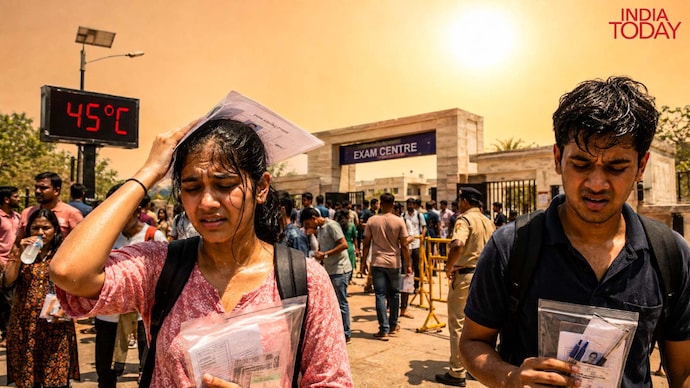
The exam begins long before the question paper arrives.
It begins outside examination centres where students wait in long queues under a scorching sun. It begins after hours of travel from another district or city. It begins without shade, without seating and often without adequate drinking water.
Then comes the exam hall.
It is 1:30 pm. The electricity fails. Ceiling fans stop. Students continue writing as temperatures outside cross 45°C.
For millions of students across India, this is becoming the reality of exam season.
India’s biggest examinations, from JEE Main and JEE Advanced to CUET-UG, NEET, UPSC and university exams, continue to be scheduled between April and June, when the country experiences its most intense heatwaves.
As extreme heat becomes more frequent and the NEET-UG 2026 re-examination approaches on June 21, the debate is gaining urgency, especially for students who had already appeared on May 3 and now have to go through the entire process again amid extreme summer conditions.
Are students competing with each other, or with the climate itself?
And more importantly: Is India still following an examination calendar built for a climate that no longer exists?
WHEN EXAMS COLLIDE WITH EXTREME HEAT
India’s peak examination season arrives at the same time as its most punishing heatwave period, forcing millions of students to sit high-stakes tests under extreme weather conditions.
This year, temperatures have climbed close to 50 degrees Celsius in parts of north and central India, turning exam travel, long waits outside centres and hours-long papers into an added physical challenge.
The India Meteorological Department (IMD) has issued heatwave warnings across several states, including Uttar Pradesh, Madhya Pradesh, Delhi, Punjab, Haryana and Vidarbha, with similar conditions expected in Rajasthan, Telangana, Coastal Andhra Pradesh, Chhattisgarh, Uttarakhand and parts of Jammu & Kashmir.
The concerns are especially significant for NEET-UG, one of India’s largest entrance exams, with over 22 lakh aspirants often travelling across districts and states, exposing many to prolonged heat stress even before entering the examination hall.
“Competitive exams like NEET, JEE, UPSC Civil Services Examination and CUET are already emotionally and mentally demanding for students,” says Avinash Agarwal, Director, Disha Publication.
Many aspirants travel long distances, wait outside centres for hours, and often enter examination halls physically exhausted even before the paper begins, he explains.
He adds that with temperatures crossing 45°C in several regions, physical strain increasingly affects concentration, stamina and performance.
ARE STUDENTS WRITING EXAMS, OR ENDURING CONDITIONS?
The debate moved beyond theory when students at Nagpur University raised concerns over exam conditions during the ongoing heatwave.
Students reported power cuts, poor ventilation, overcrowded halls and lack of cooling arrangements during afternoon exams, while outages also disrupted CCTV systems and reportedly led to theft incidents.
Many urged authorities to shift exams to morning slots, raising a larger question: Can students perform fairly in high-stakes exams while dealing with extreme heat, dehydration and fatigue?
A similar concern is being echoed by education administrators. “This is largely due to an academic cycle that just doesn’t suit Indian conditions,” says Commodore SR Sridhar (Retd), Registrar, IIIT-Bangalore.
He adds that the issue goes beyond weather disruptions and reflects a larger systemic challenge. “The academic calendar is tightly wound with no leeway to manoeuvre between school and college academic cycles,” Sridhar adds.
THE INVISIBLE IMPACT OF HEAT ON PERFORMANCE
Extreme heat is not merely uncomfortable, it affects cognition.
Research globally has linked excessive heat exposure to:
- Reduced concentration and memory retention
- Increased fatigue and slower response time
- Higher stress and irritability
- Risk of dehydration, dizziness and heat-related illness
For examinations where minutes determine ranks and ranks determine futures, even small physiological disadvantages can matter.
A student competing for a medical or civil services seat should be tested on knowledge, not on how well they tolerate a 45°C afternoon.
Agarwal says this raises an important fairness question. "Exams should test preparation and problem-solving ability, not a student’s capacity to endure extreme weather."
He argues that climate-sensitive examination planning is becoming increasingly necessary through improved centre infrastructure, hydration support, better waiting arrangements and weather-conscious scheduling.
"The focus should be on making the examination experience more student-centric as climate conditions become increasingly severe," he says.
WHY NOT SHIFT THE NATIONAL EXAM SEASON TO SEPTEMBER–JANUARY?
The debate is now extending beyond individual exam centres to the academic calendar itself. Many are asking why India’s biggest examinations remain concentrated between April and June when safer weather windows exist.
A September–January cycle could reduce heat exposure, improve exam hall conditions, ease pressure on infrastructure and create a more comfortable environment for students.
Sridhar believes a structural reset may be needed.
"A built-in four-month ‘de-pressure window’ could help, but only if designed carefully. It separates learning from high-pressure testing and gives students time to revise, recover mentally, avoid peak summer heat and choose safer exam windows," Sridhar adds.
He adds that such an approach could also reduce burnout created by back-to-back board exams, entrance tests and coaching pressures.
A POSSIBLE MODEL FOR CLIMATE-ADAPTIVE EXAM SCHEDULING
Sridhar proposes a model that attempts to preserve the university calendar while moving major examinations away from extreme summer conditions:
According to him, this approach keeps the broader academic cycle largely intact while reducing exposure to dangerous weather conditions during high-stakes exams.
BUT WHY HAS INDIA NOT MOVED YET?
However, shifting India’s examination calendar is far from straightforward.
National exams are closely linked to academic sessions, admission timelines, counselling processes and seat allocations that already run on tight schedules.
A shift could also collide with monsoon disruptions in many states, while redesigning systems that handle millions of students would require major institutional changes.
Sridhar acknowledges these implementation hurdles.
"The key challenge would be synchronising all national exams and speeding up evaluation and admissions," Sridhar further explains.
Yet as heatwaves intensify, climate realities may push this conversation from possibility to necessity.
THE FUTURE SHOULD NOT BE WRITTEN IN A HEATWAVE
India’s competitive exams shape the futures of millions. But while exams stay the same, the surrounding climate has changed.
Heatwaves are no longer exceptions, they are now part of India’s summers. Yet students still travel long distances and sit exams in extreme heat.
Exams should measure knowledge and merit, not endurance against dehydration and 45°C afternoons.
As India adapts to climate change, perhaps its academic calendar must adapt too.
The future of students should be decided by what they know, not by how much heat they can survive.
The exam begins long before the question paper arrives.
It begins outside examination centres where students wait in long queues under a scorching sun. It begins after hours of travel from another district or city. It begins without shade, without seating and often without adequate drinking water.
Then comes the exam hall.
It is 1:30 pm. The electricity fails. Ceiling fans stop. Students continue writing as temperatures outside cross 45°C.
For millions of students across India, this is becoming the reality of exam season.
India’s biggest examinations, from JEE Main and JEE Advanced to CUET-UG, NEET, UPSC and university exams, continue to be scheduled between April and June, when the country experiences its most intense heatwaves.
As extreme heat becomes more frequent and the NEET-UG 2026 re-examination approaches on June 21, the debate is gaining urgency, especially for students who had already appeared on May 3 and now have to go through the entire process again amid extreme summer conditions.
Are students competing with each other, or with the climate itself?
And more importantly: Is India still following an examination calendar built for a climate that no longer exists?
WHEN EXAMS COLLIDE WITH EXTREME HEAT
India’s peak examination season arrives at the same time as its most punishing heatwave period, forcing millions of students to sit high-stakes tests under extreme weather conditions.
This year, temperatures have climbed close to 50 degrees Celsius in parts of north and central India, turning exam travel, long waits outside centres and hours-long papers into an added physical challenge.
The India Meteorological Department (IMD) has issued heatwave warnings across several states, including Uttar Pradesh, Madhya Pradesh, Delhi, Punjab, Haryana and Vidarbha, with similar conditions expected in Rajasthan, Telangana, Coastal Andhra Pradesh, Chhattisgarh, Uttarakhand and parts of Jammu & Kashmir.
The concerns are especially significant for NEET-UG, one of India’s largest entrance exams, with over 22 lakh aspirants often travelling across districts and states, exposing many to prolonged heat stress even before entering the examination hall.
“Competitive exams like NEET, JEE, UPSC Civil Services Examination and CUET are already emotionally and mentally demanding for students,” says Avinash Agarwal, Director, Disha Publication.
Many aspirants travel long distances, wait outside centres for hours, and often enter examination halls physically exhausted even before the paper begins, he explains.
He adds that with temperatures crossing 45°C in several regions, physical strain increasingly affects concentration, stamina and performance.
ARE STUDENTS WRITING EXAMS, OR ENDURING CONDITIONS?
The debate moved beyond theory when students at Nagpur University raised concerns over exam conditions during the ongoing heatwave.
Students reported power cuts, poor ventilation, overcrowded halls and lack of cooling arrangements during afternoon exams, while outages also disrupted CCTV systems and reportedly led to theft incidents.
Many urged authorities to shift exams to morning slots, raising a larger question: Can students perform fairly in high-stakes exams while dealing with extreme heat, dehydration and fatigue?
A similar concern is being echoed by education administrators. “This is largely due to an academic cycle that just doesn’t suit Indian conditions,” says Commodore SR Sridhar (Retd), Registrar, IIIT-Bangalore.
He adds that the issue goes beyond weather disruptions and reflects a larger systemic challenge. “The academic calendar is tightly wound with no leeway to manoeuvre between school and college academic cycles,” Sridhar adds.
THE INVISIBLE IMPACT OF HEAT ON PERFORMANCE
Extreme heat is not merely uncomfortable, it affects cognition.
Research globally has linked excessive heat exposure to:
- Reduced concentration and memory retention
- Increased fatigue and slower response time
- Higher stress and irritability
- Risk of dehydration, dizziness and heat-related illness
For examinations where minutes determine ranks and ranks determine futures, even small physiological disadvantages can matter.
A student competing for a medical or civil services seat should be tested on knowledge, not on how well they tolerate a 45°C afternoon.
Agarwal says this raises an important fairness question. "Exams should test preparation and problem-solving ability, not a student’s capacity to endure extreme weather."
He argues that climate-sensitive examination planning is becoming increasingly necessary through improved centre infrastructure, hydration support, better waiting arrangements and weather-conscious scheduling.
"The focus should be on making the examination experience more student-centric as climate conditions become increasingly severe," he says.
WHY NOT SHIFT THE NATIONAL EXAM SEASON TO SEPTEMBER–JANUARY?
The debate is now extending beyond individual exam centres to the academic calendar itself. Many are asking why India’s biggest examinations remain concentrated between April and June when safer weather windows exist.
A September–January cycle could reduce heat exposure, improve exam hall conditions, ease pressure on infrastructure and create a more comfortable environment for students.
Sridhar believes a structural reset may be needed.
"A built-in four-month ‘de-pressure window’ could help, but only if designed carefully. It separates learning from high-pressure testing and gives students time to revise, recover mentally, avoid peak summer heat and choose safer exam windows," Sridhar adds.
He adds that such an approach could also reduce burnout created by back-to-back board exams, entrance tests and coaching pressures.
A POSSIBLE MODEL FOR CLIMATE-ADAPTIVE EXAM SCHEDULING
Sridhar proposes a model that attempts to preserve the university calendar while moving major examinations away from extreme summer conditions:
According to him, this approach keeps the broader academic cycle largely intact while reducing exposure to dangerous weather conditions during high-stakes exams.
BUT WHY HAS INDIA NOT MOVED YET?
However, shifting India’s examination calendar is far from straightforward.
National exams are closely linked to academic sessions, admission timelines, counselling processes and seat allocations that already run on tight schedules.
A shift could also collide with monsoon disruptions in many states, while redesigning systems that handle millions of students would require major institutional changes.
Sridhar acknowledges these implementation hurdles.
"The key challenge would be synchronising all national exams and speeding up evaluation and admissions," Sridhar further explains.
Yet as heatwaves intensify, climate realities may push this conversation from possibility to necessity.
THE FUTURE SHOULD NOT BE WRITTEN IN A HEATWAVE
India’s competitive exams shape the futures of millions. But while exams stay the same, the surrounding climate has changed.
Heatwaves are no longer exceptions, they are now part of India’s summers. Yet students still travel long distances and sit exams in extreme heat.
Exams should measure knowledge and merit, not endurance against dehydration and 45°C afternoons.
As India adapts to climate change, perhaps its academic calendar must adapt too.
The future of students should be decided by what they know, not by how much heat they can survive.

