Can cockroaches survive nuclear war? The truth behind the viral myth
Cockroaches are often called the only creatures that could survive nuclear war. The truth is more complicated. While they can tolerate radiation better than humans, they are far from indestructible. Here is how science, Cold War fears, and evolutionary survival turned cockroaches into the world's most persistent apocalypse myth.
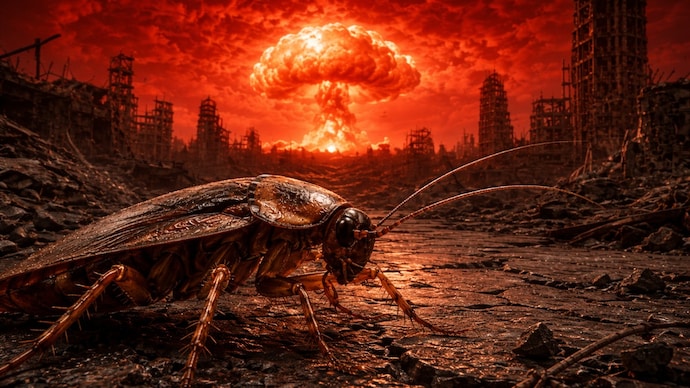
A city burns. Concrete cracks. Glass melts into the streets. Somewhere in the ruins, long after people are gone, something small crawls out from beneath a wall.
The cockroach.
For decades, pop culture has loved this image. Nuclear war wipes out civilisation, but cockroaches survive and inherit the Earth. It appears in films, cartoons, classroom jokes, and internet memes with almost religious certainty.
But how true is it?
Not entirely. And yet, like the insect itself, the myth refuses to die.
HOW COCKROACHES BECAME THE "LAST SURVIVORS"
The idea did not appear out of nowhere.
After the atomic bombings of Hiroshima and Nagasaki in 1945, people noticed something unsettling. Insects, including cockroaches, seemed to reappear quickly in damaged areas where humans had died in huge numbers.
Over time, this observation morphed into a bigger claim. If humans perish in nuclear war, cockroaches will survive.
Science partly fuelled the legend.
Cockroaches are genuinely tougher against radiation than humans. Studies show some species can withstand doses many times higher than what would kill a person.
Humans exposed to around 5 sieverts of radiation face severe danger. Certain cockroaches can tolerate far more before dying.
The reason lies in biology. Human cells divide constantly because they constantly produce red blood cells needed to carry oxygen through the body, making them highly vulnerable to radiation damage.
Cockroaches, however, have a very different circulatory system using haemolymph instead of human-style red blood cell circulation. They do not rely on blood to transport oxygen like humans and instead breathe through a network of tiny tubes called tracheae. Their haemolymph mainly carries nutrients, hormones, waste products, and immune cells.
It is this slower cell division in cockroaches that makes them less vulnerable to radiation damage and offers an advantage.
But "better than humans" slowly became "immune to nuclear bombs" in popular imagination. Those are not the same thing.
SO CAN THEY ACTUALLY SURVIVE A NUCLEAR WAR?
Can cockroaches survive a direct nuclear blast? No.
Cockroaches are not magical creatures. The heat, shockwave, and extreme pressure near a nuclear explosion would kill them like almost any other living thing.
Where they do better is in the aftermath.
If a cockroach is far enough away from the explosion itself, hidden underground or inside structures, it may survive radiation levels that would kill many mammals.
Their small size helps. Their bodies need less food and water. They can squeeze into cracks and survive on scraps for weeks.
But even here, the myth gets exaggerated.
Very high radiation still kills cockroaches. Experiments conducted for television programmes and scientific studies found that while they outperform humans, they are not the most radiation-resistant organisms on Earth.
Some microbes, fungi, and tiny organisms like tardigrades survive far harsher conditions.
Cockroaches simply became the face of survival because humans already associated them with persistence, dirt, and urban decay.
THE REAL REASON THE MYTH STICKS
Part of the myth’s power comes from timing.
The Cold War filled the world with fears of nuclear annihilation. People imagined empty cities, fallout shelters, poisoned skies. Cockroaches fit perfectly into that nightmare.
They were ancient, hard to kill, and already living alongside humans in sewers and ruins.
There is also a strange evolutionary truth behind the legend.
Cockroach ancestors have existed for more than 300 million years. They survived mass extinctions that wiped out entire species long before humans appeared. Dinosaurs disappeared. But cockroach relatives endured.
That does not mean modern cockroaches are invincible. It simply means they are adaptable.
And adaptability often looks like immortality from the outside.
THE CREATURE HUMANS SECRETLY ADMIRE
People rarely admit it, but part of the fascination is respect.
Cockroaches can live for days without their heads because their bodies breathe through tiny openings instead of relying on the mouth. Some survive a month without food. Others sprint faster than many humans can react.
They are disgusting to many people. But biologically, they are extraordinary.
Which is probably why the nuclear myth keeps crawling back.
Not because it is fully true, but because it captures a deeper fear. That human civilisation, for all its technology and power, may still be more fragile than a scavenger hiding beneath the floorboards.
A city burns. Concrete cracks. Glass melts into the streets. Somewhere in the ruins, long after people are gone, something small crawls out from beneath a wall.
The cockroach.
For decades, pop culture has loved this image. Nuclear war wipes out civilisation, but cockroaches survive and inherit the Earth. It appears in films, cartoons, classroom jokes, and internet memes with almost religious certainty.
But how true is it?
Not entirely. And yet, like the insect itself, the myth refuses to die.
HOW COCKROACHES BECAME THE "LAST SURVIVORS"
The idea did not appear out of nowhere.
After the atomic bombings of Hiroshima and Nagasaki in 1945, people noticed something unsettling. Insects, including cockroaches, seemed to reappear quickly in damaged areas where humans had died in huge numbers.
Over time, this observation morphed into a bigger claim. If humans perish in nuclear war, cockroaches will survive.
Science partly fuelled the legend.
Cockroaches are genuinely tougher against radiation than humans. Studies show some species can withstand doses many times higher than what would kill a person.
Humans exposed to around 5 sieverts of radiation face severe danger. Certain cockroaches can tolerate far more before dying.
The reason lies in biology. Human cells divide constantly because they constantly produce red blood cells needed to carry oxygen through the body, making them highly vulnerable to radiation damage.
Cockroaches, however, have a very different circulatory system using haemolymph instead of human-style red blood cell circulation. They do not rely on blood to transport oxygen like humans and instead breathe through a network of tiny tubes called tracheae. Their haemolymph mainly carries nutrients, hormones, waste products, and immune cells.
It is this slower cell division in cockroaches that makes them less vulnerable to radiation damage and offers an advantage.
But "better than humans" slowly became "immune to nuclear bombs" in popular imagination. Those are not the same thing.
SO CAN THEY ACTUALLY SURVIVE A NUCLEAR WAR?
Can cockroaches survive a direct nuclear blast? No.
Cockroaches are not magical creatures. The heat, shockwave, and extreme pressure near a nuclear explosion would kill them like almost any other living thing.
Where they do better is in the aftermath.
If a cockroach is far enough away from the explosion itself, hidden underground or inside structures, it may survive radiation levels that would kill many mammals.
Their small size helps. Their bodies need less food and water. They can squeeze into cracks and survive on scraps for weeks.
But even here, the myth gets exaggerated.
Very high radiation still kills cockroaches. Experiments conducted for television programmes and scientific studies found that while they outperform humans, they are not the most radiation-resistant organisms on Earth.
Some microbes, fungi, and tiny organisms like tardigrades survive far harsher conditions.
Cockroaches simply became the face of survival because humans already associated them with persistence, dirt, and urban decay.
THE REAL REASON THE MYTH STICKS
Part of the myth’s power comes from timing.
The Cold War filled the world with fears of nuclear annihilation. People imagined empty cities, fallout shelters, poisoned skies. Cockroaches fit perfectly into that nightmare.
They were ancient, hard to kill, and already living alongside humans in sewers and ruins.
There is also a strange evolutionary truth behind the legend.
Cockroach ancestors have existed for more than 300 million years. They survived mass extinctions that wiped out entire species long before humans appeared. Dinosaurs disappeared. But cockroach relatives endured.
That does not mean modern cockroaches are invincible. It simply means they are adaptable.
And adaptability often looks like immortality from the outside.
THE CREATURE HUMANS SECRETLY ADMIRE
People rarely admit it, but part of the fascination is respect.
Cockroaches can live for days without their heads because their bodies breathe through tiny openings instead of relying on the mouth. Some survive a month without food. Others sprint faster than many humans can react.
They are disgusting to many people. But biologically, they are extraordinary.
Which is probably why the nuclear myth keeps crawling back.
Not because it is fully true, but because it captures a deeper fear. That human civilisation, for all its technology and power, may still be more fragile than a scavenger hiding beneath the floorboards.

