advertisement
CBSE Board Exam 2026 Live

CBSE Board Exam 2026 Live: Maths MCQs 'lengthy', check paper analysis

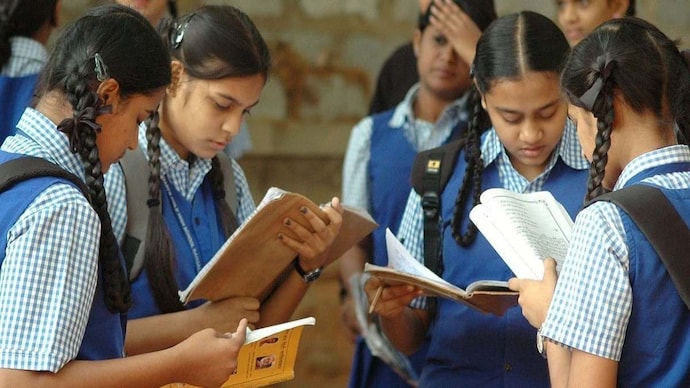
The CBSE Board Exams 2026 have officially commenced today for Class 10 and Class 12, with more than 43 lakh students appearing across examination centres nationwide. Exams are being held in a single shift from 10:30 am to 1:30 pm, so timely arrival at centres is crucial. Get complete exam day guidelines, last-minute preparation tips, dress code rules, and all essential updates to ensure a smooth and stress-free exam experience. Stay tuned for the latest news and live updates from the CBSE Board Exams 2026.
...Read More
CBSE maths exam guidelines out, permitted items and banned list explained
CBSE Board Exams 2026: Last-minute tips, important instructions, and what not to carry

The Central Board of Secondary Education (CBSE) board examinations for 2026 began on Monday, February 17, marking the start of the annual exam season for lakhs of students across the country. This year, more than 24 lakh boys and around 19 lakh girls are appearing for the Class 10 and Class 12 exams.

Students who are not satisfied with their performance will have the option to appear for improvement examinations, as per CBSE norms.

On the first day, Class 10 students appeared for the Mathematics examination, both Basic and Standard versions, while Class 12 students wrote the Biotechnology paper. All exams were conducted in a single shift from 10:30 am to 1:30 pm, following the board’s prescribed guidelines.

Check CBSE Class 10 Maths Standard paper analysis here

Check CBSE Class 10 Maths Basic paper analysis here

Many students and parents often wonder whether CBSE releases official answer keys for board examinations. However, CBSE does not issue answer keys for these exams. Based on past trends, the board is expected to declare the results in May 2026.

Early feedback from schools suggests that the Class 10 Mathematics Standard paper was moderate in difficulty and closely aligned with the NCERT syllabus. Teachers described the question paper as balanced and familiar, allowing most students to complete it on time.

Teachers from JAIN International Residential School, Bengaluru, said the paper was moderate and comparatively easier than last year, which helped well-prepared students attempt most questions with confidence.

With the examinations now underway, CBSE has advised students to follow all instructions carefully and remain calm, as the board exam season continues in the coming weeks.

Experts noted that the Multiple Choice Questions (MCQs) were mostly direct and concept-based, especially on topics such as Arithmetic Progression, Probability, HCF and LCM. However, assertion-reason questions required careful thinking and were found slightly tricky by some students.

Teachers also observed that many questions followed the CBSE sample paper pattern, and internal choices allowed students' flexibility while attempting the exam.

This year also marks the implementation of CBSE’s two-exam policy, making it mandatory for all Class 10 students to appear in the first board examination. Students who fail to appear in at least three subjects will be placed in the “essential repeat” category.

CBSE has also issued a strong advisory asking students and parents not to believe rumours regarding question paper leaks. The board stated that its examination process is secure and students should rely only on official communication.

Students were advised to reach the centres well in advance, as entry was closed at 10 am sharp.

Stay tuned to this LIVE blog for real-time updates, student reactions, expert analysis and highlights from the CBSE Board Exams 2026.

...Read More
Feb 17, 2026 20:39 IST

CBSE Class 10 Math exam 2026 live: Algebra dominates Maths standard paper

The CBSE Class 10 Mathematics Standard paper was of moderate difficulty and slightly more application-oriented compared to the Basic paper, as per initial expert review. The question paper emphasised conceptual clarity and analytical thinking, though it remained fully aligned with the NCERT syllabus.

The multiple-choice questions required logical reasoning, with some closely framed options that needed careful reading. Algebra carried significant weightage, especially topics like Quadratic Equations and Pair of Linear Equations, while questions from Geometry and Trigonometry tested students’ ability to present clear, step-wise solutions.

The long-answer and case-study sections involved moderate calculations, making time management important during the exam.

Overall, students described the paper as fair but requiring consistent practice. Those who prepared through NCERT and previous year question papers are expected to perform well.

Feb 17, 2026 19:30 IST

CBSE Class 10 Math exam 2026 live: NCERT dominates CBSE Class 10 Math question paper

The CBSE Class 10 Mathematics (Basic and Standard) examination held on February 17, 2026, was of moderate difficulty and maintained a balanced mix of conceptual and application-based questions, according to Nishant Kumar Singh, Subject Matter Expert at Seth M.R. Jaipuria Schools.

He said the question paper closely followed the NCERT syllabus, allowing well-prepared students to attempt most sections with confidence. Multiple-choice and short-answer questions were largely direct and concept-driven, although some assertion–reason questions required careful interpretation.

The two- and three-mark questions were accessible but required clarity in understanding, while the long-answer questions tested logical presentation and deeper conceptual knowledge. The final questions in the paper assessed higher-order thinking skills.

The case-study section focused on the application of mathematics in real-life situations, emphasising analysis and time management rather than memorisation.

Overall, Singh noted that students with consistent preparation and strong conceptual clarity were well placed to perform well, adding that the paper reflected CBSE’s competency-based approach while maintaining clarity and fairness.

Feb 17, 2026 18:35 IST

CBSE Class 10 Math exam 2026 live: Was this year’s Maths paper tougher than previous years?

A comparative review of this year’s Class 10 Mathematics examination suggests that the paper was not tougher in terms of syllabus, but it was more demanding in terms of thinking.

In previous years, many questions followed familiar formats. Students who had practised standard question types could often identify the method quickly and proceed with calculation. The emphasis was largely on applying formulas correctly and completing steps efficiently.

This year, the pattern showed a noticeable shift.

Several questions required interpretation before execution. Instead of directly signalling which formula to use, problems expected students to recognise patterns, understand relationships and then decide the approach. Topics such as cyclic number patterns, polynomial behaviour, tangency and properties of cyclic quadrilaterals were framed to test conceptual clarity rather than routine solving.

This changed the nature of difficulty.

The challenge was not due to complex calculations but due to the thinking required at the first stage. Students needed to understand the structure of the problem before beginning the solution. This meant those who relied mainly on memorisation may have found the paper more demanding, while students with strong conceptual preparation were better placed to attempt it.

Another key difference was the balance between speed and understanding.

Earlier papers often gave an advantage to students who could solve quickly. This year, the length and design of the paper appeared balanced, allowing sufficient time but requiring steady reasoning.

The focus shifted from speed-based solving to clarity-based solving.

In terms of syllabus coverage, the paper remained within the prescribed curriculum. There were no out-of-scope questions.

However, the framing required deeper engagement with core concepts across algebra, geometry and number systems.

  • Compared to previous years, the key differences observed were:

  • Greater emphasis on conceptual understanding

  • Reduced reliance on direct formula-based questions

  • Higher focus on interpretation and reasoning

  • Less advantage for mechanical speed

Overall, the paper reflected a move towards assessing how well students understand mathematics, not just how well they can perform calculations. It was aligned with the competency-based assessment approach, where the emphasis is on clarity of concepts and the ability to apply them in varied contexts.

Feb 17, 2026 17:58 IST

CBSE Class 10 Math exam 2026: Ex-ISRO scientist says Maths paper tested thinking, not memorisation

Academic feedback suggests that today’s Mathematics paper placed clear emphasis on conceptual understanding rather than routine calculation. Teachers noted that several questions required students to think beyond mechanical execution and demonstrate genuine reasoning.

"Certain questions demand genuine thinking rather than mechanical execution. They probe whether computation has become internalised as part of neural activity, whether one can visualise geometrically, and whether parametric representations can be interpreted structurally rather than procedurally. The paper consistently tests this cognitive layer. Whether through cyclic digit patterns, polynomial coefficient behaviour, geometric tangency, spatial reasoning, or properties of cyclic quadrilaterals, the emphasis remains on recognising structure rather than executing routine calculation," said Gurpreet Singh, ex ISRO scientist and currently Math lead at Newton School of Technology.

Questions based on cyclic digit patterns, polynomial behaviour, tangency and cyclic quadrilaterals required deeper analysis and clarity of concepts.

Observers said the assessment focused more on structural understanding across algebra and geometry than on direct computation. This meant students who had internalised concepts and practised application-based problems were at an advantage.

"The length of the exam appears optimal. It filters for depth of understanding rather than speed, reducing the advantage of mechanical problem solving and rewarding genuine conceptual clarity," he added.

More student reactions and detailed analysis are expected as discussions continue outside exam centres.

Feb 17, 2026 17:40 IST

CBSE Board Exam 2026: Finished one exam, another to go? How Class 10 students can reset after maths

For many Class 10 students, the Maths exam can feel mentally exhausting. Once it’s over, the challenge is to avoid overthinking and shift focus to the next paper. Experts advise students to stop analysing every answer, take a short mental break, and return to revision with a fresh plan.

Teachers recommend prioritising upcoming subjects, revising key chapters instead of starting new topics, and maintaining proper sleep and hydration during the exam stretch. Staying calm and consistent, they say, often makes more difference than last-minute cramming.

Feb 17, 2026 17:17 IST

CBSE Class 10 Board Exam 2026: Worried after the CBSE Class 10 maths exam? Here are your next steps

If the CBSE Class 10 Maths exam didn’t go as expected, students don’t need to panic. Under the rules of the Central Board of Secondary Education, there are multiple safeguards in place.

Students who pass but are unhappy with their marks can opt for re-evaluation or verification of marks once results are declared. Those who fail in Maths may be allowed to appear for the compartment exam, giving them another chance within the same academic year.

Additionally, with CBSE’s multiple-attempt framework, eligible students may also get an opportunity to improve their performance in later exams, subject to board guidelines. CBSE advises students to wait for official results before taking any decision.

Feb 17, 2026 16:52 IST

CBSE Board Exam 2026: What happens if you miss one paper? Explained

Students who miss a CBSE board exam should note that appearing in the first board examination is mandatory under the new system. The Central Board of Secondary Education has clarified that candidates who miss three or more subjects will be placed under the ‘essential repeat’ category and will not be allowed to appear for the second exam.

However, students who miss one or two papers due to valid reasons may get an opportunity to appear later, depending on CBSE guidelines. Those who receive a compartment in the first exam can also take the second exam. CBSE has urged students to follow official updates closely and avoid misinformation.

Feb 17, 2026 16:38 IST

CBSE Board Exam 2026: Last-minute tips before the physical education paper

Focus on high-weightage theory sections like Sports Science, Training in Sports, Biomechanics.

Revise definitions, key terms, diagrams (like asana techniques), and case-based concepts carefully.

Practice MCQs and case-let questions as they carry a significant portion of marks.

Maintain neat presentation and structured answers where required.

Remember, balancing speed with accuracy is key in this 90-minute theory paper

Feb 17, 2026 16:10 IST

CBSE Board Exam 2026: Which is the next Class 10 examination?

The next examination for Class 10 students will be Home Science. Following this, the next major papers will be English Communicative and English (Language and Literature).

Students are advised to prepare thoroughly, as English is a core subject and plays an important role in overall academic performance. Proper revision, regular practice, and a clear understanding of the syllabus will help students perform well in the upcoming exams.

CBSE recommends that students manage their time effectively, revise important topics, and stay focused as the examinations continue.

Feb 17, 2026 15:23 IST

CBSE Board Exam 2026: Class 10 Maths paper analysis by teacher

In comparison to last year, this year's grade 10 Math board exam Standard Paper was simple, but to the surprise, the Basic Paper was trickier than the current year's Standard paper. The Class 10 Maths Standard paper required mathematical understanding, while the Basic paper required patience and careful reading and analysis, which actually made it feel harder, said Department of Mathematics, Manav Rachna International School, Gurugram.

Some questions in the Standard paper were based on direct application of the concepts, while questions on the same topic required twisted interpretation in the Basic paper. For example, the probability question in the Standard paper was formula-based, while it required data interpretation in the Basic paper.

Similarly, in Geometry, there were questions which required multiple-step reasoning in Basic paper while they were simpler in Standard paper.

Overall, the Class 10 Maths appeared to be more straightforward than the Basic paper.

Feb 17, 2026 14:19 IST

CBSE Class 10 Maths Standard paper analysis : Students find it moderate

According to Vamanrao S Patil (TGT) and Benasir P.A. (TGT) from JAIN International Residential School, Bengaluru, the Grade 10 Mathematics question paper remained largely within expectations. They described the examination as moderate in difficulty and comparatively easier than last year’s paper.

Teachers noted that the paper covered the entire syllabus and was largely based on the NCERT, which benefited students who had prepared thoroughly from the textbook. Such students were able to attempt most questions with confidence.

Shilpi Jain, TGT Mathematics at Silverline Prestige School, Ghaziabad, said the three-hour, 80-mark paper included internal choices and maintained a balanced mix of competency-based and conventional questions. She added that many questions followed the CBSE sample paper pattern, enabling students to complete the paper within the allotted time.

Students also expressed satisfaction with the overall standard of the examination, and all sets were considered easy.

Echoing similar views, Nilutpal Bora, PGT Mathematics at Modern English School, Guwahati, described the paper as well-balanced, with a focus on comprehension, application, and conceptual understanding rather than rote learning.

Teachers observed that MCQs were manageable, while assertion–reason questions required greater attention. School-level feedback indicated that most MCQs were direct and concept-based. Familiar questions on topics such as HCF, LCM, Arithmetic Progression, and Probability allowed students to attempt them without much difficulty.

However, assertion–reason questions were slightly tricky, demanding careful reading and logical reasoning instead of straightforward formula application. Overall, the exam pattern remained consistent across all sets.

Feb 17, 2026 14:01 IST

Conceptual questions make CBSE Class 10 Maths paper tricky

Early feedback from schools suggests that the CBSE Class 10 Mathematics Basic (241) examination was rated between medium and difficult level, with a clear focus on conceptual understanding and application.

According to Prableen Kaur, Mathematics Teacher at KIIT World School, Gurgaon, the paper was aligned with the NCERT curriculum, but several questions required higher-order thinking skills. The structure of the question paper ensured a mix of knowledge-based and application-based questions, allowing students to demonstrate their problem-solving ability.

The question paper was divided into five sections. Section A included 18 multiple-choice questions and two assertion-reasoning questions of one mark each. Section B consisted of six very short answer questions of two marks each, while Section C had six short answer questions carrying three marks each. Section D included four long answer questions of five marks each, and Section E featured three case-based questions of four marks each.

School-level observations indicate that Section A required careful thinking. The MCQs and assertion-reasoning questions were concept-based and demanded clarity of fundamentals. Teachers noted that average students found this section slightly difficult, as it required more than direct formula-based responses.

Sections B and C, which included very short and short answer questions, were largely based on NCERT. Some questions were direct and familiar to students who had practised from the textbook. However, Section D, which included long answer questions, required deeper conceptual clarity and step-wise problem-solving.

Teachers said these questions tested whether students understood the logic behind mathematical concepts rather than relying only on memorised methods.

The case-based questions in Section E were structured around real-life situations. These questions assessed students’ ability to interpret information and apply mathematical concepts to practical scenarios. According to teachers, this section was balanced and within the reach of average students.

Overall, schools reported that the paper followed the prescribed pattern and remained within the syllabus, but it required conceptual clarity and steady time management. Students who had focused on NCERT and understood core concepts were better placed to attempt the paper confidently.

Feb 17, 2026 13:53 IST

CBSE Class 10 Maths Basic 2026: How tough was the paper?

Early observations from schools suggest that the Basic Mathematics examination maintained a balanced approach, testing both core concepts and application. Teachers and students described the paper as moderate in difficulty, with no major surprises in terms of syllabus coverage, but some sections required careful reading and time management.

At several exam centres, teachers noted that the overall structure of the paper followed the familiar pattern prescribed by the board. Most questions were based on NCERT concepts, and students who had practised standard examples and exercises were able to attempt the paper with confidence.

However, the Multiple-Choice Questions (MCQs) emerged as the most time-consuming part of the exam. According to school teachers present at centres, the MCQs were lengthy and required detailed calculation. Students could not rely on quick elimination alone and had to work through the steps to reach the correct answer.

Feb 17, 2026 13:38 IST

CBSE Class 10 Math Basic Exam 2026 paper analysis: Cheers and Tears as Students React to Results

Reactions are now emerging from students across the country as results are announced. Faces tell different stories, many students are celebrating with friends and family, while others appear disappointed and are quietly processing their scores.

Schools nationwide are witnessing emotional scenes, with cheers, hugs and moments of reflection unfolding at the same time. More reactions are expected as students continue to check their results.

Feb 17, 2026 13:30 IST

CBSE Class 10 Math board exam gets over: What’s next?

As the CBSE Class 10 Mathematics board exam has concluded, students and parents are now shifting their focus to what lies ahead. In the hours after the exam, paper analysis, expert teacher reviews, and student reactions are expected to emerge, offering insights into the paper’s difficulty level and possible scoring trends.

In the weeks ahead, CBSE will start the evaluation of answer sheets, along with updates on answer keys (if released) and the Class 10 results timeline.

Meanwhile, students are advised to remain focused on their upcoming exams and regularly check official announcements related to results, re-evaluation, and compartment examinations.

Feb 17, 2026 13:18 IST

CBSE Class 10 Math Standard Exam 2026 paper analysis: When will it be out?

Students and parents eagerly waiting for the CBSE Class 10 Math Standard Exam 2026 paper analysis are expected to get detailed insights soon after the exam concludes. Teachers usually begin sharing their reviews once the question paper is out and student feedback starts coming in.

Meanwhile, teachers have already commented on the CBSE Class 10 Maths Basic paper, describing it as moderate in difficulty with lengthy MCQs and a few tricky questions, especially from the circles chapter.

Similar expert reactions and section-wise analysis for the Maths Standard paper are likely to be released shortly, helping students understand the difficulty level, expected cut-offs, and overall performance trends.

Feb 17, 2026 13:00 IST

30 minutes left for CBSE Class 10 Math Board Exam 2026 to conclude

With just 30 minutes left for the CBSE Class 10 Mathematics Board Exam 2026 to conclude, early reactions suggest that the Basic Mathematics paper is being perceived as moderately difficult, striking a balance between foundational concepts and critical thinking. While the exam followed a familiar pattern, students found the MCQs notably lengthy, requiring extra time and careful analysis.

Detailed student reactions and paper feedback are expected in the next 30 minutes as the exam comes to an end.

Feb 17, 2026 12:52 IST

Class 10 Math Basic paper had lengthy MCQs, tricky circles twist: Teacher

According to Tanmoy Das, PGT Mathematics, Modern English School, Kahilipara, Guwahati, Assam, the recent Basic Mathematics Examination is generally perceived as being of a moderate difficulty level, offering a fair balance between foundational concepts and critical thinking. While the paper followed a familiar structure, the Multiple-Choice Questions (MCQs) stood out for being notably lengthy.

"These initial questions required students to invest significant time in analysis and calculation, demanding more than just a surface-level understanding of navigating the options effectively." said Tanmoy Das.

In contrast, the case study questions were lauded for their directness and clarity. Since many of these problems reflected scenarios that students had repeatedly practised, they were considered common and highly approachable.

The 5-mark section also featured straightforward, "good" questions that allowed students to demonstrate their depth of knowledge, although a specific problem regarding circles introduced a "tricky" element that tested higher-order thinking skills. The short-answer sections maintained this balanced tone, with 3-mark questions falling into the moderate category and 2-mark questions being described as easy and direct.

However, examiners cleverly embedded a probability question in the 2-mark section that, while seemingly simple, served as a tool to evaluate the students' ability to apply mathematical concepts to practical scenarios. Overall, the paper rewarded students who had focused on consistent practice and application-based learning.

Feb 17, 2026 12:31 IST

CBSE Class 10, 12 board exam to end in 1 hour

With just an hour remaining before the CBSE Class 10 Mathematics (Basic and Standard) examination concludes, anxiety is running high among parents and teachers. Many are closely watching for early reactions, eager to gauge whether this year’s paper will turn out to be easy, moderate, or challenging, as expectations and speculation build around the overall difficulty level.

Feb 17, 2026 12:20 IST

CBSE introduces on-screen marking for faster, error-free evaluation

In a major overhaul of the evaluation process, the Central Board of Secondary Education (CBSE) is introducing On-Screen Marking (OSM) for Class 12 answer sheets this year.

Under the new system, answer books will be scanned page by page and evaluated on a secure digital platform. Examiners will log in with protected credentials and assess students' responses directly on screen, replacing the traditional manual checking process.

With over 10 crore answer booklets expected, CBSE said digital evaluation will significantly reduce human error, enable better monitoring, and speed up the declaration of results. To ensure complete transparency, every page-including blank pages-will be scanned and recorded.

The move marks a decisive step toward modernising board examinations, aiming for greater efficiency, accuracy, and accountability in the assessment process.

Feb 17, 2026 12:08 IST

What parents are saying about Class 10, 12 board exams?

Rajan, a parent of a student appearing for the board examinations in Raipur, Chhattisgarh, said that children have been putting in relentless effort, often studying late, despite repeated advice to take adequate rest. Rajan, told ANI that the students prepared using multiple books and guide materials, attended numerous online classes, and shared that his own child studied until 4:30 am on the day of the examination.

He also praised the teachers for their dedicated support and hard work.

Feb 17, 2026 11:51 IST

CBSE releases key guidelines on Class 12 practical exam marks upload

The Central Board of Secondary Education (CBSE) has issued comprehensive instructions for the conduct of Class 12 practical board examinations 2026 for private candidates and students appearing for re-examination.

As per the official notification, the practical exams will be conducted from February 23 to March 17, 2026, and will take place at the same schools or examination centres assigned for the theory examinations, ensuring a streamlined and uniform assessment process.

CBSE has further clarified that subjects without a practical component will not require project work or internal assessment. In such cases, the marks allotted for these components will be calculated on a pro-rata basis, derived directly from the student’s performance in the theory examination.

These guidelines aim to maintain fairness, consistency, and clarity in the evaluation process for all eligible candidates appearing outside the regular school system.

Feb 17, 2026 11:15 IST

What is the marking scheme for CBSE Class 10 Math (Basic and Standard)?

The Central Board of Secondary Education (CBSE) Class 10 Mathematics examination is offered at two levels, Mathematics Standard and Mathematics Basic, each following a clearly defined marking scheme and section-wise structure. The Mathematics Standard question paper consists of 38 questions divided into five sections (A to E).

Section A includes 20 one-mark questions, of which Questions 1–18 are MCQs and Questions 19–20 are assertion-reason-based. Section B contains 5 very short answer questions of 2 marks each, while Section C has 6 short answer questions carrying 3 marks each. Section D comprises 4 long answer questions of 5 marks each, and Section E includes 3 case study-based questions of 4 marks each, with sub-parts of 1, 1, and 2 marks respectively.

Similarly, the Mathematics Basic paper is also divided into five sections: Section A has 20 one-mark objective questions, Section B includes 5 VSA questions of 2 marks each, Section C consists of 6 SA questions of 3 marks each, Section D has 4 long answer questions of 5 marks each, and Section E contains 3 case study-based questions of 4 marks each, again divided into 1, 1, and 2 mark sub-parts, making both papers systematic while differing mainly in difficulty level and depth of assessment.

Feb 17, 2026 10:50 IST

CBSE Class 10 Math board exam paper analysis of last year

The Central Board of Secondary Education (CBSE) conducted the Class 10 Mathematics examination on March 10, 2025. According to students and educators, the Mathematics Standard paper was challenging and lengthy, with a strong emphasis on conceptual understanding rather than direct or straightforward questions. The exam largely followed a competency-based assessment pattern, requiring students to apply concepts effectively, particularly in application-oriented MCQs and case study–based questions.

A thorough understanding of the NCERT textbooks proved essential, as most questions were closely aligned with the prescribed syllabus. While the overall difficulty level of the CBSE Class 10 Math Board Exam 2025 paper was considered moderate, effective time management played a crucial role due to the length of the exam. Although there were slight variations across different question paper sets, the overall structure and pattern of the examination remained consistent.

Feb 17, 2026 10:31 IST

CBSE Class 10 Math board exam begins

The Central Board of Secondary Education (CBSE) Class 10 Mathematics board examination has begun across the country as well as at centres abroad. The exam is being conducted under strict security and in accordance with board guidelines. Once the examination concludes at 1:30 pm, detailed student reactions along with a comprehensive paper analysis by teachers and experts will be shared.

Feb 17, 2026 10:19 IST

CBSE issues strict advisory on mathematics question paper distribution

The Central Board of Secondary Education (CBSE) has issued an important advisory to principals and centre superintendents ahead of the 2026 board exams, which begin today.

As per a circular dated February 14, 2026, admit cards have been released after finalising the List of Candidates (LOC). The Mathematics examination will be held on February 17 across India and at overseas centres.

CBSE has directed that:

  • Students must receive only the question paper mentioned on their admit card
  • No subject change is allowed during question paper distribution
  • Candidates of Mathematics Standard must not be given Mathematics Basic, and vice versa.

The Board warned that if a student appears for a subject not mentioned on the admit card:

  • The candidate will be marked “Absent” for the originally allotted subject
  • The wrongly attempted examination will be cancelled, and results will be prepared accordingly.

CBSE has urged all examination centres to strictly follow these instructions to avoid discrepancies.

Feb 17, 2026 10:09 IST

Class 10 Math exam to begin in 30 minutes, late entry not permitted

The Class 10 Mathematics examination will begin shortly at all exam centres, and late entry will not be permitted under any circumstances. Students are advised to arrive early to ensure smooth entry and compliance with exam rules.

Feb 17, 2026 10:02 IST

What items should students bring to the examination?

Students are required to bring their own stationery, as borrowing or sharing items with others is not permitted under any circumstances. In addition, students may carry a transparent water bottle for personal use, provided it meets examination guidelines.

Feb 17, 2026 09:45 IST

CBSE Board Exam 2026 Live: Are students allowed to leave the exam hall early?

Students appearing for the CBSE Class 12 examinations are advised to remain in the exam hall until the scheduled end time. Staying back allows candidates to recheck their answer sheets, ensure all questions have been attempted, and verify that no important details, such as roll number or question numbers, have been missed.

The Central Board of Secondary Education (CBSE) encourages students to use the full duration of the examination to avoid avoidable mistakes and ensure their responses are complete and accurate.

Feb 17, 2026 09:31 IST

CBSE Class 10 Math exam 2026: How many marks you need to pass board exams?

To pass the CBSE board examination, students must secure a minimum of 33% marks in each subject.

Those who score 33% or more in a subject are considered to have qualified in that paper.

Feb 17, 2026 08:14 IST

CBSE Class 10 Math exam 2026 today: Entry to close after 10 am

As CBSE board exams commence across India and at select centres abroad, the national education board has issued a strict reminder that no student will be allowed to enter the exam centre after 10 am. Students arriving late will not be permitted to appear for that day’s examination in the respective subject.

In a live webcast regarding CBSE Board Exams 2026, the CBSE Examination Controller stated that candidates can enter the exam centres from 9 am to 10 am, with entry into the actual examination halls beginning at 9:45 am and closing precisely at 10 am.

Following this, the sealed question paper packets will be opened in the control room.

After the last entry, a crucial procedural window from 10 am to 10:15 am will take place. During this time, Assistant Superintendents will verify admit cards, ensure students are seated in their assigned places, check for any prohibited items, and provide essential instructions to candidates before the examination officially begins.

Feb 17, 2026 07:17 IST

CBSE makes first board exam mandatory for Class 10 students

CBSE has clarified that it is mandatory for all Class 10 students to appear in the first board exam. From 2026 onwards, CBSE will conduct two board exam sessions for Class 10 students.

Students who fail to attempt at least three subjects in the first exam will be classified under the "essential repeat" category. This clarification comes in response to requests from some students seeking permission to appear only in the second exam without attending the first.

"All students must appear in the first board exam. Those who pass will have the opportunity to improve their scores in any three subjects, including Science, Mathematics, Social Science, and languages," said Sanyam Bhardwaj, CBSE Examination Controller.

Feb 17, 2026 07:00 IST

Which topics should students focus on for maximum marks in Class 10 Math exam?

In the Class 10 Maths exam, scoring well often depends on understanding which chapters carry more weight. Topics like Algebra, Geometry, Mensuration, and Probability usually appear frequently and carry significant marks. Focusing on these high-weightage chapters while revising can give students an edge in securing better scores.

Last-minute preparation should focus on solving previous years' question papers. This helps familiarise students with the way CBSE frames questions, including tricky twists on familiar concepts. Time yourself while solving papers to improve speed and accuracy.

Students must also pay attention to small mistakes, which are often the real cause of lost marks. Simple errors in calculations, missing steps, or misreading questions can cost valuable points.

Feb 17, 2026 06:49 IST

CBSE warns students about rumours of question paper leaks

The Central Board of Secondary Education has issued a strict warning against fake news and misleading claims circulating on social media about question paper leaks.

The board clarified that rumours about fake Class 10 and 12 papers, which have appeared in previous years, are false and meant to create unnecessary panic.

CBSE urged students and parents not to fall for unverified information, as engaging with or sharing such content can cause anxiety and distract students during exams. The board also warned that anyone attempting to spread misinformation or disrupt the examination process will face strict action under applicable rules and regulations.

Feb 17, 2026 06:42 IST

What are the key exam day instructions issued for CBSE board students?

As the CBSE Class 10 and Class 12 board exams 2026 begin at designated centres across the country, candidates must strictly adhere to the exam day guidelines issued by the board. Students are required to carry their CBSE admit cards to the examination centre, as entry into the exam hall will not be permitted without them.

Only hard copies of the admit cards are allowed, and these documents contain essential details such as candidate information and the exam schedule.

Electronic gadgets including mobile phones, smartwatches, calculators, Bluetooth devices, or any other communication tools are strictly prohibited inside the exam centre. Students must also ensure they do not carry any loose sheets of paper, written notes, study materials, or any suspicious items into the examination hall.

Candidates will not be allowed to leave the exam hall before the examination concludes. Additionally, any student found discussing answers, engaging in unfair means, or cheating during the exam will be barred from continuing the paper. Students are advised to carefully follow all instructions to avoid disqualification and ensure a smooth examination process.

Feb 17, 2026 06:36 IST

Delhi Police issues traffic advisory as CBSE exams coincide with AI Summit

With CBSE Class 10 and 12 board exams starting today and the India AI Summit underway, the Delhi Police has issued a traffic advisory to ensure smooth vehicular movement and minimise inconvenience to students and the public.

The AI Summit is being held from February 16 to 20, while the CBSE examinations commence on February 17, leading to overlapping schedules.

Police said coordinated arrangements are in place, and students carrying admit cards or date sheets will be assisted to reach exam centres on time.

Feb 17, 2026 06:24 IST

CBSE Board Exam 2026 begins today

The CBSE Board Exam 2026 begins today, with over 45 lakh students from Classes 10 and 12 appearing across India and overseas, marking a crucial milestone in the academic calendar that will shape admissions, result timelines, and students’ next-step planning.

The CBSE students are advised to stay calm, read all questions carefully before answering, manage their time wisely, use the last few minutes to revise their answers, and maintain confidence throughout the examination.

advertisement