CBSE 10th Board Results 2026
CBSE 10th results 2026: Girls outperform boys with 95% pass rate, key highlights here
The Central Board of Secondary Education has declared the Class 10 results, bringing relief to over 25 lakh students across the country. Students can now check their scores on the official website, Digilocker and UMANG app.
...Read More
The Central Board of Secondary Education has declared the Class 10 Result 2026, earlier than its usual May timeline, bringing clarity for over 25 lakh students across the country.
The overall pass percentage remains at 93.70% for this year.
Tanay Srivastava from Amity International School, Sector 46, Gurugram has scored a perfect 100% in CBSE Class 10 Result 2026, placing him among the top-performing students this year.
His marksheet shows near-perfect consistency across subjects.
The results are now available on official websites, cbse.gov.in and results.cbse.nic.in, which have started showing scores after initial delays. Students can also access their marks on DigiLocker and the UMANG app, where results were made live earlier and provided faster access during peak traffic.
More than 25 lakh students appeared for the examination this year, out of which over 23.16 lakh students have successfully passed, reflecting a strong overall performance.
Among regions, Trivandrum and Vijayawada emerged as the top-performing districts with a pass percentage of 99.79% each, followed by Chennai at 99.58%, while Bengaluru also recorded a high pass percentage of 98.91%, continuing the trend of strong results from southern regions.
CBSE Class 10 result live updates: How to check results on official website
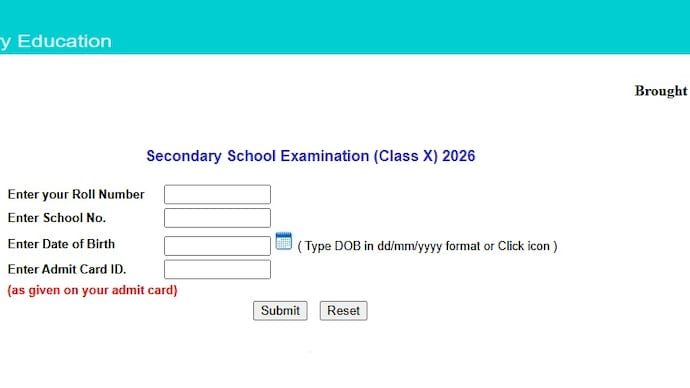
Students can check their result on official websites by following these steps:
- Visit cbse.gov.in or results.cbse.nic.in
- Click on the Class 10 result 2026 link
- Enter your roll number, date of birth, school number, and admit card ID
- Click on submit
- Your result will appear on the screen
- Download or print a copy for reference
Earlier, DigiLocker had issued a notification advising students to create accounts in advance to ensure smooth access to marksheets.
As per the system, students with an APAAR ID linked to CBSE can directly view their documents in the ‘Issued Documents’ section, while others can access their results using standard login credentials.
Beyond the top performers, regions such as Delhi East (97.33%), Delhi West (97.45%), Pune (96.66%), Ajmer (94.78%), and Bhubaneswar (94.67%) also recorded strong results, though they remain below the top tier.
At the lower end, Patna (89.34%), Prayagraj (89.00%), Noida (87.06%), and Guwahati (83.32%) reported comparatively lower pass percentages. This creates a gap of more than 16 percentage points between the highest and lowest performing regions, pointing to uneven academic outcomes across the country.
The data also highlights performance beyond India. CBSE-affiliated foreign schools recorded a pass percentage of 98.57%, significantly higher than the national average of 93.70%, indicating strong outcomes in international centres.
Gender-wise, girls continued to outperform boys, with a pass percentage of 94.90% compared to 92.69% for boys, maintaining a consistent trend seen in previous years.
Institution-wise data reveals another important pattern. Jawahar Navodaya Vidyalayas (99.49%) and Kendriya Vidyalayas (99.29%) recorded the highest success rates, followed by independent schools at 97.94%. In comparison, government schools (91.41%) and government-aided schools (91.01%) lagged behind, showing a clear performance gap based on school type.
The scale of the examination also stands out. CBSE conducted the Class 10 exams across 27,339 schools and 8,075 centres, evaluating over 1.63 crore answer sheets. On a single day, exams were held for nearly 24.95 lakh students, reflecting the size and complexity of the operation.
Notably, the board completed the exam cycle in 23 days this year, compared to 34 days last year, which helped enable the early April result declaration.
Overall, the data suggests three key trends, consistent high pass rates, strong regional disparities, and clear differences across school types. The 2026 result is not just an outcome but a reflection of broader patterns within the school education system.
This year, a total of 25,08,319 students appeared for the Class 10 examination, including 14,08,546 boys and 10,99,773 girls, across 83 subjects and 8,075 centres.
The exams were conducted from February 17 to March 11 in a single shift starting at 10:30 am.
CBSE has followed a revised academic structure this year, allowing it to complete evaluation earlier than usual.
The result is part of a broader plan to introduce flexibility, including a second examination phase scheduled between May 15 and June 1, 2026, where students can improve their performance in up to three subjects.
The Phase 1 result holds importance as it determines eligibility for these improvement exams, giving students a structured opportunity to enhance their scores within the same academic cycle.
Meanwhile, Class 12 results are expected to be announced at a later date.
...Read More