If Wishes Could Kill review: A teen thriller that keeps you on edge
If Wishes Could Kill follows school students who become entangled with a wish-granting app that comes with deadly consequences. The series stands out for blending digital-age horror with Korean shamanic themes of balance, rituals and consequences.
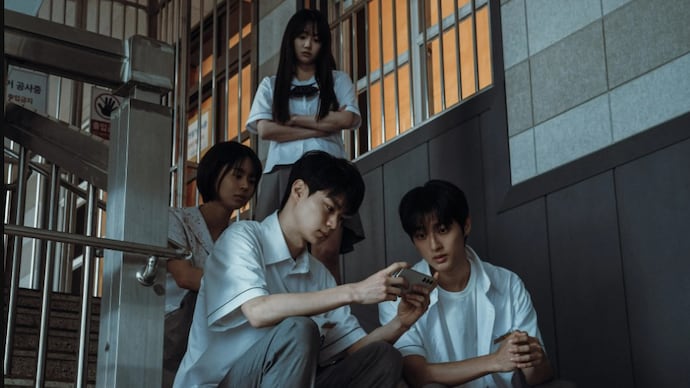
Netflix’s If Wishes Could Kill, directed by Park Youn-Seo (who also co-directed Moving) enters the crowded teen horror space with a premise that feels instantly familiar. A group of high-school students and a mysterious wish-granting app that comes with a price.
Yet, across its eight episodes, the series gradually reveals a more layered narrative, one that merges digital-age anxieties with deeper cultural undertones rooted in belief systems and consequence.
Set in a high school environment, the story follows Yoo Se-ah, Lim Na-ri, Kim Geon-woo, Kang Ha-joon and Choi Hyeong-wook, whose lives intersect through the discovery of the Girigo [also the Korean title of the show] app. The app is designed to grant wishes, almost like a genie.
However, it isn’t all simple. Each wish granted comes at a fatal price. What begins as a seemingly harmless experiment quickly escalates into an irreversible cycle of fear, suspicion and fatal outcomes, leaving the group with no choice but to tackle the curse at play.
The series is anchored by a young ensemble led by Jeon So-young as Se-ah, a track athlete who finds herself at the centre of this mystery and fatal curse. Kang Mi-na plays Na-ri, whose impulsive decisions act as key turning points in the narrative, while Baek Sun-ho’s Geon-woo provides a more grounded counterpoint.
Hyun Woo-seok is the analytical Ha-joon and Lee Hyo-je as Hyeong-wook, whose initial interaction with the app sets the story in motion.
Supporting them is Jeon So-nee, who plays a shaman figure, introducing a parallel thread that connects the app’s origins to ritualistic practices, alongside Roh Jae-won. It is this intersection, between the technological and the spiritual, that gives If Wishes Could Kill its distinct tonal identity.
The Girigo app, despite its modern interface, behaves less like software and more like a conduit for something older. The show subtly draws from Korean shamanism, with ideas of ritual, balance and consequence embedded well into its narrative. Wishes operate like offerings, and outcomes resemble a form of cosmic exchange, where every gain is offset by loss. Like they say nothing comes free.
The early episodes rely heavily on atmosphere. The tension is built through silence, anticipation and the slow unraveling of cause and effect rather than overt spectacle. There is a restraint in how the horror is staged in the show, focusing on familiar spaces, classrooms, corridors, even phone screens that turn into sites of unease. This lends the series a nostalgic quality, that echoes of older horror formats where the fear lies in what might happen rather than what is immediately visible.
Structurally, the show maintains a steady pace in its first half and while the mid-act seems stretched, it hardly gets dull. Each episode expands the mythology of the app even as the focus remains on interpersonal dynamics within the group.
However, as the story progresses, the scale of its premise begins to outpace its internal logic. The series hints at a much larger network of users beyond the central group, yet, the consequences remain largely confined to a handful of characters. This selective focus seems deliberate but also a bit illogical if you consider it broadly.
However, given the genre and the complexities, these questions won’t interfere with you binge-watching the series. Because the screenplay makes it up by building enough tension to stop you from wavering.
Certain plot threads, especially those tied to the origins of the curse, offer glimpses of a wider mythology but are not always explored with consistent clarity.
Meanwhile, the performances act as an emotional anchor to the series. The characters portray the volatility of adolescence, where one oscillates between rationality and impulse.
The finale of the series aligns with the show’s broader theme. Instead of resolving its conflict neatly, the post credit reinforces the idea that systems built on desire and exchange are difficult to dismantle. The ending underscores a recurring motif: that the act of wishing, in itself, carries consequences that extend beyond immediate intent.
If Wishes Could Kill merges contemporary digital anxieties with older belief systems, and the result is a series that remains engaging and atmospheric, even as it grapples with the complexities of its own premise.
If Wishes Could Kill is now streaming on Netflix.
Netflix’s If Wishes Could Kill, directed by Park Youn-Seo (who also co-directed Moving) enters the crowded teen horror space with a premise that feels instantly familiar. A group of high-school students and a mysterious wish-granting app that comes with a price.
Yet, across its eight episodes, the series gradually reveals a more layered narrative, one that merges digital-age anxieties with deeper cultural undertones rooted in belief systems and consequence.
Set in a high school environment, the story follows Yoo Se-ah, Lim Na-ri, Kim Geon-woo, Kang Ha-joon and Choi Hyeong-wook, whose lives intersect through the discovery of the Girigo [also the Korean title of the show] app. The app is designed to grant wishes, almost like a genie.
However, it isn’t all simple. Each wish granted comes at a fatal price. What begins as a seemingly harmless experiment quickly escalates into an irreversible cycle of fear, suspicion and fatal outcomes, leaving the group with no choice but to tackle the curse at play.
The series is anchored by a young ensemble led by Jeon So-young as Se-ah, a track athlete who finds herself at the centre of this mystery and fatal curse. Kang Mi-na plays Na-ri, whose impulsive decisions act as key turning points in the narrative, while Baek Sun-ho’s Geon-woo provides a more grounded counterpoint.
Hyun Woo-seok is the analytical Ha-joon and Lee Hyo-je as Hyeong-wook, whose initial interaction with the app sets the story in motion.
Supporting them is Jeon So-nee, who plays a shaman figure, introducing a parallel thread that connects the app’s origins to ritualistic practices, alongside Roh Jae-won. It is this intersection, between the technological and the spiritual, that gives If Wishes Could Kill its distinct tonal identity.
The Girigo app, despite its modern interface, behaves less like software and more like a conduit for something older. The show subtly draws from Korean shamanism, with ideas of ritual, balance and consequence embedded well into its narrative. Wishes operate like offerings, and outcomes resemble a form of cosmic exchange, where every gain is offset by loss. Like they say nothing comes free.
The early episodes rely heavily on atmosphere. The tension is built through silence, anticipation and the slow unraveling of cause and effect rather than overt spectacle. There is a restraint in how the horror is staged in the show, focusing on familiar spaces, classrooms, corridors, even phone screens that turn into sites of unease. This lends the series a nostalgic quality, that echoes of older horror formats where the fear lies in what might happen rather than what is immediately visible.
Structurally, the show maintains a steady pace in its first half and while the mid-act seems stretched, it hardly gets dull. Each episode expands the mythology of the app even as the focus remains on interpersonal dynamics within the group.
However, as the story progresses, the scale of its premise begins to outpace its internal logic. The series hints at a much larger network of users beyond the central group, yet, the consequences remain largely confined to a handful of characters. This selective focus seems deliberate but also a bit illogical if you consider it broadly.
However, given the genre and the complexities, these questions won’t interfere with you binge-watching the series. Because the screenplay makes it up by building enough tension to stop you from wavering.
Certain plot threads, especially those tied to the origins of the curse, offer glimpses of a wider mythology but are not always explored with consistent clarity.
Meanwhile, the performances act as an emotional anchor to the series. The characters portray the volatility of adolescence, where one oscillates between rationality and impulse.
The finale of the series aligns with the show’s broader theme. Instead of resolving its conflict neatly, the post credit reinforces the idea that systems built on desire and exchange are difficult to dismantle. The ending underscores a recurring motif: that the act of wishing, in itself, carries consequences that extend beyond immediate intent.
If Wishes Could Kill merges contemporary digital anxieties with older belief systems, and the result is a series that remains engaging and atmospheric, even as it grapples with the complexities of its own premise.
If Wishes Could Kill is now streaming on Netflix.

