Nukkad Natak review: Indie film on activism has the intent but lacks consistency
Nukkad Natak is a sincere, passion-driven film that captures the struggles of young outsiders through street theatre. While it occasionally struggles to balance its message with storytelling, its raw honesty and relatable characters make it an engaging watch.
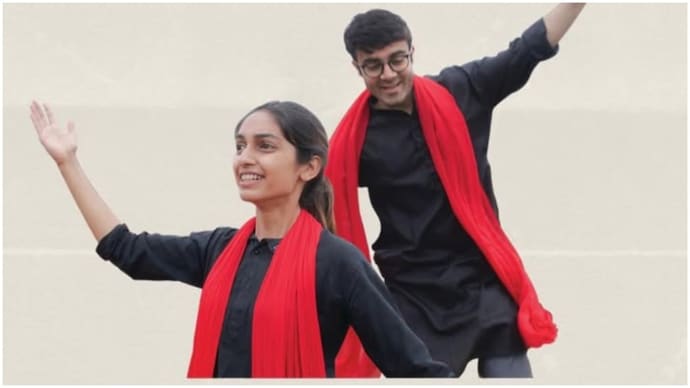
There’s something oddly personal about watching Nukkad Natak on Netflix, because this isn’t just a film made for festivals or theatres; it is the fruit of perseverance, hard work, passion and love for cinema.
Backed by crowdfunding, pushed through sheer hustle, promoted on social media, and fronted by a team of young outsiders – the film carries that underdog energy into every frame. Even the title of the production house, 'How To Enter Bollywood,' comes across less as a cheeky joke and more as a quiet, self-aware nod to where they’re coming from.
The story by Tanmaya Shekhar (also the director, co-producer) follows Shivang, an introverted engineering student who writes letters to his grandfather, using them as a way to document his college life, his identity, and friendship with Molshri – the fiery, instinct-driven theatre enthusiast who heads a nukkad natak group.
Shivang is still coming to terms with his sexuality, often finding comfort in anonymous online spaces, while Molshri is convinced she can change the world, even if it means crossing a few lines.
Their bond, built through street theatre, is what anchors the film. But things take a turn when a well-meaning act lands them in trouble, leading to their expulsion. Their way back is oddly simple on paper and complicated in reality: get five underprivileged children admitted to a school. And this is where the film finds its new ground.
As the two step outside their campus bubble to engage with real people with real problems, the narrative begins to ask questions that hit you at the right spot. What does education mean to families who depend on their children’s daily income? Can survival take precedence over schooling? Do these children even have the documents to enter a system which we feel is our birthright? The on-ground conversations – messy, uncomfortable, and often unresolved – are easily the most compelling parts of the film.
What also works is the film’s awareness of its own characters. Shivang and Molshri aren’t saviours; they’re young, slightly naive individuals whose understanding of social realities comes largely from what they have consumed online. A brief moment where they admit to researching a play on child labour on the internet quietly lands, because it reflects a larger truth about our youth and their understanding of social issues. Their activism, at least initially, feels slightly performative, driven more by intent than by optics.
The film also leans into familiar territory a little too often and a little too soon. There’s a visible attempt to evoke emotion through poverty and marginalisation – a trope Hindi cinema frequently relies on.
While these realities are important, the way they’re framed here sometimes feels designed to move you rather than emerging organically. The LGBTQIA+ track, too, while relevant, doesn’t always blend seamlessly into the narrative. Shivang’s journey has moments of honesty, but it also feels like the film is consciously trying to include it as part of a larger message.
And that’s where Nukkad Natak falters slightly. Because when storytelling becomes overly aware of what it wants to say, it risks losing the natural impact it could have had. The film tries to address multiple themes at once, and in doing so, the narrative occasionally feels scattered.
That said, there’s a different kind of honesty that keeps you invested. The film feels like it’s growing along with its characters. Molshri’s arc finds grounding in her interactions with a young girl, where her idea of “changing the world” becomes more personal and tangible, while Shivang’s journey remains quieter but adds emotional depth.
The team, in a sweet note, names its lead characters by their real names (the last time I remember this was Karisma-Raveena in Andaz Apna Apna). The performances are sincere and unpolished in a way that works for the film. Molshri leans a bit into excess at times, but her conviction holds, while Shivang’s restraint balances the tone. The climax, though predictable, circles back effectively to the idea of nukkad natak as a medium of change.
In many ways, the film mirrors the street plays it celebrates: earnest, slightly chaotic, and driven by purpose. It doesn’t always strike the right balance between message and storytelling, but it never lets you disengage.
And maybe that’s its biggest win. More importantly, it stands as a reminder for young actors and filmmakers who spend years waiting for a break. Pick up that pen, write, shoot, act, and you never know, your film might travel to nearly 200 countries through global platforms.
There’s something oddly personal about watching Nukkad Natak on Netflix, because this isn’t just a film made for festivals or theatres; it is the fruit of perseverance, hard work, passion and love for cinema.
Backed by crowdfunding, pushed through sheer hustle, promoted on social media, and fronted by a team of young outsiders – the film carries that underdog energy into every frame. Even the title of the production house, 'How To Enter Bollywood,' comes across less as a cheeky joke and more as a quiet, self-aware nod to where they’re coming from.
The story by Tanmaya Shekhar (also the director, co-producer) follows Shivang, an introverted engineering student who writes letters to his grandfather, using them as a way to document his college life, his identity, and friendship with Molshri – the fiery, instinct-driven theatre enthusiast who heads a nukkad natak group.
Shivang is still coming to terms with his sexuality, often finding comfort in anonymous online spaces, while Molshri is convinced she can change the world, even if it means crossing a few lines.
Their bond, built through street theatre, is what anchors the film. But things take a turn when a well-meaning act lands them in trouble, leading to their expulsion. Their way back is oddly simple on paper and complicated in reality: get five underprivileged children admitted to a school. And this is where the film finds its new ground.
As the two step outside their campus bubble to engage with real people with real problems, the narrative begins to ask questions that hit you at the right spot. What does education mean to families who depend on their children’s daily income? Can survival take precedence over schooling? Do these children even have the documents to enter a system which we feel is our birthright? The on-ground conversations – messy, uncomfortable, and often unresolved – are easily the most compelling parts of the film.
What also works is the film’s awareness of its own characters. Shivang and Molshri aren’t saviours; they’re young, slightly naive individuals whose understanding of social realities comes largely from what they have consumed online. A brief moment where they admit to researching a play on child labour on the internet quietly lands, because it reflects a larger truth about our youth and their understanding of social issues. Their activism, at least initially, feels slightly performative, driven more by intent than by optics.
The film also leans into familiar territory a little too often and a little too soon. There’s a visible attempt to evoke emotion through poverty and marginalisation – a trope Hindi cinema frequently relies on.
While these realities are important, the way they’re framed here sometimes feels designed to move you rather than emerging organically. The LGBTQIA+ track, too, while relevant, doesn’t always blend seamlessly into the narrative. Shivang’s journey has moments of honesty, but it also feels like the film is consciously trying to include it as part of a larger message.
And that’s where Nukkad Natak falters slightly. Because when storytelling becomes overly aware of what it wants to say, it risks losing the natural impact it could have had. The film tries to address multiple themes at once, and in doing so, the narrative occasionally feels scattered.
That said, there’s a different kind of honesty that keeps you invested. The film feels like it’s growing along with its characters. Molshri’s arc finds grounding in her interactions with a young girl, where her idea of “changing the world” becomes more personal and tangible, while Shivang’s journey remains quieter but adds emotional depth.
The team, in a sweet note, names its lead characters by their real names (the last time I remember this was Karisma-Raveena in Andaz Apna Apna). The performances are sincere and unpolished in a way that works for the film. Molshri leans a bit into excess at times, but her conviction holds, while Shivang’s restraint balances the tone. The climax, though predictable, circles back effectively to the idea of nukkad natak as a medium of change.
In many ways, the film mirrors the street plays it celebrates: earnest, slightly chaotic, and driven by purpose. It doesn’t always strike the right balance between message and storytelling, but it never lets you disengage.
And maybe that’s its biggest win. More importantly, it stands as a reminder for young actors and filmmakers who spend years waiting for a break. Pick up that pen, write, shoot, act, and you never know, your film might travel to nearly 200 countries through global platforms.

