How a wrong turn gave Bombay, not capital Calcutta, India's first passenger train
The Indian Railways network, which marked its 173rd anniversary on Thursday, started with a 33-km Bombay-Thane line. Calcutta, the British Raj's capital, would have got India's first passenger train, but everything changed after a wrong turn by a ship and a shipwreck.
"No one can safely say whether railways in this country will earn or not," said Governor-General of British India Lord Dalhousie in 1848. That was the administrator's cautious pitch as the Victorian Raj was looking to extract the most from its colony. Dalhousie could hardly have imagined what would follow. Today, Indian Railways is profitable. It's indispensable. The alomst-70,000 kilometre network is hauling millions of tonnes of freight and carrying millions of passengers daily. It's a lifeline for the 98% of Indians who could never take a flight in their lives. And it all started, exactly 173 years ago.
On Thursday, the Indian Railways marked its 173rd anniversary. It was on April 16, 1853, that the first passenger train rolled between Bombay's Bori Bunder and Thane. A 33-km journey took about 75 minutes, with 400 passengers. But ever wondered why it was Bombay (now Mumbai)? Logic would suggest the capital of the British Raj, Calcutta (now Kolkata), should have been the first.
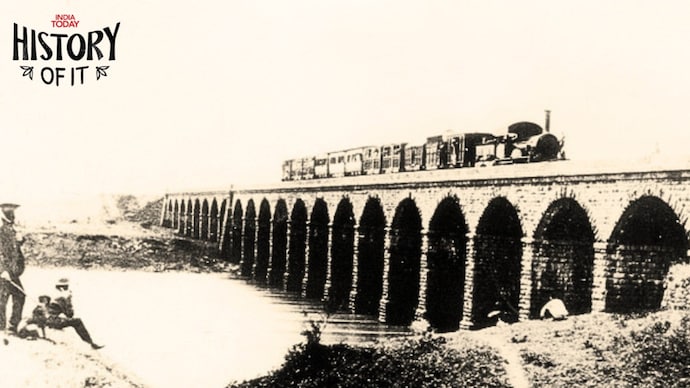
Union Railway Minister Ashwini Vaishnav on Thursday shared a collage, with a vintage steam locomotive chugging across a brick-and-mortar bridge, and below, was a modern Amrit Bharat train. "Journey continues..." Vaishnav's image caption said.
Although the vintage image Vaishnav shared was not from the first run of the Indian Railways from Bombay, and was not even from the Bombay's Bori Bunder-Thane route, it was enough to visually remind where the journey of Indian Railways began.
So, why did the capital of the British Empire in India, Calcutta, the nerve centre of administration, trade, and military operations of the Raj, not get the first passenger train? But history, and some ships carrying the locomotive and a few coaches for Calcutta, had other plans. Bombay won the race. Calcutta saw a passenger train run from Howrah to nearby Hooghly on August 15, 1854, a year after the Bombay-Thane record.
Calcutta lost the race to Bombay because of a string of mishaps and delays. A ship carrying the locomotive from Britain took a wrong turn and ended up in Australia. Another ship carrying carriages sank at the Sandheads near the Hooghly's tricky and notorious sandbanks, long feared by sailors, which featured in Rudyard Kipling's The City of Dreadful Night. Bureaucratic hurdles like permissions in French-controlled Chandernagore, and some local resistance, made Bombay race ahead to claim India's first train, according to Mumbai-based author, journalist and a fellow rail enthusiast, Rajendra B Aklekar.
To understand what happened and how, let's go back to where it all began.
WHY BRITISH WANTED RAILWAYS IN INDIA. WHAT WAS THE NECESSITY?
Railways in India were not born out of the British Raj's sense of the welfare of the land and its people. It was an imperial necessity.
Railway administrator-historian GS Khosla in his book, A History of Indian Railways, noted that railways became central to "economic progress, defence of borders, development of agriculture and industry, and integration of people". For the British, the railways were important for the deployment of troops quickly, transporting raw materials like cotton and coal to ports, and sustaining trade networks.
For context, it was seen as a means of a major upgrade from the "unreliable transport network, ie, chiefly bullock carts", highlighted by Rajendra B Aklekar in his book, A Short History of Indian Railways.
Early proposals for railways in India emerged in the 1830s. The industrial demand, especially for cotton exports, drove them. The idea of connecting the hinterland to ports. But executing the idea and the proposals in a vast, unfamiliar terrain was anything but simple for the British planners and engineers.
The concept of railway companies soon took shape, even as some small rail lines to carry construction materials and minerals had been operational in the Madras Presidency by the early 1850s. But, the Great Indian Peninsula Railway (GIPR) in the west and the East India Railway (EIR) in the east would spearhead the effort of getting the first proper, mixed-used and sustainable railway line in the Subcontinent.
The world's first public railway line between Stockton and Darlington in central England (close to the North Sea) had opened in 1825. Now it was time to get something like that in its biggest colony, British India.
RAILWAYS FOR CALCUTTA WAS FIRST ON THE PAPER
Calcutta was ahead in imagination, if not execution, of having a railway line.
In a piece called, Two Men and a Railway Line on India Railways Fan Club Association (IRFCA), author and rail historian, Anuradha Kumar recounted, plans for a railway from Calcutta were articulated as early as the 1840s by merchant prince Dwarkanath Tagore (grandfather of Nobel laureate Rabindranath Tagore) and engineer Rowland Macdonald Stephenson. They envisioned a network connecting eastern India's commercial hub and the coal fields at Raniganj.
Calcutta was then the epicentre of the East India Company's operations and was linked to global trade networks stretching from Canton in the East to London in the West.
The East India Railway Company (EIR) was formed in 1845, years before serious railway work began in Bombay. But railway progress in western India soon caught up.
In the west, the Great Indian Peninsula Railway (GIPR) was incorporated in 1849. Work began in earnest by 1850, with the foundation stone being laid at Sion in Bombay.
Construction progressed fast. By 1852, the line between Thane and Bombay was ready. Trial runs were conducted, and locals, awestruck by the steam engine, called it "lokhandi rakshas", the iron demon, noted Aklekar in his book, A Short History of Indian Railways.
While Bombay was catching up fast, railway progress in Calcutta was stuck.
HOW SHIPWRECK AT DIAMOND HARBOUR, A WRONG TURN CAUSED DELAY ON CALCUTTA'S RAILWAY PLANS
If Bombay's railway story was one of steady progress, Calcutta's was one of relentless setbacks. First came administrative complications. Approval for the proposed railway line, which was to pass through the French colony of Chandernagore (north of Kolkata), was time-consuming. Then came the fear of wildlife.
Tigers roamed some desolate stretches of the tracks. Elephants, meanwhile, would uproot telegraph poles, forcing engineers to fit iron spikes around them as protection, noted railway administrator-historian, GS Khosla in his book, A History of Indian Railways.
Khosla noted that horse allowances for engineers and inspectors were recommended to be increased from Rs 30 to Rs 105.
Then came the disasters.
A ship carrying railway carriages for the railway line being laid from Calcutta to Hoogly and beyond, sank at the Sandheads near Diamond Harbour. The treacherous sandbanks at the mouth of the Hooghly river were only for the efficient sailors to navigate.
"The ship HMS Goodwin, which was carrying the first railway carriages for the EIR, sank at Sandheads near Diamond Harbour, at the mouth of the Hooghly. Sandheads has been documented as a very dangerous area and only an expert sailor could navigate it safely. This left the railways without carriages, and since the arrival of another set would take weeks, they were made locally," wrote Aklekar in his book, A Short History of Indian Railways.
But the most bizarre twist was yet to come.
"...The locomotives or engines arriving for the EIR also met a somewhat similar fate... The ship carrying the locomotives went to the continent of Australia instead of reaching India. Finally, the locomotive reached Calcutta via Australia by HMS Dekagree in 1854, but by then, it was too late to compete with Bombay," Aklekar added.
"The first passenger train had been run in Bombay a year earlier and the EIR had missed making history!" wrote Aklekar, adding that it was a combination of such mishaps — "sinking ships, delayed equipment, and sheer bad luck" — that stalled Calcutta's progress and handed Bombay the passenger rail advantage.
INDIA'S FIRST PASSENGER TRAIN JOURNEY RECEIVED 21-GUN SALUTE
The first passenger train in eastern India finally ran from Howrah to Hooghly (38 km) on August 15, 1854, over a year later. The line was soon extended to Pundooah (Chinsurah subdivision of the Hooghly district), then to Raniganj (located in the Asansol and Durgapur subdivisions of Paschim Bardhaman district), connecting port city Calcutta to the crucial coal mines on the fringes of Chotanagpur.
Meanwhile, India's first passenger train from Bombay's Bori Bunder to Thane chugged on April 16, 1853. It was a moment of spectacle and was marked by a 21-gun salute.
The Indian Railways began as a 33 km experiment and has grown into one of the largest railway networks in the world. And today it spans over 68,000 km, connecting nearly every corner of the country. Recently the network reached Aizawl, which became the fourth Northeast capital to be connected to India's rail network, after Guwahati, Itanagar, and Agartala.
In the end, it didn't really matter whether Bombay or Calcutta got there first. What mattered was that the railway network took root and helped in running India's transformation engine. But the twist of fate is interesting. Trains in India now crisscross the country and Lord Dalhousie's doubt about whether the railways would be profitable seems almost quaint. The Indian Railways did much more than just make profits. It built the nation and is still doing so.
"No one can safely say whether railways in this country will earn or not," said Governor-General of British India Lord Dalhousie in 1848. That was the administrator's cautious pitch as the Victorian Raj was looking to extract the most from its colony. Dalhousie could hardly have imagined what would follow. Today, Indian Railways is profitable. It's indispensable. The alomst-70,000 kilometre network is hauling millions of tonnes of freight and carrying millions of passengers daily. It's a lifeline for the 98% of Indians who could never take a flight in their lives. And it all started, exactly 173 years ago.
On Thursday, the Indian Railways marked its 173rd anniversary. It was on April 16, 1853, that the first passenger train rolled between Bombay's Bori Bunder and Thane. A 33-km journey took about 75 minutes, with 400 passengers. But ever wondered why it was Bombay (now Mumbai)? Logic would suggest the capital of the British Raj, Calcutta (now Kolkata), should have been the first.
Union Railway Minister Ashwini Vaishnav on Thursday shared a collage, with a vintage steam locomotive chugging across a brick-and-mortar bridge, and below, was a modern Amrit Bharat train. "Journey continues..." Vaishnav's image caption said.
Although the vintage image Vaishnav shared was not from the first run of the Indian Railways from Bombay, and was not even from the Bombay's Bori Bunder-Thane route, it was enough to visually remind where the journey of Indian Railways began.
So, why did the capital of the British Empire in India, Calcutta, the nerve centre of administration, trade, and military operations of the Raj, not get the first passenger train? But history, and some ships carrying the locomotive and a few coaches for Calcutta, had other plans. Bombay won the race. Calcutta saw a passenger train run from Howrah to nearby Hooghly on August 15, 1854, a year after the Bombay-Thane record.
Calcutta lost the race to Bombay because of a string of mishaps and delays. A ship carrying the locomotive from Britain took a wrong turn and ended up in Australia. Another ship carrying carriages sank at the Sandheads near the Hooghly's tricky and notorious sandbanks, long feared by sailors, which featured in Rudyard Kipling's The City of Dreadful Night. Bureaucratic hurdles like permissions in French-controlled Chandernagore, and some local resistance, made Bombay race ahead to claim India's first train, according to Mumbai-based author, journalist and a fellow rail enthusiast, Rajendra B Aklekar.
To understand what happened and how, let's go back to where it all began.
WHY BRITISH WANTED RAILWAYS IN INDIA. WHAT WAS THE NECESSITY?
Railways in India were not born out of the British Raj's sense of the welfare of the land and its people. It was an imperial necessity.
Railway administrator-historian GS Khosla in his book, A History of Indian Railways, noted that railways became central to "economic progress, defence of borders, development of agriculture and industry, and integration of people". For the British, the railways were important for the deployment of troops quickly, transporting raw materials like cotton and coal to ports, and sustaining trade networks.
For context, it was seen as a means of a major upgrade from the "unreliable transport network, ie, chiefly bullock carts", highlighted by Rajendra B Aklekar in his book, A Short History of Indian Railways.
Early proposals for railways in India emerged in the 1830s. The industrial demand, especially for cotton exports, drove them. The idea of connecting the hinterland to ports. But executing the idea and the proposals in a vast, unfamiliar terrain was anything but simple for the British planners and engineers.
The concept of railway companies soon took shape, even as some small rail lines to carry construction materials and minerals had been operational in the Madras Presidency by the early 1850s. But, the Great Indian Peninsula Railway (GIPR) in the west and the East India Railway (EIR) in the east would spearhead the effort of getting the first proper, mixed-used and sustainable railway line in the Subcontinent.
The world's first public railway line between Stockton and Darlington in central England (close to the North Sea) had opened in 1825. Now it was time to get something like that in its biggest colony, British India.
RAILWAYS FOR CALCUTTA WAS FIRST ON THE PAPER
Calcutta was ahead in imagination, if not execution, of having a railway line.
In a piece called, Two Men and a Railway Line on India Railways Fan Club Association (IRFCA), author and rail historian, Anuradha Kumar recounted, plans for a railway from Calcutta were articulated as early as the 1840s by merchant prince Dwarkanath Tagore (grandfather of Nobel laureate Rabindranath Tagore) and engineer Rowland Macdonald Stephenson. They envisioned a network connecting eastern India's commercial hub and the coal fields at Raniganj.
Calcutta was then the epicentre of the East India Company's operations and was linked to global trade networks stretching from Canton in the East to London in the West.
The East India Railway Company (EIR) was formed in 1845, years before serious railway work began in Bombay. But railway progress in western India soon caught up.
In the west, the Great Indian Peninsula Railway (GIPR) was incorporated in 1849. Work began in earnest by 1850, with the foundation stone being laid at Sion in Bombay.
Construction progressed fast. By 1852, the line between Thane and Bombay was ready. Trial runs were conducted, and locals, awestruck by the steam engine, called it "lokhandi rakshas", the iron demon, noted Aklekar in his book, A Short History of Indian Railways.
While Bombay was catching up fast, railway progress in Calcutta was stuck.
HOW SHIPWRECK AT DIAMOND HARBOUR, A WRONG TURN CAUSED DELAY ON CALCUTTA'S RAILWAY PLANS
If Bombay's railway story was one of steady progress, Calcutta's was one of relentless setbacks. First came administrative complications. Approval for the proposed railway line, which was to pass through the French colony of Chandernagore (north of Kolkata), was time-consuming. Then came the fear of wildlife.
Tigers roamed some desolate stretches of the tracks. Elephants, meanwhile, would uproot telegraph poles, forcing engineers to fit iron spikes around them as protection, noted railway administrator-historian, GS Khosla in his book, A History of Indian Railways.
Khosla noted that horse allowances for engineers and inspectors were recommended to be increased from Rs 30 to Rs 105.
Then came the disasters.
A ship carrying railway carriages for the railway line being laid from Calcutta to Hoogly and beyond, sank at the Sandheads near Diamond Harbour. The treacherous sandbanks at the mouth of the Hooghly river were only for the efficient sailors to navigate.
"The ship HMS Goodwin, which was carrying the first railway carriages for the EIR, sank at Sandheads near Diamond Harbour, at the mouth of the Hooghly. Sandheads has been documented as a very dangerous area and only an expert sailor could navigate it safely. This left the railways without carriages, and since the arrival of another set would take weeks, they were made locally," wrote Aklekar in his book, A Short History of Indian Railways.
But the most bizarre twist was yet to come.
"...The locomotives or engines arriving for the EIR also met a somewhat similar fate... The ship carrying the locomotives went to the continent of Australia instead of reaching India. Finally, the locomotive reached Calcutta via Australia by HMS Dekagree in 1854, but by then, it was too late to compete with Bombay," Aklekar added.
"The first passenger train had been run in Bombay a year earlier and the EIR had missed making history!" wrote Aklekar, adding that it was a combination of such mishaps — "sinking ships, delayed equipment, and sheer bad luck" — that stalled Calcutta's progress and handed Bombay the passenger rail advantage.
INDIA'S FIRST PASSENGER TRAIN JOURNEY RECEIVED 21-GUN SALUTE
The first passenger train in eastern India finally ran from Howrah to Hooghly (38 km) on August 15, 1854, over a year later. The line was soon extended to Pundooah (Chinsurah subdivision of the Hooghly district), then to Raniganj (located in the Asansol and Durgapur subdivisions of Paschim Bardhaman district), connecting port city Calcutta to the crucial coal mines on the fringes of Chotanagpur.
Meanwhile, India's first passenger train from Bombay's Bori Bunder to Thane chugged on April 16, 1853. It was a moment of spectacle and was marked by a 21-gun salute.
The Indian Railways began as a 33 km experiment and has grown into one of the largest railway networks in the world. And today it spans over 68,000 km, connecting nearly every corner of the country. Recently the network reached Aizawl, which became the fourth Northeast capital to be connected to India's rail network, after Guwahati, Itanagar, and Agartala.
In the end, it didn't really matter whether Bombay or Calcutta got there first. What mattered was that the railway network took root and helped in running India's transformation engine. But the twist of fate is interesting. Trains in India now crisscross the country and Lord Dalhousie's doubt about whether the railways would be profitable seems almost quaint. The Indian Railways did much more than just make profits. It built the nation and is still doing so.

