India bites the Bullet: How B-28 will break new frontiers in high-speed rail
The Mumbai-Ahmedabad corridor has given Indian engineers the experience of laying bullet train systems. The indigenous B-28 trainset rids the ambition of foreign reliance
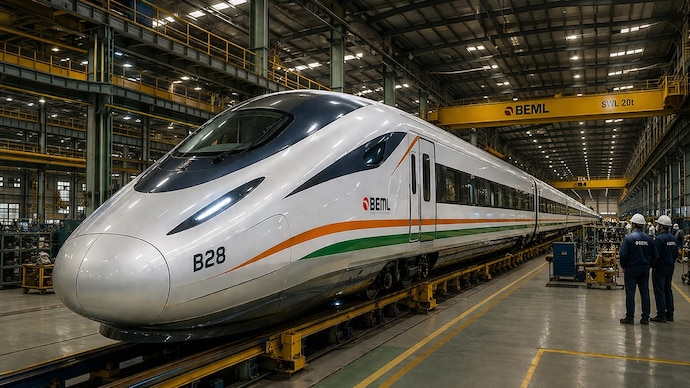
Last week, standing at a newly inaugurated plant in Bengaluru, railways minister Ashwini Vaishnaw sought to change that reality. He announced the B-28 trainset, a milestone in India’s high-speed-rail development and manufacturing meant to be achieved indigenously.
ENTER THE B-28
To be constructed by a joint venture of two government entities—Chennai’s Integral Coach Factory (which is providing design expertise) and Bengaluru-based defence public sector undertaking BEML (which will manufacture)—the B-28 is to be India’s first wholly-self-developed high-speed trainset, conceived under Atmanirbhar Bharat. For context, Vande Bharat trains, with top speeds of 180 kmph, are classified as ‘semi-high speed’.
The Rs 866.87 crore contract encompasses design, manufacturing and commissioning of two trainsets (eight coaches each). The aim is a top speed of 280 kmph, although the run will be limited to 249 kmph. In terms of performance, that places B-28 squarely in the same neighbourhood as some of the high-speed rail systems worldwide, yet far behind the fastest Shinkansen models that clock up to 350 kmph.
WHY ‘MADE IN INDIA’ MATTERS
The first advantage is cost, and then leverage. B-28 coaches are estimated at Rs 27.86 crore apiece. Similar Japanese Shinkansen coaches were estimated to cost Rs 46-48 crore each. That’s almost a 40 per cent gap per coach. So, think of the costs saved as India plans to build seven more corridors.
However, the significance extends beyond just the unit price. The concentrations of foreign technology and financing in India’s high-speed-rail programme have influenced and, at the same time, limited the route to Indian manufacturing scaling the gap in technology and implementation of precision engineering in rolling-stock production. Discussions with Japan for Shinkansen trains for the Mumbai-Ahmedabad bullet train corridor became complicated and dragged on for years due to escalation in costs and conditions attached to imported technology.
With B-28, India aims to retain all control on technology, supply chain and ultimately the speed of expansion. That way, what is being laid out is a template for a new industry in manufacturing.
BUILD WHERE AND HOW?
BEML’s Aditya Plant at the company’s Thippasandra campus in Bengaluru is built to handle the enormity of the project in more ways than one. The facility has been custom-built to manufacture high-speed rail, with robotic laser-welding systems specifically configured for the high-strength structural work that the near-250-kmph travel requires. At those velocities, tolerances permissible in a normal rolling stock are fatal.
The heavily automated and specialised nature of the plant allows for an annual production capacity of approximately 100 high-speed coaches. The plant will equip the B-28 with the complex internal systems required for high-speed rail. The facility constructs tightly sealed, pressurised coaches with advanced HVAC (heating, ventilation and air conditioning) and air filtration, shielding both passengers during rapid tunnel transitions and vital electronics from India’s extreme heat and dust.
Under the hood, the trains rely on an IGBT-based distributed traction system for quick acceleration and microprocessor-controlled brakes to handle high-velocity deceleration safely. To tie it all together, the plant integrates smart safety protocols directly into the build, ensuring that the trainsets are fully compatible with ETCS Level-2 signalling and meet stringent EN 45545 fire safety standards.
WHEN WILL IT ACTUALLY RUN?
Manufacturing is already underway. The official target to roll out the first completed prototype trainset is March 2027. The Surat-Vapi stretch of the Mumbai-Ahmedabad bullet train corridor—a distance of 97 km—is expected to be operational by August next year.
By all accounts, that is an ambitious schedule. Infrastructure projects in India have a long history of missing both deadlines and budget, and high-speed rail, with its demanding technical specifications, affords more room for delay.
WHAT’S IN IT FOR YOU?
The B-28 will operate in climate-controlled chair car mode only. The seats will recline and rotate. There will be specific arrangements for passengers with limited mobility and onboard infotainment systems, besides the usual bells and whistles.
Vaishnaw said the proposed Chennai-Bengaluru corridor could improve connectivity between the two cities to just 73 minutes. Economically, this would, in effect, join two of southern India’s largest centres into a de facto single metropolis. That corridor remains in plan.
This sheds light on why the B-28 is being treated as more than just a procurement choice. Owing to the Mumbai-Ahmedabad bullet train project, Indian engineering has already earned the requisite experience in civil engineering, manufacturing and laying of tracks. With B-28, the loop somewhat closes to make India completely self-reliant in creating its own bullet train corridors.
Subscribe to India Today Magazine

