Why Mahila-Muslim is the axis of power in battleground Bengal
The BJP recognises women are Mamata Banerjee's pillar of strength and has recalibrated its strategy. The Muslim vote presents an evolving challenge
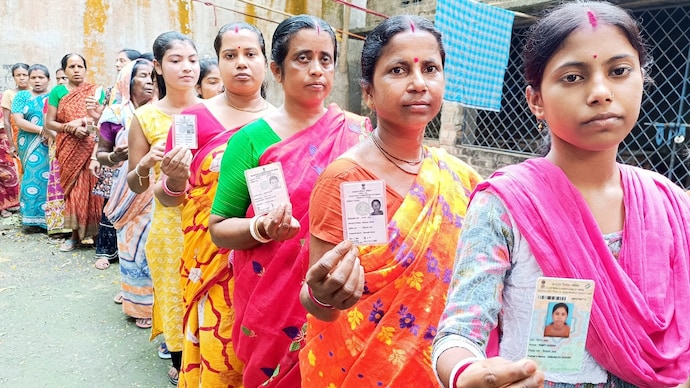
For chief minister and Trinamool Congress (TMC) supremo Mamata Banerjee, women have long formed the backbone of electoral success. Over the past decade, her government has built an extensive welfare architecture aimed specifically at women and offering them tangible benefits.
Perhaps the most prominent among these schemes is Lakshmir Bhandar, a cash transfer programme that is estimated to benefit over 20 million women. With an annual budget of Rs 26,700 crore and a total expenditure of Rs 74,000 crore since its inception in 2021, Lakshmir Bhandar is seen as having created a deep and direct connection between beneficiaries and Mamata.
This bounty for women is complemented by the Kanyashree scheme, which has supported nearly 10 million girls with financial assistance aimed at promoting education and discouraging early marriage. The disbursement so far: Rs 16,554 crore.
The Rupasree scheme, which provides Rs 25,000 to economically disadvantaged families for marriage of daughters, has benefited over 2.2 million, the total spending so far exceeding Rs 5,500 crore.
These initiatives have not only expanded the TMC government’s welfarism but also helped project Mamata as a leader attentive to women’s needs. It all fits well into her ‘Ma Maati Manush’ governance cry.
Electorally too, this has translated into advantage for the TMC. While precise figures remain contested, political analyst Biswanath Chakraborty, who teaches at Kolkata’s Rabindra Bharati University, suggests that in both the 2021 assembly elections and the 2024 Lok Sabha polls, women voted for the TMC at rates approximately four percentage points higher than men. This gender gap may have acted as a crucial cushion for the ruling party, especially in the hard-fought seats.
“Mamata Banerjee’s work speaks. What she has done for women speaks. There is no way anyone else can dent Bengal women’s support for her,” says Kakoli Ghosh Dastidar, Lok Sabha MP and chief of the TMC’s women’s wing.
The BJP recognises this advantage of Mamata and has attempted to recalibrate its strategy in this election. Throughout the campaign, the party announced a series of promises for Bengal’s women. These include a monthly cash allowance of Rs 3,000, financial assistance of Rs 21,000 and nutritional kits for pregnant women from marginalised backgrounds, and a one-time grant of Rs 50,000 for girls opting for higher education. The party has also pledged 33 per cent reservation for women in all state government jobs, including police.
Beyond welfare, the BJP has sought to foreground the issue of women’s safety and justice. A key symbolic marker was the candidature of the mother of the trainee doctor who was raped and murdered at Kolkata’s R.G. Kar Medical College and Hospital in 2024. She is contesting from the Panihati seat in North 24 Parganas.
Turning law and order into an election plank, Prime Minister Narendra Modi has repeatedly invoked cases of alleged atrocities against women in Bengal, framing them as evidence of the TMC government’s failure.
Mamata’s party has countered by pointing to crimes against women in BJP-ruled states. Mention has come of the rape cases in Unnao and Hathras in Uttar Pradesh as well as the ethnic violence in Manipur, in which women too became victims. Questioning the BJP’s moral positioning, TMC leaders such as Mahua Moitra have highlighted how her party has one of the highest proportions of women representatives in Parliament—38 per cent of its Lok Sabha MPs being women.
The debate over the women’s reservation bill, offering women 33 per cent reservation in Parliament and state assemblies, and its linkage with delimitation had briefly sharpened this contest. After the bill was defeated in Parliament last week, the BJP accused Opposition parties of being anti-woman.
“We are trying to tell women how anti-woman the TMC is. We are also getting forms registered for the Rs 3,000 financial assistance that we have promised women,” says Phalguni Patra, who heads the BJP’s Mahila Morch in Bengal.
The TMC has shot back that it supported women’s reservation but was opposed to its linkage with the census and delimitation processes. In the broader electoral context of Bengal, this issue remains only one among the many tools being used to influence a critical voter base.
If women represent a pillar of stability for the TMC, the Muslim vote presents a more complex and evolving challenge. Historically, the community has played a decisive role in Bengal elections. In 2021, the TMC swept 131 of the 146 seats where Muslims make up 25 per cent to 90 per cent of the population. This consolidation was driven by fears surrounding the Citizenship (Amendment) Act and the National Register of Citizens (NRC)—moves pitched by the TMC as discriminatory towards Muslims—as well as incidents like the death of four Muslims in firing by central paramilitary forces in Sitalkuchi assembly constituency in 2021.
These factors may have helped unite Muslims behind Mamata, but five years on, that cohesion appears to have weakened. Across districts such as Murshidabad, Malda, Uttar Dinajpur, Dakshin Dinajpur, North 24 Parganas and South 24 Parganas, signs of discontent among Muslim voters are evident.
The reasons are multiple. One of the most prominent ones is the state government’s eventual implementation of the Waqf amendment framework in 2025, which included directives to upload data on 82,000 waqf properties after months of resistance. For some, this shift was a departure from the TMC’s earlier positions.
There are also grievances linked to changes in the OBC classification system. Following a legal challenge and subsequent survey, several Muslim communities were reportedly moved from the more backward Category A to Category B, reducing their access to reservation benefits. At the same time, some Hindu communities were reclassified upward. Although officials indicate that the number of Muslim communities affected is smaller than the number of Hindu communities upgraded, the perception of constrained opportunity could contribute to Muslim dissatisfaction.
This unease could open up space for other political players. The Congress is attempting a revival in its traditional strongholds of Malda and Murshidabad, with leaders like Mausam Benazir Noor, who recently switched sides from the TMC, expressing optimism about regaining lost ground. The Indian Secular Front (ISF), led by Nawsad Siddique, is trying to expand its footprint by contesting multiple seats. Similar smaller formations, such as former TMC leader Humayun Kabir’s Aam Janata Unnayan Party, have also sought to tap into this sentiment.
“Mamata Banerjee should stop considering Muslims as her vote-bank. She has not done anything to elevate them socially or financially,” says Sahabuddin Siraji, a state committee member of the ISF.
At the grassroots, the disillusionment is visible. In Bhangar, represented by Siddique in the outing legislative assembly, wall graffiti urging the TMC to “go to Delhi and seek votes” reflects resentment over the party’s stance during protests against the Waqf bill.
Abdul Matin, assistant professor of political science at Jadavpur University, Kolkata, says such messaging carries a symbolic logic, signalling that voters expect their concerns to be addressed within the state rather than redirected elsewhere.
Despite this fragmentation, there remains a strong undercurrent of strategic voting. Many analysts believe that even if dissatisfaction persists, fears of a BJP victory could push Muslims to eventually consolidate behind the TMC. As Matin notes, the question for many is ultimately one of political survival, wherein division of votes could inadvertently benefit the BJP.
The TMC is attempting to contain fractures in its Muslim base while relying on its organisational strength to maintain voter outreach. At the same time, controversies such as the rise and subsequent containment of Kabir, indicate the party’s efforts to prevent further erosion of its supporters in the community.
In this complex landscape, the BJP, which has no Muslim candidate in the race, has announced to implement a uniform civil code in Bengal. This may well become an additional point of mobilisation, potentially allowing Mamata to consolidate those sections of the Muslim vote that appear uncertain or divided.
Subscribe to India Today Magazine
For chief minister and Trinamool Congress (TMC) supremo Mamata Banerjee, women have long formed the backbone of electoral success. Over the past decade, her government has built an extensive welfare architecture aimed specifically at women and offering them tangible benefits.
Perhaps the most prominent among these schemes is Lakshmir Bhandar, a cash transfer programme that is estimated to benefit over 20 million women. With an annual budget of Rs 26,700 crore and a total expenditure of Rs 74,000 crore since its inception in 2021, Lakshmir Bhandar is seen as having created a deep and direct connection between beneficiaries and Mamata.
This bounty for women is complemented by the Kanyashree scheme, which has supported nearly 10 million girls with financial assistance aimed at promoting education and discouraging early marriage. The disbursement so far: Rs 16,554 crore.
The Rupasree scheme, which provides Rs 25,000 to economically disadvantaged families for marriage of daughters, has benefited over 2.2 million, the total spending so far exceeding Rs 5,500 crore.
These initiatives have not only expanded the TMC government’s welfarism but also helped project Mamata as a leader attentive to women’s needs. It all fits well into her ‘Ma Maati Manush’ governance cry.
Electorally too, this has translated into advantage for the TMC. While precise figures remain contested, political analyst Biswanath Chakraborty, who teaches at Kolkata’s Rabindra Bharati University, suggests that in both the 2021 assembly elections and the 2024 Lok Sabha polls, women voted for the TMC at rates approximately four percentage points higher than men. This gender gap may have acted as a crucial cushion for the ruling party, especially in the hard-fought seats.
“Mamata Banerjee’s work speaks. What she has done for women speaks. There is no way anyone else can dent Bengal women’s support for her,” says Kakoli Ghosh Dastidar, Lok Sabha MP and chief of the TMC’s women’s wing.
The BJP recognises this advantage of Mamata and has attempted to recalibrate its strategy in this election. Throughout the campaign, the party announced a series of promises for Bengal’s women. These include a monthly cash allowance of Rs 3,000, financial assistance of Rs 21,000 and nutritional kits for pregnant women from marginalised backgrounds, and a one-time grant of Rs 50,000 for girls opting for higher education. The party has also pledged 33 per cent reservation for women in all state government jobs, including police.
Beyond welfare, the BJP has sought to foreground the issue of women’s safety and justice. A key symbolic marker was the candidature of the mother of the trainee doctor who was raped and murdered at Kolkata’s R.G. Kar Medical College and Hospital in 2024. She is contesting from the Panihati seat in North 24 Parganas.
Turning law and order into an election plank, Prime Minister Narendra Modi has repeatedly invoked cases of alleged atrocities against women in Bengal, framing them as evidence of the TMC government’s failure.
Mamata’s party has countered by pointing to crimes against women in BJP-ruled states. Mention has come of the rape cases in Unnao and Hathras in Uttar Pradesh as well as the ethnic violence in Manipur, in which women too became victims. Questioning the BJP’s moral positioning, TMC leaders such as Mahua Moitra have highlighted how her party has one of the highest proportions of women representatives in Parliament—38 per cent of its Lok Sabha MPs being women.
The debate over the women’s reservation bill, offering women 33 per cent reservation in Parliament and state assemblies, and its linkage with delimitation had briefly sharpened this contest. After the bill was defeated in Parliament last week, the BJP accused Opposition parties of being anti-woman.
“We are trying to tell women how anti-woman the TMC is. We are also getting forms registered for the Rs 3,000 financial assistance that we have promised women,” says Phalguni Patra, who heads the BJP’s Mahila Morch in Bengal.
The TMC has shot back that it supported women’s reservation but was opposed to its linkage with the census and delimitation processes. In the broader electoral context of Bengal, this issue remains only one among the many tools being used to influence a critical voter base.
If women represent a pillar of stability for the TMC, the Muslim vote presents a more complex and evolving challenge. Historically, the community has played a decisive role in Bengal elections. In 2021, the TMC swept 131 of the 146 seats where Muslims make up 25 per cent to 90 per cent of the population. This consolidation was driven by fears surrounding the Citizenship (Amendment) Act and the National Register of Citizens (NRC)—moves pitched by the TMC as discriminatory towards Muslims—as well as incidents like the death of four Muslims in firing by central paramilitary forces in Sitalkuchi assembly constituency in 2021.
These factors may have helped unite Muslims behind Mamata, but five years on, that cohesion appears to have weakened. Across districts such as Murshidabad, Malda, Uttar Dinajpur, Dakshin Dinajpur, North 24 Parganas and South 24 Parganas, signs of discontent among Muslim voters are evident.
The reasons are multiple. One of the most prominent ones is the state government’s eventual implementation of the Waqf amendment framework in 2025, which included directives to upload data on 82,000 waqf properties after months of resistance. For some, this shift was a departure from the TMC’s earlier positions.
There are also grievances linked to changes in the OBC classification system. Following a legal challenge and subsequent survey, several Muslim communities were reportedly moved from the more backward Category A to Category B, reducing their access to reservation benefits. At the same time, some Hindu communities were reclassified upward. Although officials indicate that the number of Muslim communities affected is smaller than the number of Hindu communities upgraded, the perception of constrained opportunity could contribute to Muslim dissatisfaction.
This unease could open up space for other political players. The Congress is attempting a revival in its traditional strongholds of Malda and Murshidabad, with leaders like Mausam Benazir Noor, who recently switched sides from the TMC, expressing optimism about regaining lost ground. The Indian Secular Front (ISF), led by Nawsad Siddique, is trying to expand its footprint by contesting multiple seats. Similar smaller formations, such as former TMC leader Humayun Kabir’s Aam Janata Unnayan Party, have also sought to tap into this sentiment.
“Mamata Banerjee should stop considering Muslims as her vote-bank. She has not done anything to elevate them socially or financially,” says Sahabuddin Siraji, a state committee member of the ISF.
At the grassroots, the disillusionment is visible. In Bhangar, represented by Siddique in the outing legislative assembly, wall graffiti urging the TMC to “go to Delhi and seek votes” reflects resentment over the party’s stance during protests against the Waqf bill.
Abdul Matin, assistant professor of political science at Jadavpur University, Kolkata, says such messaging carries a symbolic logic, signalling that voters expect their concerns to be addressed within the state rather than redirected elsewhere.
Despite this fragmentation, there remains a strong undercurrent of strategic voting. Many analysts believe that even if dissatisfaction persists, fears of a BJP victory could push Muslims to eventually consolidate behind the TMC. As Matin notes, the question for many is ultimately one of political survival, wherein division of votes could inadvertently benefit the BJP.
The TMC is attempting to contain fractures in its Muslim base while relying on its organisational strength to maintain voter outreach. At the same time, controversies such as the rise and subsequent containment of Kabir, indicate the party’s efforts to prevent further erosion of its supporters in the community.
In this complex landscape, the BJP, which has no Muslim candidate in the race, has announced to implement a uniform civil code in Bengal. This may well become an additional point of mobilisation, potentially allowing Mamata to consolidate those sections of the Muslim vote that appear uncertain or divided.
Subscribe to India Today Magazine

