Why Modi's bow to Makhanlal Sarkar is balm for every unsung BJP warrior
When PM Modi touched the feet of the 98-year-old in Kolkata, he was acknowledging the blood and sweat of every ordinary worker who has kept the party flag high
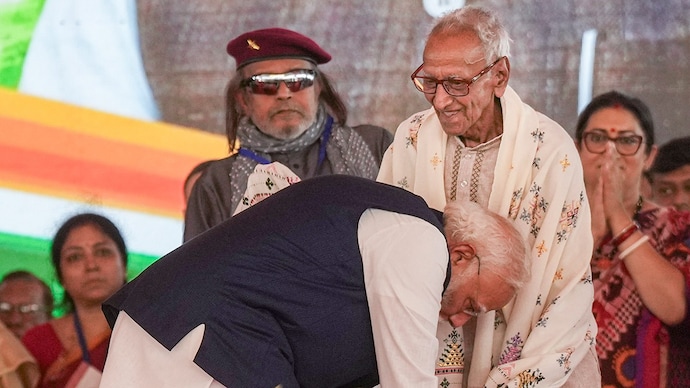
The man at the centre-stage was Makhanlal Sarkar from Siliguri, West Bengal. Not a minister, MP or face that television recognises, yet one with a big presence in the BJP’s political history. Sarkar, an ordinary party worker, was arrested in 1953 in Kashmir while accompanying Syama Prasad Mookerjee during the movement to hoist the Indian Tricolour there, a famous act of nationalist defiance in post-Independence India.
When produced before a judge for singing a nationalist song, Sarkar had refused to apologise and even sang the song in court. He went on to become an organisational backbone of the Jana Sangh, and later the BJP, across north Bengal, enrolling thousands of members in districts where the party had no visible presence or future. He did this without office, without reward, and largely without recognition.
Modi’s gesture was not spontaneous sentiment. It was a political and cultural signal that travelled far beyond Bengal: that this government remembers who built the foundation of the party and it remembers what that building process cost.
The BJP’s rise to its present electoral dominance is often narrated through vote-share charts and cabinet formations. What that narrative omits is the physical cost borne by workers in states where, at one point in the past, merely being associated with the Sangh made you a target. In precisely those states where the party is now pushing to widen its base, without diluting its ideological core, the Sangh’s history is written in the lives of people who never made the headlines.
In Tripura, back on August 6, 1999, four RSS pracharaks—Shyamal Kanti Sengupta, Dinenandranath Dey, Sudhamoy Datta and Subhankar Chakrabarty—were abducted from the Vanavasi Kalyan Ashram in Dhalai district and murdered by militants of the National Liberation Front of Tripura (NLFT). Their crime: working among tribal communities and promoting education, harmony and self-reliance.
The mastermind was an NLFT commander who claimed ‘direct orders from God’ to conduct violence against Hindus and push for a Christian theocracy in the state’s tribal belt. Intelligence sources revealed that the four pracharaks were taken across the border into Bangladesh, severely complicating any rescue. Their names are not in textbooks. But they had died in the service of exactly the kind of civilisational presence in the Northeast that the Sangh has always seen as its primary mission.
In Kerala, the violence is all documented. Ranjith Sreenivasan, a lawyer and state secretary of the BJP’s OBC Morcha, was hacked to death at his home in Alappuzha on December 19, 2021, allegedly by a squad of the now-banned Popular Front of India (PFI) and its wing Social Democratic Party of India (SDPI). A court in Alappuzha awarded the death penalty to 14 of the 15 accused; it was the first time in Kerala that so many had received capital punishment for the same crime.
The court slotted the crime in the ‘rarest of rare’ category. Kannur’s longer ledger of political violence between the CPI(M) and the Sangh runs into dozens of deaths over three decades, with RSS organiser C. Sadanandan Master losing both legs in an attack in 1994 and yet continuing in public life. He was eventually nominated to the Rajya Sabha by the Modi government.
In Tamil Nadu, following raids on PFI premises across 11 states in September 2022, SDPI workers launched coordinated attacks on BJP and RSS functionaries, with petrol bombs hurled at the homes of Sangh organisers and offices ransacked. BJP state chief K. Annamalai documented 19 incidents in a letter to the Union home minister, noting that the state’s DMK (Dravida Munnetra Kazhagam) government had not issued a single statement condemning the arson. Tamil Nadu is a state where the BJP holds minimal electoral weight, but it is also where its workers have faced systematic intimidation but stayed.
In Punjab, sacrifices were made in an era of open insurgency. BJP MLA and Amritsar district chief Harbans Lal Khanna was shot dead by Sikh militants on April 2, 1984. Militant group Dashmesh Regiment claimed responsibility. Five years later, in June 1989, Khalistani terrorists walked into Jawaharlal Nehru Park in Moga during an RSS morning shakha and opened fire, killing 25 swayamsevaks who had refused to lower the Sangh’s flag at gunpoint. The RSS resumed its shakha at the same spot the very next morning. That single act of defiant composure may have carried more strategic worth than any police operation.
There is a grievance that runs quietly but persistently through the BJP’s loyalist cadre, one that the party leadership is seen as having never fully addressed. The complaint: the party values turncoats more than those who built it.
The evidence cited is not anecdotal. Leaders who spent decades in rival parties, opposed the BJP on platforms across the country, and in some cases participated in the political ecosystems that made life difficult for Sangh workers have been inducted and rewarded with positions that old-timers could never have dreamt of. Defectors have been made Union ministers or chief ministers, given presidentship of BJP state units, national organisational roles and fielded as candidates in polls.
Suvendu Adhikari, the BJP’s first chief minister of Bengal who took oath on May 9, is himself a prominent example of this pattern. He was a senior Trinamool Congress leader who joined the BJP in December 2020, only a few months before assembly elections. His elevation in the BJP was swift. For workers who faced Trinamool-linked violence in Bengal across successive election cycles, Adhikari’s rapid rise to the top is a complicated reading.
This is not unique to Bengal. Across states, the BJP has made a strategic calculation that expanding its electoral footprint requires absorbing influential leaders from rival parties, regardless of their history. This has indeed delivered results in states like Maharashtra, Odisha and Haryana. Yet the calculation has a cost within the party’s own ranks, one that accumulates quietly and surfaces in murmured conversations at booth committees, in district offices, and among the swayamsevaks who kept shakhas running through seasons of violence and electoral defeat. Hence, the question: if loyalty and ideology through decades of sacrifice earns you no priority, what exactly is the ideology worth to those who lead it?
This is the precise context in which Modi’s gesture toward Sarkar becomes something more than ceremony. By choosing to publicly honour a 98-year-old anonymous party worker, Modi sent a message to exactly that constituency of quiet, long-serving cadre that feels overlooked. The signal: the leadership has not forgotten what the organisation is built on even as it makes room for new entrants at the top. Sarkar standing on that stage was an acknowledgement of that.
What is significant about today’s BJP leadership is the clarity of its dual ambition: to grow electorally in states while holding firm on the ideological identity that these workers bled for. The party is not offering a diluted version of itself to new constituencies. It is attempting to find new social bridges to reach those constituencies without dismantling what it already is.
In Tamil Nadu, that means an aggressive OBC outreach, anchored by leaders like Annamalai who speak the social grammar of the state without abandoning the national cultural framework. In Kerala, it means positioning the BJP as the only credible political alternative to violence and minority-appeasement politics. In the Northeast, it means deepening the tribal civilisational work that the Vanavasi Kalyan Ashram has been doing for decades.
The party’s record is instructive. The electoral turnarounds in Odisha, Maharashtra, Haryana and Assam were not achieved through ideological dilution. They were achieved through patient grassroots organisation, calculated social expansion that brought in historically isolated communities, and the kind of long-haul booth-level discipline that the Sangh structure makes possible.
Bengal sits in a category of its own, and that is why the May 9 ceremony carried so much emotional weight. This is not simply a state the BJP had struggled to win electorally. This is a state where BJP workers faced systematic post-poll violence and forced evacuation from their own homes and poll booths. The scale and pattern of this violence has been documented by courts and commissions over successive election cycles. BJP workers did not just lose elections in Bengal. They lost family members and homes too.
For the cadre that endured a decade of this violence, Sarkar’s felicitation was a specific kind of vindication, one that can only be understood by those who stayed when leaving was the rational choice. That is the subtext of Modi’s bow to the 98-year-old Sarkar, who was until this week largely unknown outside Siliguri. The BJP’s political project moves forward. But on May 9, for one moment, it looked back and acknowledged the price at which the ground was held.
Subscribe to India Today Magazine
The man at the centre-stage was Makhanlal Sarkar from Siliguri, West Bengal. Not a minister, MP or face that television recognises, yet one with a big presence in the BJP’s political history. Sarkar, an ordinary party worker, was arrested in 1953 in Kashmir while accompanying Syama Prasad Mookerjee during the movement to hoist the Indian Tricolour there, a famous act of nationalist defiance in post-Independence India.
When produced before a judge for singing a nationalist song, Sarkar had refused to apologise and even sang the song in court. He went on to become an organisational backbone of the Jana Sangh, and later the BJP, across north Bengal, enrolling thousands of members in districts where the party had no visible presence or future. He did this without office, without reward, and largely without recognition.
Modi’s gesture was not spontaneous sentiment. It was a political and cultural signal that travelled far beyond Bengal: that this government remembers who built the foundation of the party and it remembers what that building process cost.
The BJP’s rise to its present electoral dominance is often narrated through vote-share charts and cabinet formations. What that narrative omits is the physical cost borne by workers in states where, at one point in the past, merely being associated with the Sangh made you a target. In precisely those states where the party is now pushing to widen its base, without diluting its ideological core, the Sangh’s history is written in the lives of people who never made the headlines.
In Tripura, back on August 6, 1999, four RSS pracharaks—Shyamal Kanti Sengupta, Dinenandranath Dey, Sudhamoy Datta and Subhankar Chakrabarty—were abducted from the Vanavasi Kalyan Ashram in Dhalai district and murdered by militants of the National Liberation Front of Tripura (NLFT). Their crime: working among tribal communities and promoting education, harmony and self-reliance.
The mastermind was an NLFT commander who claimed ‘direct orders from God’ to conduct violence against Hindus and push for a Christian theocracy in the state’s tribal belt. Intelligence sources revealed that the four pracharaks were taken across the border into Bangladesh, severely complicating any rescue. Their names are not in textbooks. But they had died in the service of exactly the kind of civilisational presence in the Northeast that the Sangh has always seen as its primary mission.
In Kerala, the violence is all documented. Ranjith Sreenivasan, a lawyer and state secretary of the BJP’s OBC Morcha, was hacked to death at his home in Alappuzha on December 19, 2021, allegedly by a squad of the now-banned Popular Front of India (PFI) and its wing Social Democratic Party of India (SDPI). A court in Alappuzha awarded the death penalty to 14 of the 15 accused; it was the first time in Kerala that so many had received capital punishment for the same crime.
The court slotted the crime in the ‘rarest of rare’ category. Kannur’s longer ledger of political violence between the CPI(M) and the Sangh runs into dozens of deaths over three decades, with RSS organiser C. Sadanandan Master losing both legs in an attack in 1994 and yet continuing in public life. He was eventually nominated to the Rajya Sabha by the Modi government.
In Tamil Nadu, following raids on PFI premises across 11 states in September 2022, SDPI workers launched coordinated attacks on BJP and RSS functionaries, with petrol bombs hurled at the homes of Sangh organisers and offices ransacked. BJP state chief K. Annamalai documented 19 incidents in a letter to the Union home minister, noting that the state’s DMK (Dravida Munnetra Kazhagam) government had not issued a single statement condemning the arson. Tamil Nadu is a state where the BJP holds minimal electoral weight, but it is also where its workers have faced systematic intimidation but stayed.
In Punjab, sacrifices were made in an era of open insurgency. BJP MLA and Amritsar district chief Harbans Lal Khanna was shot dead by Sikh militants on April 2, 1984. Militant group Dashmesh Regiment claimed responsibility. Five years later, in June 1989, Khalistani terrorists walked into Jawaharlal Nehru Park in Moga during an RSS morning shakha and opened fire, killing 25 swayamsevaks who had refused to lower the Sangh’s flag at gunpoint. The RSS resumed its shakha at the same spot the very next morning. That single act of defiant composure may have carried more strategic worth than any police operation.
There is a grievance that runs quietly but persistently through the BJP’s loyalist cadre, one that the party leadership is seen as having never fully addressed. The complaint: the party values turncoats more than those who built it.
The evidence cited is not anecdotal. Leaders who spent decades in rival parties, opposed the BJP on platforms across the country, and in some cases participated in the political ecosystems that made life difficult for Sangh workers have been inducted and rewarded with positions that old-timers could never have dreamt of. Defectors have been made Union ministers or chief ministers, given presidentship of BJP state units, national organisational roles and fielded as candidates in polls.
Suvendu Adhikari, the BJP’s first chief minister of Bengal who took oath on May 9, is himself a prominent example of this pattern. He was a senior Trinamool Congress leader who joined the BJP in December 2020, only a few months before assembly elections. His elevation in the BJP was swift. For workers who faced Trinamool-linked violence in Bengal across successive election cycles, Adhikari’s rapid rise to the top is a complicated reading.
This is not unique to Bengal. Across states, the BJP has made a strategic calculation that expanding its electoral footprint requires absorbing influential leaders from rival parties, regardless of their history. This has indeed delivered results in states like Maharashtra, Odisha and Haryana. Yet the calculation has a cost within the party’s own ranks, one that accumulates quietly and surfaces in murmured conversations at booth committees, in district offices, and among the swayamsevaks who kept shakhas running through seasons of violence and electoral defeat. Hence, the question: if loyalty and ideology through decades of sacrifice earns you no priority, what exactly is the ideology worth to those who lead it?
This is the precise context in which Modi’s gesture toward Sarkar becomes something more than ceremony. By choosing to publicly honour a 98-year-old anonymous party worker, Modi sent a message to exactly that constituency of quiet, long-serving cadre that feels overlooked. The signal: the leadership has not forgotten what the organisation is built on even as it makes room for new entrants at the top. Sarkar standing on that stage was an acknowledgement of that.
What is significant about today’s BJP leadership is the clarity of its dual ambition: to grow electorally in states while holding firm on the ideological identity that these workers bled for. The party is not offering a diluted version of itself to new constituencies. It is attempting to find new social bridges to reach those constituencies without dismantling what it already is.
In Tamil Nadu, that means an aggressive OBC outreach, anchored by leaders like Annamalai who speak the social grammar of the state without abandoning the national cultural framework. In Kerala, it means positioning the BJP as the only credible political alternative to violence and minority-appeasement politics. In the Northeast, it means deepening the tribal civilisational work that the Vanavasi Kalyan Ashram has been doing for decades.
The party’s record is instructive. The electoral turnarounds in Odisha, Maharashtra, Haryana and Assam were not achieved through ideological dilution. They were achieved through patient grassroots organisation, calculated social expansion that brought in historically isolated communities, and the kind of long-haul booth-level discipline that the Sangh structure makes possible.
Bengal sits in a category of its own, and that is why the May 9 ceremony carried so much emotional weight. This is not simply a state the BJP had struggled to win electorally. This is a state where BJP workers faced systematic post-poll violence and forced evacuation from their own homes and poll booths. The scale and pattern of this violence has been documented by courts and commissions over successive election cycles. BJP workers did not just lose elections in Bengal. They lost family members and homes too.
For the cadre that endured a decade of this violence, Sarkar’s felicitation was a specific kind of vindication, one that can only be understood by those who stayed when leaving was the rational choice. That is the subtext of Modi’s bow to the 98-year-old Sarkar, who was until this week largely unknown outside Siliguri. The BJP’s political project moves forward. But on May 9, for one moment, it looked back and acknowledged the price at which the ground was held.
Subscribe to India Today Magazine

