Not Shiva-Pashupati on Harappan seal? US historian Audrey Truschke sparks outrage
American historian Audrey Truschke challenged the Ministry of Culture's description of the Harappan Pashupati seal as "Shiva-Pashupati". She triggered a row by saying that the figure on the seal was "not Shiva", but the image was "more likely adapted from proto-Elamite iconography". Truschke's remark triggered a wider debate on archaeology, civilisational continuity and who gets to interpret India's ancient past.
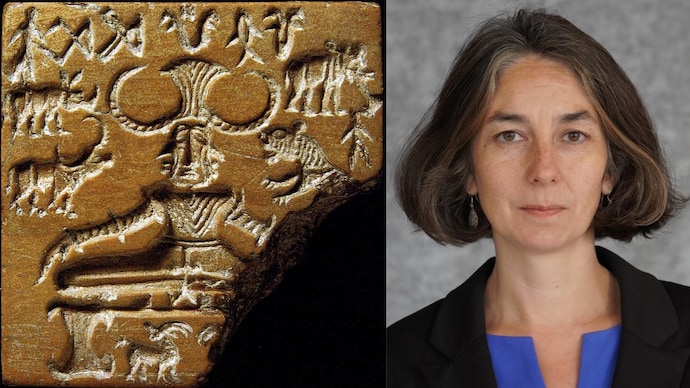
A nearly 4,300-year-old seal from Mohenjo-daro (now in Pakistan) is at the centre of a raging debate. The debate over the famous Harappan "Pashupati Seal" erupted after American historian Audrey Truschke on X challenged the Indian government's interpretation of the artefact. The Ministry of Culture, in a post on X, described the seal as one of the most powerful symbols of India's "unbroken civilisational continuity" and identified the seated figure on it as one "widely seen as Shiva-Pashupati".
The artefact at the centre of the debate is Seal 420/DK-G area find and one of the few seals from the Indus-Saraswati Civilisation, depicting a human figure seated in a yogic posture.
Audrey Truschke countered the Culture Ministry's claim, arguing that the image was "more likely adapted from proto-Elamite iconography" and represented a Eurasian "lord of animals" deity rather than Hindu deity, Shiva.
Her remarks triggered sharp reactions from Indian historians, writers and commentators, many of whom backed the ministry's interpretation and accused Truschke of dismissing indigenous understandings of Indian history.
The Ministry of Culture had said the seal showed a figure seated in Mulabandhasana and argued that its "yogic posture, Shaivite symbolism, and spiritual ethos" continue to survive in India's temples, yoga traditions and cultural life.
WHAT IS PROTO-ELAMITE THAT TRUSCHKE IS REFERRING TO?
Truschke said, "This isn't Shiva. It's more likely adapted from proto-Elamite iconography, showing a Eurasian deity 'lord of animals'."
The Proto-Elamite civilisation flourished in parts of present-day southwestern Iran roughly between 3200 BCE and 2700 BCE. It was broadly contemporaneous with the early phases of the Indus Valley Civilisation that flourished in modern day India and Pakistan.
The exchange has now snowballed into a larger debate about archaeology, civilisational continuity and the interpretation of icons of India's ancient past.
At the centre of the dispute is a small steatite seal discovered at Mohenjo-daro in present-day Pakistan. The artefact, dating to around 2300-2000 BCE, depicts a human figure with headgear and horns seated cross-legged and surrounded by animals.
British archaeologist John Marshall, who led excavations at Mohenjo-daro in the 1920s, identified the figure as a "Proto-Shiva" or an early form of Pashupati, the lord of animals.
That interpretation has influenced popular understanding for nearly a century, although it has long remained contested within academic circles.
Thousands of seals, usually made of steatite and ranging from square to rectangular shapes, have been found across the sites of the Harappan Civilisation (or the Indus-Saraswati Civilisation).
Archaeologists believe seals were used for trade, administration, identification, ownership marking and possibly religious or ritualistic purposes. The seals motifs, including that of animal, and inscriptions in the still-undeciphered Harappan script.
AUDREY TRUSCHKE OBJECTS TO GOVT's SHIVA-PASHUPATI IDENTIFICATION
The controversy began after Truschke challenged the Ministry of Culture's social media post.
"This isn't Shiva," she wrote. "It's more likely adapted from proto-Elamite iconography, showing a Eurasian deity 'lord of animals'," she added.
Truschke also shared an academic article and discussed possible links between Harappan imagery and motifs found in neighbouring ancient cultures in general. Her intervention was not entirely new. Several scholars have previously questioned whether the Harappan figure can be confidently identified as Shiva.
"The force of Marshall's argument has endured. Indeed, no matter what position is taken regarding the seal's iconography, it is always prefaced by Marshall's interpretation," German Indologist Doris Srinivasan wrote in the Archives of Asian Art in 1975-1976.
However, Truschke's remarks triggered a controversy as she challenged and touched on a highly sensitive debate about India's civilisational continuity and Shiva, the revered Hindu deity.
Critics also accused Truschke of selectively ignoring features that appear uniquely rooted in the Indian subcontinent.
WHY INDIAN SCHOLARS DISAGREE WITH TRUSCHKE ON PASHUPATI-SHIVA SEAL
One of the strongest responses to Truschke's assertion came from author Amish Tripathi.
"The Pashupati seal has an elephant, a water buffalo and a rhinoceros. Ancient Elam was centred in southwestern Iran. Elephants, water buffalos and rhinoceroses are not native to ancient Elam. BTW, they are native to India. Also, the figure is seated in a Yogic posture. Is Yoga also Elamite now? Seriously?" Tripathi wrote on X.
Tripathi added that the comparison with proto-Elamite imagery did not explain the presence of Indian fauna or the yogic posture visible on the seal.
Historian and professor Lavanya Vemsani was even more categorical with her explanation.
"The Elamite seal is completely different from the Pashupati/Proto-Shiva seal. They are not the same. Not even 1% of similarity exists between them to merit comparison," she wrote on X.
Vemsani argued that the Harappan figure depicts "Shiva sitting in Mulabandhasana" and is surrounded by animals endemic to India.
IS THE PROTO-SHIVA THEORY OUTDATED OR DOES THE DEBATE REMAIN UNSETTLED?
In fact, the Proto-Shiva identification of the Pashupati Seal has been debated now for over a century.
Historian-YouTuber Ruchika Sharma argued that the theory is outdated and rests on assumptions made during the colonial era by John Marshall.
"This seal is called seal 420 and has nothing to do with the Puranic deity Shiva. This is an outdated theory that has no evidence and has been junked by all serious historians and archaeologists," Sharma wrote on X.
According to her, Marshall identified the figure as Proto-Shiva because it appeared to sit in a yogic posture, was surrounded by animals and seemed to wear a trident-like headdress. "But all these reasons are misidentifications. The headdress is the horns of a water buffalo, not a trident," she argued.
Sharma also cited historian Doris Srinivasan, who questioned whether the attributes associated with later Shiva can be projected back into the Harappan period.
"Vedic Rudra was neither a yogi nor a Pashupati," Sharma said. "Shiva being a yogi and being a Pashupati — both these traits appear from the 2nd century BC onwards."
According to her line of argument, the Pashupati might represent a shaman, a local deity, a bull-man or something else entirely.
Citing Srinivasan, Ruchika Sharma argued that "Vedic Rudra was neither a yogi nor a Pashupati" and was instead "a destructive force, a killer of animals rather than a protector or lord of animals".
Doris Srinivasan, in Archives of Asian Art (1975-1976) did not conclude that the Pashupati was Shiva. She argued that the evidence "goes counter to Marshall's idea of a tricephalic proto-Siva" and that "the figure on the Mohenjo-daro seal is likely to be a divine bull-man." Srinivasan wrote that "Marshall's identification may need revision" and that the figure was more likely "a deity of fertility and abundance".
Ruchika Sharma also questioned John Marshall, saying he was not a trained archaeologist. However, according to reports, Marshall was trained in archaeology at Knossos (on the Greek island of Crete) under British archaeologist Arthur Evans. Marshall had also participated in excavations for a few years before being appointed the Director General of archaeology in India in 1902.
WHAT DOES DEVDUTT PATTANAIK SAY ABOUT THE SEAL?
Mythologist and author Devdutt Pattanaik occupies a position that differs from both the Culture Ministry's and Truschke's interpretations of the Pashupati Seal.
Writing in The Hindu in 2022, Pattanaik noted that many scholars no longer accepted a straightforward identification of the Harappan seal's figure with Shiva. "We have all heard of the Pashupati seal in Harappa. Scholars are clear that it has nothing to do with Shiva, even though it is still labelled as proto-Shiva in popular books," Pattanaik wrote.
Pattanaik noted that there are at least two famous versions of the horned Harappan deity seal. One is in Delhi, showing the figure surrounded by animals. Another is in Islamabad without the animals.
Pattanaik pointed out several features that complicate the picture. One version of the seal appears ithyphallic (erect penis), while the another contains symbols that some interpret differently. The figure wears horns, which is a feature that's not associated with mainstream depictions of Shiva, he noted.
"The Delhi one is ithyphallic (erect penis), like the later images of Lakulish, a tantrik form of Shiva, while the Islamabad seal shows a downward pointing triangle suggesting a vagina. So is the image male, female or maybe transgender?" he wrote.
At the same time, Pattanaik acknowledged that the seated posture remains striking and difficult to ignore.
"What is indisputable though is the horned deity's characteristic seating posture. It is the throne-pose or bhadra-asana of yoga today," he wrote in The Hindu newspaper.
Norweigian PhD scholar at SOAS University of London, Aleksander Engeskaug, took to X to recall that his "old friend seal 420 from Mohenjo-daro" was his topic of BA thesis many years ago. "My conclusion was that the seal has nothing to do whatsoever with Shiva, yoga or Hinduism," he wrote.
IS THE PASHUPATI SEAL DEBATE POLITICAL?
The dispute, it looks like, is no longer just about archaeology. The historians, who supported the Culture Ministry's position, said the seal represents evidence of cultural and civilisational continuity stretching from the Harappan world to contemporary Hindu traditions. The Culture Ministry itself described the artefact as proof that "this civilisational thread has remained alive and unbroken".
For critics like Ruchika Sharma, such claims risk projecting later religious identities onto a civilisation whose script remains undeciphered and whose beliefs remain only partially understood. Because the Harappan script remains undeciphered, historians rely on archaeology, material evidence and comparative analysis.
Author Hindol Sengupta framed the controversy as a broader argument about who gets to interpret India's past.
"Supposedly, it is not 'Pashupati', it is 'Lord of Animals'. Who is going to tell this notorious Indian-and Hindu-baiter that Pashupati means Lord of Animals?" he wrote on X.
He also argued that similarities between different ancient cultures do not automatically justify claims of borrowing or derivation.
While the name and attributes associated with Shiva might have taken shape centuries after the decline of the Harappan civilisation, many experts note that ancient societies often personified natural forces, animals and fertility through divine figures.
Now in 2026, even as the debate is raging, nearly a century after Marshall first proposed the Proto-Shiva theory, the Mohenjo-daro's Pashupatinath Seal remains as enigmatic as ever. The script on it is unread. What survives instead are competing interpretations, which are archaeological, religious, civilisational and political in nature.
A nearly 4,300-year-old seal from Mohenjo-daro (now in Pakistan) is at the centre of a raging debate. The debate over the famous Harappan "Pashupati Seal" erupted after American historian Audrey Truschke on X challenged the Indian government's interpretation of the artefact. The Ministry of Culture, in a post on X, described the seal as one of the most powerful symbols of India's "unbroken civilisational continuity" and identified the seated figure on it as one "widely seen as Shiva-Pashupati".
The artefact at the centre of the debate is Seal 420/DK-G area find and one of the few seals from the Indus-Saraswati Civilisation, depicting a human figure seated in a yogic posture.
Audrey Truschke countered the Culture Ministry's claim, arguing that the image was "more likely adapted from proto-Elamite iconography" and represented a Eurasian "lord of animals" deity rather than Hindu deity, Shiva.
Her remarks triggered sharp reactions from Indian historians, writers and commentators, many of whom backed the ministry's interpretation and accused Truschke of dismissing indigenous understandings of Indian history.
The Ministry of Culture had said the seal showed a figure seated in Mulabandhasana and argued that its "yogic posture, Shaivite symbolism, and spiritual ethos" continue to survive in India's temples, yoga traditions and cultural life.
WHAT IS PROTO-ELAMITE THAT TRUSCHKE IS REFERRING TO?
Truschke said, "This isn't Shiva. It's more likely adapted from proto-Elamite iconography, showing a Eurasian deity 'lord of animals'."
The Proto-Elamite civilisation flourished in parts of present-day southwestern Iran roughly between 3200 BCE and 2700 BCE. It was broadly contemporaneous with the early phases of the Indus Valley Civilisation that flourished in modern day India and Pakistan.
The exchange has now snowballed into a larger debate about archaeology, civilisational continuity and the interpretation of icons of India's ancient past.
At the centre of the dispute is a small steatite seal discovered at Mohenjo-daro in present-day Pakistan. The artefact, dating to around 2300-2000 BCE, depicts a human figure with headgear and horns seated cross-legged and surrounded by animals.
British archaeologist John Marshall, who led excavations at Mohenjo-daro in the 1920s, identified the figure as a "Proto-Shiva" or an early form of Pashupati, the lord of animals.
That interpretation has influenced popular understanding for nearly a century, although it has long remained contested within academic circles.
Thousands of seals, usually made of steatite and ranging from square to rectangular shapes, have been found across the sites of the Harappan Civilisation (or the Indus-Saraswati Civilisation).
Archaeologists believe seals were used for trade, administration, identification, ownership marking and possibly religious or ritualistic purposes. The seals motifs, including that of animal, and inscriptions in the still-undeciphered Harappan script.
AUDREY TRUSCHKE OBJECTS TO GOVT's SHIVA-PASHUPATI IDENTIFICATION
The controversy began after Truschke challenged the Ministry of Culture's social media post.
"This isn't Shiva," she wrote. "It's more likely adapted from proto-Elamite iconography, showing a Eurasian deity 'lord of animals'," she added.
Truschke also shared an academic article and discussed possible links between Harappan imagery and motifs found in neighbouring ancient cultures in general. Her intervention was not entirely new. Several scholars have previously questioned whether the Harappan figure can be confidently identified as Shiva.
"The force of Marshall's argument has endured. Indeed, no matter what position is taken regarding the seal's iconography, it is always prefaced by Marshall's interpretation," German Indologist Doris Srinivasan wrote in the Archives of Asian Art in 1975-1976.
However, Truschke's remarks triggered a controversy as she challenged and touched on a highly sensitive debate about India's civilisational continuity and Shiva, the revered Hindu deity.
Critics also accused Truschke of selectively ignoring features that appear uniquely rooted in the Indian subcontinent.
WHY INDIAN SCHOLARS DISAGREE WITH TRUSCHKE ON PASHUPATI-SHIVA SEAL
One of the strongest responses to Truschke's assertion came from author Amish Tripathi.
"The Pashupati seal has an elephant, a water buffalo and a rhinoceros. Ancient Elam was centred in southwestern Iran. Elephants, water buffalos and rhinoceroses are not native to ancient Elam. BTW, they are native to India. Also, the figure is seated in a Yogic posture. Is Yoga also Elamite now? Seriously?" Tripathi wrote on X.
Tripathi added that the comparison with proto-Elamite imagery did not explain the presence of Indian fauna or the yogic posture visible on the seal.
Historian and professor Lavanya Vemsani was even more categorical with her explanation.
"The Elamite seal is completely different from the Pashupati/Proto-Shiva seal. They are not the same. Not even 1% of similarity exists between them to merit comparison," she wrote on X.
Vemsani argued that the Harappan figure depicts "Shiva sitting in Mulabandhasana" and is surrounded by animals endemic to India.
IS THE PROTO-SHIVA THEORY OUTDATED OR DOES THE DEBATE REMAIN UNSETTLED?
In fact, the Proto-Shiva identification of the Pashupati Seal has been debated now for over a century.
Historian-YouTuber Ruchika Sharma argued that the theory is outdated and rests on assumptions made during the colonial era by John Marshall.
"This seal is called seal 420 and has nothing to do with the Puranic deity Shiva. This is an outdated theory that has no evidence and has been junked by all serious historians and archaeologists," Sharma wrote on X.
According to her, Marshall identified the figure as Proto-Shiva because it appeared to sit in a yogic posture, was surrounded by animals and seemed to wear a trident-like headdress. "But all these reasons are misidentifications. The headdress is the horns of a water buffalo, not a trident," she argued.
Sharma also cited historian Doris Srinivasan, who questioned whether the attributes associated with later Shiva can be projected back into the Harappan period.
"Vedic Rudra was neither a yogi nor a Pashupati," Sharma said. "Shiva being a yogi and being a Pashupati — both these traits appear from the 2nd century BC onwards."
According to her line of argument, the Pashupati might represent a shaman, a local deity, a bull-man or something else entirely.
Citing Srinivasan, Ruchika Sharma argued that "Vedic Rudra was neither a yogi nor a Pashupati" and was instead "a destructive force, a killer of animals rather than a protector or lord of animals".
Doris Srinivasan, in Archives of Asian Art (1975-1976) did not conclude that the Pashupati was Shiva. She argued that the evidence "goes counter to Marshall's idea of a tricephalic proto-Siva" and that "the figure on the Mohenjo-daro seal is likely to be a divine bull-man." Srinivasan wrote that "Marshall's identification may need revision" and that the figure was more likely "a deity of fertility and abundance".
Ruchika Sharma also questioned John Marshall, saying he was not a trained archaeologist. However, according to reports, Marshall was trained in archaeology at Knossos (on the Greek island of Crete) under British archaeologist Arthur Evans. Marshall had also participated in excavations for a few years before being appointed the Director General of archaeology in India in 1902.
WHAT DOES DEVDUTT PATTANAIK SAY ABOUT THE SEAL?
Mythologist and author Devdutt Pattanaik occupies a position that differs from both the Culture Ministry's and Truschke's interpretations of the Pashupati Seal.
Writing in The Hindu in 2022, Pattanaik noted that many scholars no longer accepted a straightforward identification of the Harappan seal's figure with Shiva. "We have all heard of the Pashupati seal in Harappa. Scholars are clear that it has nothing to do with Shiva, even though it is still labelled as proto-Shiva in popular books," Pattanaik wrote.
Pattanaik noted that there are at least two famous versions of the horned Harappan deity seal. One is in Delhi, showing the figure surrounded by animals. Another is in Islamabad without the animals.
Pattanaik pointed out several features that complicate the picture. One version of the seal appears ithyphallic (erect penis), while the another contains symbols that some interpret differently. The figure wears horns, which is a feature that's not associated with mainstream depictions of Shiva, he noted.
"The Delhi one is ithyphallic (erect penis), like the later images of Lakulish, a tantrik form of Shiva, while the Islamabad seal shows a downward pointing triangle suggesting a vagina. So is the image male, female or maybe transgender?" he wrote.
At the same time, Pattanaik acknowledged that the seated posture remains striking and difficult to ignore.
"What is indisputable though is the horned deity's characteristic seating posture. It is the throne-pose or bhadra-asana of yoga today," he wrote in The Hindu newspaper.
Norweigian PhD scholar at SOAS University of London, Aleksander Engeskaug, took to X to recall that his "old friend seal 420 from Mohenjo-daro" was his topic of BA thesis many years ago. "My conclusion was that the seal has nothing to do whatsoever with Shiva, yoga or Hinduism," he wrote.
IS THE PASHUPATI SEAL DEBATE POLITICAL?
The dispute, it looks like, is no longer just about archaeology. The historians, who supported the Culture Ministry's position, said the seal represents evidence of cultural and civilisational continuity stretching from the Harappan world to contemporary Hindu traditions. The Culture Ministry itself described the artefact as proof that "this civilisational thread has remained alive and unbroken".
For critics like Ruchika Sharma, such claims risk projecting later religious identities onto a civilisation whose script remains undeciphered and whose beliefs remain only partially understood. Because the Harappan script remains undeciphered, historians rely on archaeology, material evidence and comparative analysis.
Author Hindol Sengupta framed the controversy as a broader argument about who gets to interpret India's past.
"Supposedly, it is not 'Pashupati', it is 'Lord of Animals'. Who is going to tell this notorious Indian-and Hindu-baiter that Pashupati means Lord of Animals?" he wrote on X.
He also argued that similarities between different ancient cultures do not automatically justify claims of borrowing or derivation.
While the name and attributes associated with Shiva might have taken shape centuries after the decline of the Harappan civilisation, many experts note that ancient societies often personified natural forces, animals and fertility through divine figures.
Now in 2026, even as the debate is raging, nearly a century after Marshall first proposed the Proto-Shiva theory, the Mohenjo-daro's Pashupatinath Seal remains as enigmatic as ever. The script on it is unread. What survives instead are competing interpretations, which are archaeological, religious, civilisational and political in nature.

