Beyond Delhi Gymkhana, the 170-acre elite fortress called Delhi Golf Club
The eviction notice to the Delhi Gymkhana, located on a 27-acre plot, has sparked a conversation around the Delhi Golf Club, which is based on 170 acres of prime government land and has a restrictive membership model. The golf club has faced questions over racism, public access, golfers' practice rights and an ASI-protected monument.
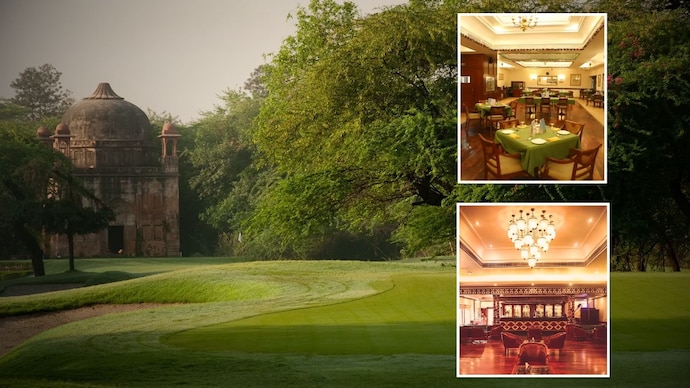
The Delhi Gymkhana Club is currently in the spotlight, but barely a few kilometres away lies an even bigger symbol of Delhi's elite culture. Spread across more than 170 acres of prime public land, the Delhi Golf Club represents not just a sporting institution but a world of inherited privilege, bureaucratic influence, and restricted access. Hidden inside the estate only a few have access to are heritage monuments, including at least one protected by the Archaelogical Survey of India (ASI).
The Delhi Golf Club has been marred by allegations and controversies surrounding elitism, hereditary membership, racism and not allowing golf athletes to practice, despite being a sporting club. The huge cache of land, estimated to have been worth at least Rs 46,000 crore over a decade ago and likely far more today, was allotted specifically for the development of golf in the national capital. However, the golf club seemingly does everything else other than promoting golf.
The controversy around Delhi Gymkhana erupted after the Centre asked the club to vacate the premises by June 5, triggering a legal battle in the Delhi High Court. The gymkhana club is located on 27.3-acre of prime Lutyens' Delhi property at 2, Safdarjung Road. That's right next to 7, Lok Kalyan Marg, the Prime Minister's residence.
The Delhi Gymkhana's land is being taken back for defence and security infrastructure. It was the Rs 1,000 rent per month that the gymkhana was paying for the vast property and the restricted access that sparked a huge debate.
However, just a few kilometres away is the Delhi Golf Club, which occupies nearly eight times more land, measuring around 179 acres. Questions began being asked about its legitimacy and operations too.
The Delhi Golf Club lies in one of India's most expensive real estate markets in Lutyens Delhi, and is close to key military and government establishments. It also houses several protected medieval monuments within its premises.
The golf club is located on Dr Zakir Hussain Road near India Gate, Humayun's Tomb, and Lodhi Garden.
"I am not a member of the Delhi Gymkhana, but I do hold the Associate membership of the India International Centre (IIC). I will shed no tears if the latter is shut down. Delhi Golf Club also needs to go; it should be preserved as a green belt, open to the public," retired IAS officer KBS Sidhu posted on X on May 24.
Notably, Delhi Golf Club was originally established as a municipal golf course during the British era in the early 1930s and became a corporate entity in February 1950. Over the decades, it evolved into a powerful networking hub for India's bureaucratic, political, and business elite.
The club currently has around 4,000 members, which include serving and retired civil servants, judges, diplomats, politicians, military officers, and wealthy businesspersons, along with their dependents. The Delhi Gymkhana has 5,600 members.
The Delhi Golf Club (DGC) features an 18-hole Lodhi Course, redesigned by legendary golfer Gary Player in 2019, and a nine-hole Peacock Course. It also includes a clubhouse, swimming pool, restaurants, bars, and private event spaces. These facilities have reinforced the DGC's image as one of Delhi's most exclusive social institutions.
DECADES OF WAIT TO GET MEMBERSHIP AT DELHI GOLF CLUB
DGC's membership structure itself has become one of the biggest sources of criticism. The club reportedly inducts only around 60 to 70 permanent members annually, depending on vacancies. In the general "business category", in which civilians, entrepreneurs, and corporate professionals apply, they often wait for decades. In some instances, applications dating back to the 1970s are still pending for membership.
In contrast, dependents of existing members enjoy priority access through reserved quotas. Children of existing members can enter special "senior dependent" categories once they turn 22, giving them a far easier pathway into permanent membership compared to ordinary applicants, according to a report in The Hindu.
Critics argue that this system effectively turns club membership into an inherited privilege passed down through generations rather than access based on sporting interest or merit.
"Very few have been enjoying the facilities at the cost of the government's exchequer as their birthright. Same with the Delhi Golf Club. Membership should be given for a limited period and auctioned with some basic criteria set for Gymkhana and for the golf club," a person wrote on X.
The Delhi High Court itself has also examined these practices in the 2023 Prem Nath Vasistha case, where petitions challenged the club's membership policies as exclusionary and contrary to the objective of promoting golf. During the hearings, the high court reportedly questioned whether reserving a large share of vacancies for dependents blocked wider public participation in the sport.
The membership fees of the Golf Club is also quite high. Fees for Indian business-category members are around Rs 15 lakh, excluding taxes and other charges. Government officers pay roughly Rs 4.5 lakh, while dependents pay about Rs 3.5 lakh. Government-tenure memberships are available at heavily subsidised rates of around Rs 25,000.
In addition to this, members must also pay annual subscriptions, security deposits, and usage charges. Even non-member golfers who wish to play occasionally through green fees pay thousands of rupees per round.
Critics argue that this structure of the Golf Club reflects a larger ecosystem where elite clubs remain socially and financially inaccessible to ordinary citizens despite occupying public land.
GOVERNMENT EXTENDED LEASE OF DELHI GOLF CLUB LAND TILL 2050
Another criticism surrounding the Delhi Golf Club centres is the land lease it has. The golf club operates on government-owned land leased through the LDO. In 2012, the Government of India extended the lease till 2050.
A 2013 India Today report revealed that the value of the golf club's land is estimated at Rs 46,722 crores, according to the Central Information Commission. Yet, the annual lease rent paid by the club has remained remarkably low.
According to the 2025 government data, the Union Housing and Urban Affairs Ministry has received over Rs 15.54 crore in ground rent and other charges from the Delhi Golf Course since 2012. This translates to a rent of nearly Rs 9 lakh a month for the 170 acres.
This has led to repeated accusations that the government is effectively subsidising luxury recreation for a small elite group using prime public land.
Former Delhi Chief Minister Arvind Kejriwal had attacked the golf club in 2014, calling it a symbol of "corruption and cronyism", particularly over how elite institutions benefit from state patronage while remaining inaccessible to ordinary people.
The criticism over the DGC became sharper as the original lease purpose was tied to promoting and developing golf in the capital for public benefit. But in 2020, several Delhi golf players alleged that an ultra-exclusive private membership structure contradicts the public objective of the DGC.
GOLFERS WERE NOT ALLOWED INTO DELHI GOLF CLUB FOR PRACTICE
In May 2025, two-time Asian Tour winner Rashid Khan and several Delhi-based caddie professionals announced a sit-in protest at Jantar Mantar, demanding practice rights at the DGC. The golfers argued that the club stands on government-leased land meant for the "promotion and advancement" of golf and therefore cannot function solely as an exclusive private enclave.
The golfers claimed that many local professionals had effectively lost access to quality practice facilities after the DGC stopped allowing caddie-pros to train at the course around 2012, with restrictions becoming stricter after 2019. Several players said the dispute had affected their careers and livelihoods, forcing some to relocate to other cities or even consider quitting professional golf altogether.
Rashid Khan alleged that despite a 2020 government directive asking the club to reserve 10% of certain membership categories for professional golfers, no Delhi-based professional had been granted such access for years.
The DGC, however, defended its position by maintaining that it is a private members' club governed by its own rules and Memorandum of Association. The club argued that playing privileges remain entirely at its discretion and cited past disciplinary issues involving some golfers whose access had been withdrawn. The matter is currently pending before the Delhi High Court, where affected golfers and caddie-pros are seeking judicial intervention for practice rights at the club.
RACISM AGAINST MEGHALAYA WOMAN IN DELHI GOLF CLUB
The DGC's image took a major hit nationally in 2017 after a Khasi woman from Meghalaya alleged that she was humiliated and asked to leave because of her traditional jainsem attire, which the staffers said looked like a "maid's uniform".
This incident triggered outrage across the northeast, with many calling it a reflection of entrenched racism, class prejudice, and cultural ignorance within elite Delhi spaces. Political leaders, activists, and civil society groups condemned the remarks against the Khasi woman in the DGC.
The controversy became so big that even the Meghalaya State Women's Commission got involved. The scenario permanently damaged the club's public image and turned it into a national conversation about discrimination faced by Northeastern communities in metropolitan India.
CONTROVERSY SURROUNDING MAINTENANCE OF MONUMENTS INSIDE THE DGC
One of the most unusual aspects of the Delhi Golf Club is that it is built around several medieval monuments, including structures from the Lodhi, Mughal, and Tughlaq periods.
The most prominent among them is the ASI-protected Lal Bangla mausoleum complex, built around 1779–1780 and linked to Mughal emperor Shah Alam II's family. Other structures inside the club include the Tomb of Syed Abid, the Lodi-era Barah Khamba, Mughal-era tombs, mosque ruins, gateways, and several scattered heritage structures.
Conservation concerns have surfaced periodically, with allegations that restoration work and maintenance of heritage structures inside the course faced delays or administrative hurdles. Questions have repeatedly emerged about whether nationally important heritage sites should remain inside a highly restricted private-access zone. The issue has also reached courts and higher authorities over the years, including concerns linked to preservation standards around protected monuments.
As scrutiny over elite clubs is intensifying across India, the Delhi Golf Club is now facing a larger question. Should the vast stretches of public land continue serving an exclusive few, or be reimagined for wider sporting, cultural, and public access?
The Delhi Gymkhana Club is currently in the spotlight, but barely a few kilometres away lies an even bigger symbol of Delhi's elite culture. Spread across more than 170 acres of prime public land, the Delhi Golf Club represents not just a sporting institution but a world of inherited privilege, bureaucratic influence, and restricted access. Hidden inside the estate only a few have access to are heritage monuments, including at least one protected by the Archaelogical Survey of India (ASI).
The Delhi Golf Club has been marred by allegations and controversies surrounding elitism, hereditary membership, racism and not allowing golf athletes to practice, despite being a sporting club. The huge cache of land, estimated to have been worth at least Rs 46,000 crore over a decade ago and likely far more today, was allotted specifically for the development of golf in the national capital. However, the golf club seemingly does everything else other than promoting golf.
The controversy around Delhi Gymkhana erupted after the Centre asked the club to vacate the premises by June 5, triggering a legal battle in the Delhi High Court. The gymkhana club is located on 27.3-acre of prime Lutyens' Delhi property at 2, Safdarjung Road. That's right next to 7, Lok Kalyan Marg, the Prime Minister's residence.
The Delhi Gymkhana's land is being taken back for defence and security infrastructure. It was the Rs 1,000 rent per month that the gymkhana was paying for the vast property and the restricted access that sparked a huge debate.
However, just a few kilometres away is the Delhi Golf Club, which occupies nearly eight times more land, measuring around 179 acres. Questions began being asked about its legitimacy and operations too.
The Delhi Golf Club lies in one of India's most expensive real estate markets in Lutyens Delhi, and is close to key military and government establishments. It also houses several protected medieval monuments within its premises.
The golf club is located on Dr Zakir Hussain Road near India Gate, Humayun's Tomb, and Lodhi Garden.
"I am not a member of the Delhi Gymkhana, but I do hold the Associate membership of the India International Centre (IIC). I will shed no tears if the latter is shut down. Delhi Golf Club also needs to go; it should be preserved as a green belt, open to the public," retired IAS officer KBS Sidhu posted on X on May 24.
Notably, Delhi Golf Club was originally established as a municipal golf course during the British era in the early 1930s and became a corporate entity in February 1950. Over the decades, it evolved into a powerful networking hub for India's bureaucratic, political, and business elite.
The club currently has around 4,000 members, which include serving and retired civil servants, judges, diplomats, politicians, military officers, and wealthy businesspersons, along with their dependents. The Delhi Gymkhana has 5,600 members.
The Delhi Golf Club (DGC) features an 18-hole Lodhi Course, redesigned by legendary golfer Gary Player in 2019, and a nine-hole Peacock Course. It also includes a clubhouse, swimming pool, restaurants, bars, and private event spaces. These facilities have reinforced the DGC's image as one of Delhi's most exclusive social institutions.
DECADES OF WAIT TO GET MEMBERSHIP AT DELHI GOLF CLUB
DGC's membership structure itself has become one of the biggest sources of criticism. The club reportedly inducts only around 60 to 70 permanent members annually, depending on vacancies. In the general "business category", in which civilians, entrepreneurs, and corporate professionals apply, they often wait for decades. In some instances, applications dating back to the 1970s are still pending for membership.
In contrast, dependents of existing members enjoy priority access through reserved quotas. Children of existing members can enter special "senior dependent" categories once they turn 22, giving them a far easier pathway into permanent membership compared to ordinary applicants, according to a report in The Hindu.
Critics argue that this system effectively turns club membership into an inherited privilege passed down through generations rather than access based on sporting interest or merit.
"Very few have been enjoying the facilities at the cost of the government's exchequer as their birthright. Same with the Delhi Golf Club. Membership should be given for a limited period and auctioned with some basic criteria set for Gymkhana and for the golf club," a person wrote on X.
The Delhi High Court itself has also examined these practices in the 2023 Prem Nath Vasistha case, where petitions challenged the club's membership policies as exclusionary and contrary to the objective of promoting golf. During the hearings, the high court reportedly questioned whether reserving a large share of vacancies for dependents blocked wider public participation in the sport.
The membership fees of the Golf Club is also quite high. Fees for Indian business-category members are around Rs 15 lakh, excluding taxes and other charges. Government officers pay roughly Rs 4.5 lakh, while dependents pay about Rs 3.5 lakh. Government-tenure memberships are available at heavily subsidised rates of around Rs 25,000.
In addition to this, members must also pay annual subscriptions, security deposits, and usage charges. Even non-member golfers who wish to play occasionally through green fees pay thousands of rupees per round.
Critics argue that this structure of the Golf Club reflects a larger ecosystem where elite clubs remain socially and financially inaccessible to ordinary citizens despite occupying public land.
GOVERNMENT EXTENDED LEASE OF DELHI GOLF CLUB LAND TILL 2050
Another criticism surrounding the Delhi Golf Club centres is the land lease it has. The golf club operates on government-owned land leased through the LDO. In 2012, the Government of India extended the lease till 2050.
A 2013 India Today report revealed that the value of the golf club's land is estimated at Rs 46,722 crores, according to the Central Information Commission. Yet, the annual lease rent paid by the club has remained remarkably low.
According to the 2025 government data, the Union Housing and Urban Affairs Ministry has received over Rs 15.54 crore in ground rent and other charges from the Delhi Golf Course since 2012. This translates to a rent of nearly Rs 9 lakh a month for the 170 acres.
This has led to repeated accusations that the government is effectively subsidising luxury recreation for a small elite group using prime public land.
Former Delhi Chief Minister Arvind Kejriwal had attacked the golf club in 2014, calling it a symbol of "corruption and cronyism", particularly over how elite institutions benefit from state patronage while remaining inaccessible to ordinary people.
The criticism over the DGC became sharper as the original lease purpose was tied to promoting and developing golf in the capital for public benefit. But in 2020, several Delhi golf players alleged that an ultra-exclusive private membership structure contradicts the public objective of the DGC.
GOLFERS WERE NOT ALLOWED INTO DELHI GOLF CLUB FOR PRACTICE
In May 2025, two-time Asian Tour winner Rashid Khan and several Delhi-based caddie professionals announced a sit-in protest at Jantar Mantar, demanding practice rights at the DGC. The golfers argued that the club stands on government-leased land meant for the "promotion and advancement" of golf and therefore cannot function solely as an exclusive private enclave.
The golfers claimed that many local professionals had effectively lost access to quality practice facilities after the DGC stopped allowing caddie-pros to train at the course around 2012, with restrictions becoming stricter after 2019. Several players said the dispute had affected their careers and livelihoods, forcing some to relocate to other cities or even consider quitting professional golf altogether.
Rashid Khan alleged that despite a 2020 government directive asking the club to reserve 10% of certain membership categories for professional golfers, no Delhi-based professional had been granted such access for years.
The DGC, however, defended its position by maintaining that it is a private members' club governed by its own rules and Memorandum of Association. The club argued that playing privileges remain entirely at its discretion and cited past disciplinary issues involving some golfers whose access had been withdrawn. The matter is currently pending before the Delhi High Court, where affected golfers and caddie-pros are seeking judicial intervention for practice rights at the club.
RACISM AGAINST MEGHALAYA WOMAN IN DELHI GOLF CLUB
The DGC's image took a major hit nationally in 2017 after a Khasi woman from Meghalaya alleged that she was humiliated and asked to leave because of her traditional jainsem attire, which the staffers said looked like a "maid's uniform".
This incident triggered outrage across the northeast, with many calling it a reflection of entrenched racism, class prejudice, and cultural ignorance within elite Delhi spaces. Political leaders, activists, and civil society groups condemned the remarks against the Khasi woman in the DGC.
The controversy became so big that even the Meghalaya State Women's Commission got involved. The scenario permanently damaged the club's public image and turned it into a national conversation about discrimination faced by Northeastern communities in metropolitan India.
CONTROVERSY SURROUNDING MAINTENANCE OF MONUMENTS INSIDE THE DGC
One of the most unusual aspects of the Delhi Golf Club is that it is built around several medieval monuments, including structures from the Lodhi, Mughal, and Tughlaq periods.
The most prominent among them is the ASI-protected Lal Bangla mausoleum complex, built around 1779–1780 and linked to Mughal emperor Shah Alam II's family. Other structures inside the club include the Tomb of Syed Abid, the Lodi-era Barah Khamba, Mughal-era tombs, mosque ruins, gateways, and several scattered heritage structures.
Conservation concerns have surfaced periodically, with allegations that restoration work and maintenance of heritage structures inside the course faced delays or administrative hurdles. Questions have repeatedly emerged about whether nationally important heritage sites should remain inside a highly restricted private-access zone. The issue has also reached courts and higher authorities over the years, including concerns linked to preservation standards around protected monuments.
As scrutiny over elite clubs is intensifying across India, the Delhi Golf Club is now facing a larger question. Should the vast stretches of public land continue serving an exclusive few, or be reimagined for wider sporting, cultural, and public access?

