Galgotias under fire for displaying Chinese robodog as own at AI Summit, clarifies
Galgotias University has addressed online criticism over claims of developing and showcasing a Chinese-made robotic dog as its own at the India AI Impact Summit in Delhi, clarifying it never claimed to have developed the technology.
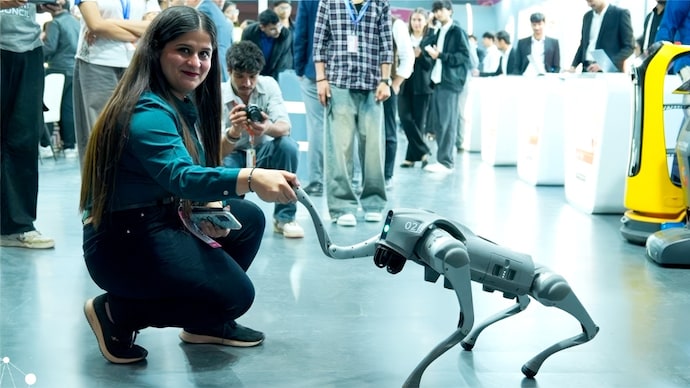
Galgotias University, which is facing an online uproar over claims that the institution had developed and showcased a Chinese-made robotic dog as its own at the India AI Impact Summit in Delhi, has clarified it never claimed to have built the device. The Greater Noida-based university said the robodog on display was procured from Unitree, a Chinese robotics firm, and was being used as a learning tool for students.
Following the controversy, Galgotias University was asked to exit the AI Summit immediately, government sources said. However, the institution said it did not receive any such order from the government.
The clarification followed a wave of social media backlash after a viral video surfaced claiming that a university professor, Neha Singh, had showcased the Unitree Go2 — an AI-powered Chinese robodog sold online for USD 2,800 (around Rs 2.3 lakh) — under the name “Orion” at the summit. Several users accused the institution of passing off imported technology as an indigenously developed product.
“The recently acquired robodog from Unitree is one such step in that journey. It is not merely a machine on display; it is a classroom in motion. Our students are experimenting with it, testing its limits and, in the process, expanding their own knowledge. Let us be clear: Galgotias has not built this robodog, nor have we ever claimed to,” the university said in a statement posted on X.
The university faced further embarrassment when its clarification was fact-checked by an X community note, which said that its claim of not presenting the robodog as its own was incorrect and misleading. “They have named the robot ‘Orion’ and explicitly claimed it was developed by their team,” the note said.
In the statement, the university said innovation and learning should not be confined by borders and that it would continue to source the best technologies from around the world to give students hands-on exposure.
The controversy was triggered by the viral video in which Neha Singh, Galgotias' professor, claimed that the university's Centre of Excellence had developed “Orion” under the institution's Rs 350 crore AI initiative. In the video, Singh was proudly explaining the features of the Chinese-made robodog at the AI summit, triggering a huge controversy.
Responding to the criticism, Galgotias said its mission was to keep students ahead of the technology curve. It said it had consistently brought cutting-edge technologies to its campus from global innovation hubs, including the US, China and Singapore, to ensure students gain real-world exposure.
“Innovation knows no borders. Learning should not either,” the university said, adding that its focus was on enabling students to study advanced technologies, question them and improve upon them.
The institution said the initiative was not about importing technology but about inspiring transformation, underlining that its larger goal was to empower young innovators to think bigger and build world-class solutions from India for the world.
Galgotias University, which is facing an online uproar over claims that the institution had developed and showcased a Chinese-made robotic dog as its own at the India AI Impact Summit in Delhi, has clarified it never claimed to have built the device. The Greater Noida-based university said the robodog on display was procured from Unitree, a Chinese robotics firm, and was being used as a learning tool for students.
Following the controversy, Galgotias University was asked to exit the AI Summit immediately, government sources said. However, the institution said it did not receive any such order from the government.
The clarification followed a wave of social media backlash after a viral video surfaced claiming that a university professor, Neha Singh, had showcased the Unitree Go2 — an AI-powered Chinese robodog sold online for USD 2,800 (around Rs 2.3 lakh) — under the name “Orion” at the summit. Several users accused the institution of passing off imported technology as an indigenously developed product.
“The recently acquired robodog from Unitree is one such step in that journey. It is not merely a machine on display; it is a classroom in motion. Our students are experimenting with it, testing its limits and, in the process, expanding their own knowledge. Let us be clear: Galgotias has not built this robodog, nor have we ever claimed to,” the university said in a statement posted on X.
The university faced further embarrassment when its clarification was fact-checked by an X community note, which said that its claim of not presenting the robodog as its own was incorrect and misleading. “They have named the robot ‘Orion’ and explicitly claimed it was developed by their team,” the note said.
In the statement, the university said innovation and learning should not be confined by borders and that it would continue to source the best technologies from around the world to give students hands-on exposure.
The controversy was triggered by the viral video in which Neha Singh, Galgotias' professor, claimed that the university's Centre of Excellence had developed “Orion” under the institution's Rs 350 crore AI initiative. In the video, Singh was proudly explaining the features of the Chinese-made robodog at the AI summit, triggering a huge controversy.
Responding to the criticism, Galgotias said its mission was to keep students ahead of the technology curve. It said it had consistently brought cutting-edge technologies to its campus from global innovation hubs, including the US, China and Singapore, to ensure students gain real-world exposure.
“Innovation knows no borders. Learning should not either,” the university said, adding that its focus was on enabling students to study advanced technologies, question them and improve upon them.
The institution said the initiative was not about importing technology but about inspiring transformation, underlining that its larger goal was to empower young innovators to think bigger and build world-class solutions from India for the world.

