A conspiracy to get Pakistan water from India under Indus treaty?
As summer temperatures rise, the pressure on Pakistan is mounting due to India keeping the Indus Waters Treaty in abeyance after the Pahalgam terror attack. But an insidious game is on to make India relent even as the West plays along Pakistan's latest peacemaker farce.
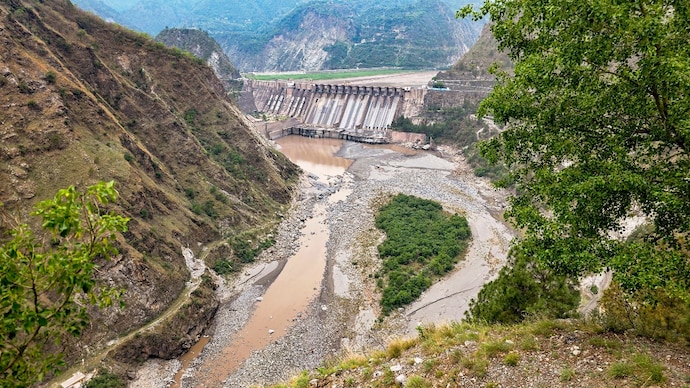
There is a coordinated push by Pakistani media and western platforms and think tanks to project Islamabad as a victim and get India to relent on sharing waters of the Indus River System. India has kept the Indus Waters Treaty (IWT) in abeyance, under which it shared water with Pakistan after its role in the Pahalgam terror attack of 2025. India's leadership has made it clear, blood and water won't flow together.
The attack at Baisaran valley in Pahalagm on April 22 last year saw tourists being segregated on the basis of religion and shot dead at point-blank range. The religious nature of the attack came after dog-whistling by Pakistani Army chief Asim Munir and when a sense of normalcy returned to Jammu and Kashmir.
The coordinated attempt at painting Pakistan as a victim of India's IWT suspension comes even as the former tries to project an image of a peacemaker by mediating in the Iran-US war. A pattern of literature has emerged across Pakistani media and global think-tanks and platforms in recent weeks on the IWT. These come immediately after a meeting convened by Pakistani President Asif Ali Zardari.
The articles, published over the last few weeks, deliberately ignore or downplay Pakistan's role in terrorism and treaty violations. London-based think tank Chatham House was the most prominent, playing the role of pushing Pakistan's agenda.
On April 15, Pakistani President Asif Ali Zardari chaired a high-level meeting on water resources in which he expressed alarm over India's suspension of the 1960 pact, framing it as the "weaponisation of water" and directing diplomatic and legal measures to safeguard Pakistan's rights.
"President Asif Ali Zardari chaired a meeting on water resources, raising concern over India's suspension of the Indus Waters Treaty, and directing transparent, declared load shedding to minimise power outages," the president's official handle posted on X on April 15.
Barely 48 hours after Zardari's meeting, UK-based Chatham House published an expert comment titled 'India and Pakistan still cannot agree to restore the Indus Waters Treaty – but re-engagement could help bring lasting peace'. Authored by Bhargabi Bharadwaj and Beatrice Mosello, it described the Pahalgam terror attack, in which 26 civilians were killed, merely as a "militant attack" for which "India blamed Pakistan (denied by Islamabad)".
The Indus Water Treaty was signed after a decade of India's Independence in 1960 by the then Government of India, led by Prime Minister Jawaharlal Nehru, and Pakistan's Head of State, General Ayub Khan. The treaty, facilitated by the World Bank, allows lower riparian state Pakistan to use the waters of the western rivers of the Indus River System, and emerged as one of the most successful water-sharing treaties in the world. Pakistan's agriculture and power generation depend heavily on the waters of the Indus system.
WHY CHATHAM HOUSE IS BEING CALLED OUT FOR ARTICLE ON INDUS WATERS TREATY
The Chatham House article makes no mention of the word "terrorism", despite Pakistan's documented support for jihadis and India's long-standing warnings that terrorists will not be treated as proxies, and cross-border attacks will be met with direct and appropriate responses.
Former Indian Foreign Secretary Kanwal Sibal called it "an insidious article". He said, "Chatham House is helping Pakistan capitalise on its new 'peace credentials'. The usual pro- Pak games by the British establishment. The article advocates external intervention to unblock India’s suspension of the Treaty..."
The argument of water for peace has been met with failure for decades. While Pakistan got water from India, it tried to bleed India with a thousand cuts. Indians pointed that flawed argument to Chatham House.
"For many decades, India honoured one of the most generous water treaties by any upper riparian state in human history; gave 80% of the Indus River system water to Pakistan. And all it got in return from Pakistan was wars and terror attacks. Chatham House wants India to be a masochist again. No, thanks," wrote author and commentator Amish Tripathi on X.
Chatham House is considered an extension of the British foreign policy establishment.
This timing is dubious. When coupled with selective framing that downplays Pakistan's role in terrorism, it becomes even more questionable. Why ask for restoration of water to Pakistan when India's core concern about terrorism emanating from the country remains unaddressed?
SYNCHRONISED REPORTING ON IWT SUSPENSION, WATER WOES
Then, just three days later, on April 20, Pakistani media outlets carried a supposedly "human interest" story on the IWT by the Associated Press of Pakistan (APP). To make it clear, the APP has no association with international news agency The Associated Press (AP) and is run by the Pakistani government.
While the Karachi-based daily Dawn headlined the APP piece 'Water worries grip KP [Khyber Pakhtunkhwa] farmers amid Indus Treaty concerns', Pakistan Today's headline was 'KP farmers fear water shortages over IWT concerns'.
The APP article had an emotional quote from a Dera Ismail Khan-based farmer, Adnan Khan. "We live by this water. If it stops, everything stops," Khan was quoted as saying.
The article highlighted risks to wheat, maize, livestock, and dams like Tarbela and Mangla, blaming the "fascist Modi government's decision to hold the treaty in abeyance" as showing "disregard for international treaties and guarantees of the World Bank". Note the use of the term "fascist".
Legal experts quoted in the article called India's keeping the IWT in abeyance "illegal".
The same day (April 20), Lahore-based daily, The Nation, echoed the same tone, quoting the leader of the Khaskheli tribe (Sindhi), Chief Sardar Raja Ghulam Murtaza Khaskheli, alleging India seeks to "weaken Pakistan by violating the Indus Waters Treaty, by seeking control over Pakistan's water resources."
The tribal leader quoted by The Nation demanded the government raise it at international fora and respond firmly to "aggressive actions". Pakistan seems to be doing well with the help of some compliant partners.
Earlier, on April 3, the US-based journal, Eurasia Review, ran an OpEd by Pakistani writer Amina Jabbar, titled 'India Remains Silent 100 Days After UN Indus Waters Treaty Deadline'.
"New Delhi has maintained complete silence since the original deadline [of suspension of IWT] which expired on 16 December 2025. The extended period without any response has prompted international legal experts and diplomats to view this situation as a pattern of behavior that demonstrates India's refusal to participate in international accountability processes," alleged the Pakistani writer.
HOW WEST PLAYS ALONG WITH PAKISTAN'S FARCE
Even the Chatham House article criticised New Delhi's "lack of response" to UN Special Rapporteurs' queries on the alleged IWT violations, framing India as evading "international accountability processes" while glossing over the treaty's suspension being tied to the Pahalgam attack.
The sudden clustering of Pakistani media hammering identical farmer distress narratives, a British establishment-linked think-tank pushing for "re-engagement" and other literature suggests that this is a narrative-building exercise on the IWT and not organic commentary.
It appears like quite a calculated bid to internationalise the issue, humanise Pakistan's plight, and pressure India into restoring the treaty on Islamabad's terms. And the narrative is being built at a time when the Islamabad-Rawalpindi hybrid regime is trying to cast the exporter of terror as a peacenik with active encouragement from a desperate American President Donald Trump.
At the Rajdeep Sardesai-hosted News Today show on India Today TV, Pakistani journalist Najam Sethi claimed that the days of Pakistan's global image as an exporter of terrorism, which has often been placed on the FATF watch lists, are long past.
"It's gone away because Pakistan has not been exporting terror. And it's number one in the world. The world knows this. And right now, the world is appreciative of Pakistan," said Najam Sethi, referring to Pakistan playing host to the now-abandoned US-Iran talks.
"Pakistan has already established itself as a good interlocutor and as a good mediator. It's standing in all the world capitals has gone up. My understanding is, in fact, knowledge is that all the top leaders of the world are in touch with Pakistan's leadership, and urging them to get on and continue to play this role," said Sethi, adding, "Whether they [the talks] succeed or not, I think Pakistan has arrived at a place where its importance is now being recognized as a player in the Middle East."
This is the latest farce being pulled off by Pakistan, and the west is playing along. It is but natural that Pakistan would try to extract its pound of flesh. Its narrative-building on the IWT could be a signal to that.
"Indus Treaty worms coming out of various 'news' portals. Deep state actors have been activated on the India-Pakistan water issue," warned Smita Prakash, a veteran journalist and editor of news agency ANI.
"Summer is coming. They will feel the pinch and big issues. Pak is playing sepoy to some powers. Hence the DS [Deep State] actors are poking their head into a bilateral issue," said the verified handle, Aravind, known for its predictions to Prakash's post.
New Delhi has been firm on the suspension of the IWT. Not just water, but $1 billion ($10 billion in current exchange terms) also flow into Pakistan from India.
As India's Permanent Representative to the United Nations, P Harish, reiterated on March 20 at a World Water Day event, "Pakistan must uphold the sanctity of human life before raising treaty concerns. India signed the 1960 treaty in good faith, but Pakistan undermined it through wars and terror attacks."
Harish noted India's attempts to modernise the pact amid technological and environmental changes were rejected by Pakistan. India is trying for optimal use of the waters of the Indus River System with dams.
The IWT was never meant to benefit a neighbour that tries to bleed India through a thousand cuts. It wasn't meant for a country that exported terrorism. By suspending the generous IWT, India has acted decisively against Pakistan. Islamabad might do its best at playing the "victim card" and using western think tanks to amp up its propaganda, but New Delhi won't relent unless it is assured and sees evidence that Pakistan has stopped sponsoring terrorism.
There is a coordinated push by Pakistani media and western platforms and think tanks to project Islamabad as a victim and get India to relent on sharing waters of the Indus River System. India has kept the Indus Waters Treaty (IWT) in abeyance, under which it shared water with Pakistan after its role in the Pahalgam terror attack of 2025. India's leadership has made it clear, blood and water won't flow together.
The attack at Baisaran valley in Pahalagm on April 22 last year saw tourists being segregated on the basis of religion and shot dead at point-blank range. The religious nature of the attack came after dog-whistling by Pakistani Army chief Asim Munir and when a sense of normalcy returned to Jammu and Kashmir.
The coordinated attempt at painting Pakistan as a victim of India's IWT suspension comes even as the former tries to project an image of a peacemaker by mediating in the Iran-US war. A pattern of literature has emerged across Pakistani media and global think-tanks and platforms in recent weeks on the IWT. These come immediately after a meeting convened by Pakistani President Asif Ali Zardari.
The articles, published over the last few weeks, deliberately ignore or downplay Pakistan's role in terrorism and treaty violations. London-based think tank Chatham House was the most prominent, playing the role of pushing Pakistan's agenda.
On April 15, Pakistani President Asif Ali Zardari chaired a high-level meeting on water resources in which he expressed alarm over India's suspension of the 1960 pact, framing it as the "weaponisation of water" and directing diplomatic and legal measures to safeguard Pakistan's rights.
"President Asif Ali Zardari chaired a meeting on water resources, raising concern over India's suspension of the Indus Waters Treaty, and directing transparent, declared load shedding to minimise power outages," the president's official handle posted on X on April 15.
Barely 48 hours after Zardari's meeting, UK-based Chatham House published an expert comment titled 'India and Pakistan still cannot agree to restore the Indus Waters Treaty – but re-engagement could help bring lasting peace'. Authored by Bhargabi Bharadwaj and Beatrice Mosello, it described the Pahalgam terror attack, in which 26 civilians were killed, merely as a "militant attack" for which "India blamed Pakistan (denied by Islamabad)".
The Indus Water Treaty was signed after a decade of India's Independence in 1960 by the then Government of India, led by Prime Minister Jawaharlal Nehru, and Pakistan's Head of State, General Ayub Khan. The treaty, facilitated by the World Bank, allows lower riparian state Pakistan to use the waters of the western rivers of the Indus River System, and emerged as one of the most successful water-sharing treaties in the world. Pakistan's agriculture and power generation depend heavily on the waters of the Indus system.
WHY CHATHAM HOUSE IS BEING CALLED OUT FOR ARTICLE ON INDUS WATERS TREATY
The Chatham House article makes no mention of the word "terrorism", despite Pakistan's documented support for jihadis and India's long-standing warnings that terrorists will not be treated as proxies, and cross-border attacks will be met with direct and appropriate responses.
Former Indian Foreign Secretary Kanwal Sibal called it "an insidious article". He said, "Chatham House is helping Pakistan capitalise on its new 'peace credentials'. The usual pro- Pak games by the British establishment. The article advocates external intervention to unblock India’s suspension of the Treaty..."
The argument of water for peace has been met with failure for decades. While Pakistan got water from India, it tried to bleed India with a thousand cuts. Indians pointed that flawed argument to Chatham House.
"For many decades, India honoured one of the most generous water treaties by any upper riparian state in human history; gave 80% of the Indus River system water to Pakistan. And all it got in return from Pakistan was wars and terror attacks. Chatham House wants India to be a masochist again. No, thanks," wrote author and commentator Amish Tripathi on X.
Chatham House is considered an extension of the British foreign policy establishment.
This timing is dubious. When coupled with selective framing that downplays Pakistan's role in terrorism, it becomes even more questionable. Why ask for restoration of water to Pakistan when India's core concern about terrorism emanating from the country remains unaddressed?
SYNCHRONISED REPORTING ON IWT SUSPENSION, WATER WOES
Then, just three days later, on April 20, Pakistani media outlets carried a supposedly "human interest" story on the IWT by the Associated Press of Pakistan (APP). To make it clear, the APP has no association with international news agency The Associated Press (AP) and is run by the Pakistani government.
While the Karachi-based daily Dawn headlined the APP piece 'Water worries grip KP [Khyber Pakhtunkhwa] farmers amid Indus Treaty concerns', Pakistan Today's headline was 'KP farmers fear water shortages over IWT concerns'.
The APP article had an emotional quote from a Dera Ismail Khan-based farmer, Adnan Khan. "We live by this water. If it stops, everything stops," Khan was quoted as saying.
The article highlighted risks to wheat, maize, livestock, and dams like Tarbela and Mangla, blaming the "fascist Modi government's decision to hold the treaty in abeyance" as showing "disregard for international treaties and guarantees of the World Bank". Note the use of the term "fascist".
Legal experts quoted in the article called India's keeping the IWT in abeyance "illegal".
The same day (April 20), Lahore-based daily, The Nation, echoed the same tone, quoting the leader of the Khaskheli tribe (Sindhi), Chief Sardar Raja Ghulam Murtaza Khaskheli, alleging India seeks to "weaken Pakistan by violating the Indus Waters Treaty, by seeking control over Pakistan's water resources."
The tribal leader quoted by The Nation demanded the government raise it at international fora and respond firmly to "aggressive actions". Pakistan seems to be doing well with the help of some compliant partners.
Earlier, on April 3, the US-based journal, Eurasia Review, ran an OpEd by Pakistani writer Amina Jabbar, titled 'India Remains Silent 100 Days After UN Indus Waters Treaty Deadline'.
"New Delhi has maintained complete silence since the original deadline [of suspension of IWT] which expired on 16 December 2025. The extended period without any response has prompted international legal experts and diplomats to view this situation as a pattern of behavior that demonstrates India's refusal to participate in international accountability processes," alleged the Pakistani writer.
HOW WEST PLAYS ALONG WITH PAKISTAN'S FARCE
Even the Chatham House article criticised New Delhi's "lack of response" to UN Special Rapporteurs' queries on the alleged IWT violations, framing India as evading "international accountability processes" while glossing over the treaty's suspension being tied to the Pahalgam attack.
The sudden clustering of Pakistani media hammering identical farmer distress narratives, a British establishment-linked think-tank pushing for "re-engagement" and other literature suggests that this is a narrative-building exercise on the IWT and not organic commentary.
It appears like quite a calculated bid to internationalise the issue, humanise Pakistan's plight, and pressure India into restoring the treaty on Islamabad's terms. And the narrative is being built at a time when the Islamabad-Rawalpindi hybrid regime is trying to cast the exporter of terror as a peacenik with active encouragement from a desperate American President Donald Trump.
At the Rajdeep Sardesai-hosted News Today show on India Today TV, Pakistani journalist Najam Sethi claimed that the days of Pakistan's global image as an exporter of terrorism, which has often been placed on the FATF watch lists, are long past.
"It's gone away because Pakistan has not been exporting terror. And it's number one in the world. The world knows this. And right now, the world is appreciative of Pakistan," said Najam Sethi, referring to Pakistan playing host to the now-abandoned US-Iran talks.
"Pakistan has already established itself as a good interlocutor and as a good mediator. It's standing in all the world capitals has gone up. My understanding is, in fact, knowledge is that all the top leaders of the world are in touch with Pakistan's leadership, and urging them to get on and continue to play this role," said Sethi, adding, "Whether they [the talks] succeed or not, I think Pakistan has arrived at a place where its importance is now being recognized as a player in the Middle East."
This is the latest farce being pulled off by Pakistan, and the west is playing along. It is but natural that Pakistan would try to extract its pound of flesh. Its narrative-building on the IWT could be a signal to that.
"Indus Treaty worms coming out of various 'news' portals. Deep state actors have been activated on the India-Pakistan water issue," warned Smita Prakash, a veteran journalist and editor of news agency ANI.
"Summer is coming. They will feel the pinch and big issues. Pak is playing sepoy to some powers. Hence the DS [Deep State] actors are poking their head into a bilateral issue," said the verified handle, Aravind, known for its predictions to Prakash's post.
New Delhi has been firm on the suspension of the IWT. Not just water, but $1 billion ($10 billion in current exchange terms) also flow into Pakistan from India.
As India's Permanent Representative to the United Nations, P Harish, reiterated on March 20 at a World Water Day event, "Pakistan must uphold the sanctity of human life before raising treaty concerns. India signed the 1960 treaty in good faith, but Pakistan undermined it through wars and terror attacks."
Harish noted India's attempts to modernise the pact amid technological and environmental changes were rejected by Pakistan. India is trying for optimal use of the waters of the Indus River System with dams.
The IWT was never meant to benefit a neighbour that tries to bleed India through a thousand cuts. It wasn't meant for a country that exported terrorism. By suspending the generous IWT, India has acted decisively against Pakistan. Islamabad might do its best at playing the "victim card" and using western think tanks to amp up its propaganda, but New Delhi won't relent unless it is assured and sees evidence that Pakistan has stopped sponsoring terrorism.

