Brothers of cave: Nagas, Kukis and a war that keeps coming home
From a shared folklore and a common cave to colonial divisions and competing homelands, the story of Manipur's Nagas and Kukis is ultimately one of kinship fractured by history, memory and the battle over land.
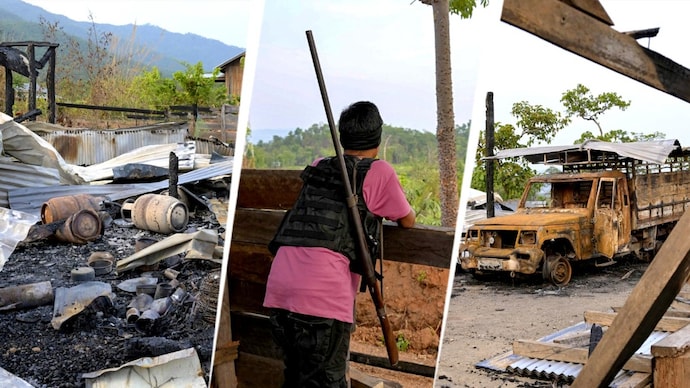
There's a story told in the hills of Manipur. Not one story, really — many versions of it, passed down by different tribes, in different tongues, each a little different from the last. But the bones of it are always the same. It goes like this.
Once, there were three brothers. Sons of the same father. One of them climbed high and settled on the mountaintops — and his children became the hill people we now call the Nagas. Another settled the slopes and the forests below — and his children we call the Kukis. And the youngest went down into the valley, into the rice and the rivers, and became the Meiteis.
This is folklore, not a family tree. No one is claiming these three people literally share one grandfather. What we have are stories — recorded over a century ago by British officers like William McCulloch and TC Hodson, who sat with village elders and wrote down what they heard. And what they heard, again and again, was a tradition of kinship. Of brotherhood. Of people who remembered, dimly, being one before they were many.
Hold that story in your head: the brothers, and the cave. Because right now, in 2026, in the hills of Manipur, two of those brothers are burning each other's villages.
THE LONG WALK
The Nagas and the Kukis are both Tibeto-Burman-speaking people — which means their languages, and the long human story behind them, link back to one of the great migrations of Asia. Scholars trace it, broadly, to the uplands of southwestern China and the eastern edge of the Himalaya, with peoples drifting south and west over many centuries, down through what is now Myanmar, settling at last in these blue-green hills.
Their languages are cousins, filed by linguists within the sprawling Tibeto-Burman family — though most experts say the Naga tongues are not one language but a scattering of many, spread across several subgroups. "Naga" was never a single people. It's an umbrella over dozens of tribes — Tangkhul, Mao, Rongmei, Liangmai, Zeliang, and more — each with its own language, its own land, its own memory.
But the two people arrived at different times. And that timing is the first crack in the story.
The Nagas are old in these hills. Many of their traditions point to a place called Makhel, where, the legend says, the tribes parted ways and scattered across the ranges, marking the spot with a giant standing stone. Deep-rooted people. Possessive of their land in the way that only those who have buried twenty generations in the same soil can be.
The Kukis came in waves too — but several historians describe the largest of these as coming later, major migrations into Manipur through the 18th and 19th centuries, as Kuki clans were pushed out of the Chin Hills of Myanmar by stronger groups to the south. And here's a detail that matters: by credible historical accounts, the Meitei kings of the valley didn't just tolerate this — they used it. They settled the famously warlike Kuki clans on the exposed frontiers, deliberately, as a living wall against Burmese invaders to the east and raiders to the north. The colonial ethnographer J Shakespear recorded exactly this.
Think about what that means. A person was invited in, partly, to be a barrier. A buffer. That word is going to echo.
The Kukis, the Chins of Myanmar, the Mizos — many of them share an older name for themselves: Zo. The people of the hills. The name that was theirs before anyone else got around to naming them.
THE WORLD THEY BUILT
Now — the culture. Picture a Naga village before the missionaries came. At its heart stood the morung — a great carved longhouse, perched at the highest point, hung with elephant heads and tusks and hornbill feathers. The morung was school, barracks, dormitory, parliament, all at once. This is where the young men slept, where boys learned warfare and woodcraft and the old songs, where the council of elders made the decisions that ran the village's life — and its wars.
And yes — in the days of headhunting, the morung is where the heads were brought. Because for the Naga warrior, taking an enemy's head was not cruelty for its own sake. Anthropologists who studied these communities describe it as bound up with everything — fertility, prosperity, manhood, the ancestral order of the world. The skull on the wall was a kind of cosmic ledger.
When enemies approached, a log drum — a single tree trunk hollowed into a giant gong — would sound through the valley. War, announced by music.
The Kuki world ran on a different engine. Where many Naga tribes governed through councils, Kuki society turned on the chief — the haosa — who held the land and led the clan, his authority strong enough that when the British came to break it, the Kukis rose against the Empire in a coordinated revolt: the Kuki Rising of 1917 to 1919, an uprising of chiefs and villages across the hills. Their lives followed jhum — shifting cultivation, the slash-and-burn rhythm of clear, plant, harvest, move on — and their festivals followed the harvest. Chavang Kut in the autumn. Mim Kut for the maize. The chief's great gong, the dahpi, would sound from his house to open the celebration, and the rice beer would flow, and there would be dancing — sword dances, war dances — and courtship and feasting.
Two people. Two ways of holding a hill. And then, within a single century, both worlds were turned inside out by the same two forces.
THE NAMING
Here's something most people don't know. Neither "Naga" nor "Kuki" began as a name these people chose for themselves.
Both terms, the evidence suggests, started as labels used by outsiders — by neighbours in the plains, by the Burmese, by the Ahoms of Assam, eventually by the British. Names handed to people from the outside, looking up at the hills. (Identities move, of course — and today these same communities claim these names with fierce pride. A label imposed can become a banner chosen. But it's worth remembering where the words came from.)
And then the British arrived, and did what empires do. They sorted. They classified. They took the messy, overlapping, intermarried reality of the hills and pressed it into neat administrative boxes — this tribe is Naga, that one is Kuki — and wrote it into census reports and gazetteers, counting "old Kukis" and "new Kukis," fixing fluid identities into hard lines. This isn't a fringe reading; it's a mainstream argument in postcolonial scholarship — that colonial classification didn't just describe these communities, it helped harden them into the rival blocs that later politics would inherit.
The missionaries came in on the same tide. And here both brothers share a wound. Christianity swept these hills with extraordinary speed — and missionary activity, by most accounts, often discouraged or displaced the older practices rather than meeting them. Converts were steered away from the folk songs, the dances, the rice beer, the feasts of merit, the sleeping in the morung. In some documented cases, Nagas even burned their own houses and carved heirlooms as proof of a clean break. The morung faded. The old religion was, in one scholar's word, desacralised — emptied of its holiness, kept on as costume, brought out for festivals and tourists.
Today, both people are overwhelmingly Christian. They kept the harvest festivals — but rebranded. By recent accounts, a Chavang Kut in Kangpokpi was held under the theme “Kut for Christ.”
So picture the irony. Two cousin-peoples — named by outsiders, sorted into rival boxes by a colonial pen, steered away from the shared older world that once bound them — and then handed the modern vocabulary of nationhood, of homeland, of self-determination.
You can see where this is going.
THE FIRST FIRE
The 1990s.
By then, both brothers had a dream, and the dreams were drawn on the same map.
The Nagas — through the insurgent group NSCN, the National Socialist Council of Nagaland, and especially its Isak-Muivah faction, the NSCN-IM — wanted Nagalim. Greater Nagaland. A single Naga homeland stitching together every Naga-inhabited patch across Nagaland, Manipur, Assam, Arunachal, and over the border into Myanmar.
The Kukis, increasingly, wanted a homeland of their own. A Kuki state, carved from the same Manipur hills.
And those two maps overlapped. The land one brother called his ancestral home was the land the other called his. There is only so much hill.
It caught fire in 1992. The flashpoint was around Moreh — the dusty, lucrative border town on the trade road to Myanmar — and the violence spiralled out from there, district by district, in a cycle of attack and retaliation.
The worst single day came in September 1993. In the hills, fighters — by most accounts belonging to the NSCN-IM — fell on Kuki villages. Kuki accounts put the dead at around 115 civilians, men, women and children. The Kukis call it the Joupi massacre, after the village that bled the most.
It went on like that, on and off, until 1997. Five years. The numbers are contested and politically charged — most accounts place the dead at more than a thousand; some scholarship puts the figure across both communities at over two thousand. By the Kuki community's own count, more than 960 of their people were killed, 360 villages uprooted, a hundred thousand driven from their homes. The Nagas have their own dead and their own grievances, their own villages burned — though, it has to be said, the Naga toll from those years is far more poorly documented than the Kuki one.
THE PEACE THAT WASN'T
After 1997, the fire went out. Sort of.
The two communities did what neighbours do. They went back to living side by side — Kuki villages in Naga-majority Ukhrul and Senapati, Naga villages in Kuki areas. They traded. They coexisted. It's worth remembering that for long stretches of their history this is the norm, not the exception — there are records of Nagas inviting Kukis to settle beside them, for protection and for help mediating disputes.
But nothing was healed. It was only paused.
Every September, the Kukis gather to remember Joupi. On the 25th anniversary, in 2018, they raised three stone monoliths inscribed with over eleven hundred names — and on the plaque, one word. The word the Kuki community uses for what they say was done to them: genocide.
This is the thing about these hills. They are made of memory. The standing stone at Makhel marks a Naga dispersal thousands of years old. The monoliths at Joupi mark a massacre most of the country has already forgotten. The Nagas raise megaliths to honour the dead and the generous; the Kukis carve names into rock so the killing is never unsaid.
A people who build an identity out of stone do not let go of a wound. They monument it.
THE RETURN
Which brings us to now. 2026.
You probably know the recent Manipur story as a two-sided war: the Meiteis of the valley against the Kukis of the hills, the violence that broke open in May 2023 and never properly closed. Through most of that, the Nagas stood aside. Neutral. Watching.
Not anymore.
According to recent reporting, since early 2026 a third front has opened — Naga against Kuki — and security officials will quietly tell journalists their nightmare has shifted. The spark, by one account, was almost unbelievably small: an argument in Ukhrul, an altercation, and within days a village was burning. From there the old machine restarted — abductions, hostages, torched homes, more than a dozen dead in a matter of weeks. In one recent flare, reporting described dozens of civilians taken hostage by both sides, with people from each community still being held as this is written.
And the reasons are the old reasons, wearing new clothes.
Land: the fear, on the Naga side, that a Kuki homeland means Kukis laying claim to soil the Nagas call their forefathers'. Resources: Kukis displaced from the valley have crowded up into the hills, pressing on the same forests and fields. And money. Trade routes through these hills are worth fortunes, and control of them has become its own flashpoint, the way the road through Moreh once was.
Layered on top of all this is a quarrel inside the Naga movement itself. The NSCN-IM has been talking peace with Delhi for over two decades — a Framework Agreement signed back in 2015 that has gone almost nowhere. And Naga insurgent politics has fractured repeatedly over the years, the most recent split spilling into open feuding between factions — so that the conflict with the Kukis has become, in part, a stage for the Nagas' war with themselves.
So let me bring you back to the three brothers and the cave. These are not ancient, eternal enemies. In their own oldest stories — the ones McCulloch and Hodson wrote down a century ago — they are family. Cousins in language. People who remembered being one. There are folktales of the brotherhood between Naga and Kuki and Meitei, and of their slow drifting apart, and the people who told them worried, even then, that the modern generation would forget the oneness that once let them stand together against the Burmese.
They forgot.
And a great deal of what divides them now was deepened from the outside. The names that label them were given by strangers. The boxes they fight over were hardened by a colonial census. The religion that might have bound them came, first, asking them to burn what they shared. None of that erases their own agency — these are people who built their own nationalisms, made their own choices, drew their own maps. But it does mean the divisions feel older and more natural than they are. Colonialism didn't invent the rivalry. It set it in cement, and handed both sides the language to die for it.
The hills remember everything. That's their gift, and their curse. Three brothers came out of a cave, a long time ago. And their children are still trying to work out where the line between them falls — one torched house, one hostage, one monument at a time.
There's a story told in the hills of Manipur. Not one story, really — many versions of it, passed down by different tribes, in different tongues, each a little different from the last. But the bones of it are always the same. It goes like this.
Once, there were three brothers. Sons of the same father. One of them climbed high and settled on the mountaintops — and his children became the hill people we now call the Nagas. Another settled the slopes and the forests below — and his children we call the Kukis. And the youngest went down into the valley, into the rice and the rivers, and became the Meiteis.
This is folklore, not a family tree. No one is claiming these three people literally share one grandfather. What we have are stories — recorded over a century ago by British officers like William McCulloch and TC Hodson, who sat with village elders and wrote down what they heard. And what they heard, again and again, was a tradition of kinship. Of brotherhood. Of people who remembered, dimly, being one before they were many.
Hold that story in your head: the brothers, and the cave. Because right now, in 2026, in the hills of Manipur, two of those brothers are burning each other's villages.
THE LONG WALK
The Nagas and the Kukis are both Tibeto-Burman-speaking people — which means their languages, and the long human story behind them, link back to one of the great migrations of Asia. Scholars trace it, broadly, to the uplands of southwestern China and the eastern edge of the Himalaya, with peoples drifting south and west over many centuries, down through what is now Myanmar, settling at last in these blue-green hills.
Their languages are cousins, filed by linguists within the sprawling Tibeto-Burman family — though most experts say the Naga tongues are not one language but a scattering of many, spread across several subgroups. "Naga" was never a single people. It's an umbrella over dozens of tribes — Tangkhul, Mao, Rongmei, Liangmai, Zeliang, and more — each with its own language, its own land, its own memory.
But the two people arrived at different times. And that timing is the first crack in the story.
The Nagas are old in these hills. Many of their traditions point to a place called Makhel, where, the legend says, the tribes parted ways and scattered across the ranges, marking the spot with a giant standing stone. Deep-rooted people. Possessive of their land in the way that only those who have buried twenty generations in the same soil can be.
The Kukis came in waves too — but several historians describe the largest of these as coming later, major migrations into Manipur through the 18th and 19th centuries, as Kuki clans were pushed out of the Chin Hills of Myanmar by stronger groups to the south. And here's a detail that matters: by credible historical accounts, the Meitei kings of the valley didn't just tolerate this — they used it. They settled the famously warlike Kuki clans on the exposed frontiers, deliberately, as a living wall against Burmese invaders to the east and raiders to the north. The colonial ethnographer J Shakespear recorded exactly this.
Think about what that means. A person was invited in, partly, to be a barrier. A buffer. That word is going to echo.
The Kukis, the Chins of Myanmar, the Mizos — many of them share an older name for themselves: Zo. The people of the hills. The name that was theirs before anyone else got around to naming them.
THE WORLD THEY BUILT
Now — the culture. Picture a Naga village before the missionaries came. At its heart stood the morung — a great carved longhouse, perched at the highest point, hung with elephant heads and tusks and hornbill feathers. The morung was school, barracks, dormitory, parliament, all at once. This is where the young men slept, where boys learned warfare and woodcraft and the old songs, where the council of elders made the decisions that ran the village's life — and its wars.
And yes — in the days of headhunting, the morung is where the heads were brought. Because for the Naga warrior, taking an enemy's head was not cruelty for its own sake. Anthropologists who studied these communities describe it as bound up with everything — fertility, prosperity, manhood, the ancestral order of the world. The skull on the wall was a kind of cosmic ledger.
When enemies approached, a log drum — a single tree trunk hollowed into a giant gong — would sound through the valley. War, announced by music.
The Kuki world ran on a different engine. Where many Naga tribes governed through councils, Kuki society turned on the chief — the haosa — who held the land and led the clan, his authority strong enough that when the British came to break it, the Kukis rose against the Empire in a coordinated revolt: the Kuki Rising of 1917 to 1919, an uprising of chiefs and villages across the hills. Their lives followed jhum — shifting cultivation, the slash-and-burn rhythm of clear, plant, harvest, move on — and their festivals followed the harvest. Chavang Kut in the autumn. Mim Kut for the maize. The chief's great gong, the dahpi, would sound from his house to open the celebration, and the rice beer would flow, and there would be dancing — sword dances, war dances — and courtship and feasting.
Two people. Two ways of holding a hill. And then, within a single century, both worlds were turned inside out by the same two forces.
THE NAMING
Here's something most people don't know. Neither "Naga" nor "Kuki" began as a name these people chose for themselves.
Both terms, the evidence suggests, started as labels used by outsiders — by neighbours in the plains, by the Burmese, by the Ahoms of Assam, eventually by the British. Names handed to people from the outside, looking up at the hills. (Identities move, of course — and today these same communities claim these names with fierce pride. A label imposed can become a banner chosen. But it's worth remembering where the words came from.)
And then the British arrived, and did what empires do. They sorted. They classified. They took the messy, overlapping, intermarried reality of the hills and pressed it into neat administrative boxes — this tribe is Naga, that one is Kuki — and wrote it into census reports and gazetteers, counting "old Kukis" and "new Kukis," fixing fluid identities into hard lines. This isn't a fringe reading; it's a mainstream argument in postcolonial scholarship — that colonial classification didn't just describe these communities, it helped harden them into the rival blocs that later politics would inherit.
The missionaries came in on the same tide. And here both brothers share a wound. Christianity swept these hills with extraordinary speed — and missionary activity, by most accounts, often discouraged or displaced the older practices rather than meeting them. Converts were steered away from the folk songs, the dances, the rice beer, the feasts of merit, the sleeping in the morung. In some documented cases, Nagas even burned their own houses and carved heirlooms as proof of a clean break. The morung faded. The old religion was, in one scholar's word, desacralised — emptied of its holiness, kept on as costume, brought out for festivals and tourists.
Today, both people are overwhelmingly Christian. They kept the harvest festivals — but rebranded. By recent accounts, a Chavang Kut in Kangpokpi was held under the theme “Kut for Christ.”
So picture the irony. Two cousin-peoples — named by outsiders, sorted into rival boxes by a colonial pen, steered away from the shared older world that once bound them — and then handed the modern vocabulary of nationhood, of homeland, of self-determination.
You can see where this is going.
THE FIRST FIRE
The 1990s.
By then, both brothers had a dream, and the dreams were drawn on the same map.
The Nagas — through the insurgent group NSCN, the National Socialist Council of Nagaland, and especially its Isak-Muivah faction, the NSCN-IM — wanted Nagalim. Greater Nagaland. A single Naga homeland stitching together every Naga-inhabited patch across Nagaland, Manipur, Assam, Arunachal, and over the border into Myanmar.
The Kukis, increasingly, wanted a homeland of their own. A Kuki state, carved from the same Manipur hills.
And those two maps overlapped. The land one brother called his ancestral home was the land the other called his. There is only so much hill.
It caught fire in 1992. The flashpoint was around Moreh — the dusty, lucrative border town on the trade road to Myanmar — and the violence spiralled out from there, district by district, in a cycle of attack and retaliation.
The worst single day came in September 1993. In the hills, fighters — by most accounts belonging to the NSCN-IM — fell on Kuki villages. Kuki accounts put the dead at around 115 civilians, men, women and children. The Kukis call it the Joupi massacre, after the village that bled the most.
It went on like that, on and off, until 1997. Five years. The numbers are contested and politically charged — most accounts place the dead at more than a thousand; some scholarship puts the figure across both communities at over two thousand. By the Kuki community's own count, more than 960 of their people were killed, 360 villages uprooted, a hundred thousand driven from their homes. The Nagas have their own dead and their own grievances, their own villages burned — though, it has to be said, the Naga toll from those years is far more poorly documented than the Kuki one.
THE PEACE THAT WASN'T
After 1997, the fire went out. Sort of.
The two communities did what neighbours do. They went back to living side by side — Kuki villages in Naga-majority Ukhrul and Senapati, Naga villages in Kuki areas. They traded. They coexisted. It's worth remembering that for long stretches of their history this is the norm, not the exception — there are records of Nagas inviting Kukis to settle beside them, for protection and for help mediating disputes.
But nothing was healed. It was only paused.
Every September, the Kukis gather to remember Joupi. On the 25th anniversary, in 2018, they raised three stone monoliths inscribed with over eleven hundred names — and on the plaque, one word. The word the Kuki community uses for what they say was done to them: genocide.
This is the thing about these hills. They are made of memory. The standing stone at Makhel marks a Naga dispersal thousands of years old. The monoliths at Joupi mark a massacre most of the country has already forgotten. The Nagas raise megaliths to honour the dead and the generous; the Kukis carve names into rock so the killing is never unsaid.
A people who build an identity out of stone do not let go of a wound. They monument it.
THE RETURN
Which brings us to now. 2026.
You probably know the recent Manipur story as a two-sided war: the Meiteis of the valley against the Kukis of the hills, the violence that broke open in May 2023 and never properly closed. Through most of that, the Nagas stood aside. Neutral. Watching.
Not anymore.
According to recent reporting, since early 2026 a third front has opened — Naga against Kuki — and security officials will quietly tell journalists their nightmare has shifted. The spark, by one account, was almost unbelievably small: an argument in Ukhrul, an altercation, and within days a village was burning. From there the old machine restarted — abductions, hostages, torched homes, more than a dozen dead in a matter of weeks. In one recent flare, reporting described dozens of civilians taken hostage by both sides, with people from each community still being held as this is written.
And the reasons are the old reasons, wearing new clothes.
Land: the fear, on the Naga side, that a Kuki homeland means Kukis laying claim to soil the Nagas call their forefathers'. Resources: Kukis displaced from the valley have crowded up into the hills, pressing on the same forests and fields. And money. Trade routes through these hills are worth fortunes, and control of them has become its own flashpoint, the way the road through Moreh once was.
Layered on top of all this is a quarrel inside the Naga movement itself. The NSCN-IM has been talking peace with Delhi for over two decades — a Framework Agreement signed back in 2015 that has gone almost nowhere. And Naga insurgent politics has fractured repeatedly over the years, the most recent split spilling into open feuding between factions — so that the conflict with the Kukis has become, in part, a stage for the Nagas' war with themselves.
So let me bring you back to the three brothers and the cave. These are not ancient, eternal enemies. In their own oldest stories — the ones McCulloch and Hodson wrote down a century ago — they are family. Cousins in language. People who remembered being one. There are folktales of the brotherhood between Naga and Kuki and Meitei, and of their slow drifting apart, and the people who told them worried, even then, that the modern generation would forget the oneness that once let them stand together against the Burmese.
They forgot.
And a great deal of what divides them now was deepened from the outside. The names that label them were given by strangers. The boxes they fight over were hardened by a colonial census. The religion that might have bound them came, first, asking them to burn what they shared. None of that erases their own agency — these are people who built their own nationalisms, made their own choices, drew their own maps. But it does mean the divisions feel older and more natural than they are. Colonialism didn't invent the rivalry. It set it in cement, and handed both sides the language to die for it.
The hills remember everything. That's their gift, and their curse. Three brothers came out of a cave, a long time ago. And their children are still trying to work out where the line between them falls — one torched house, one hostage, one monument at a time.

