From film icon to political phenomenon: The Vijay frenzy across Tamil Nadu
What is unfolding in Tamil Nadu around Vijay is no longer mere celebrity worship, but the rise of a political phenomenon driven by emotion, loyalty, and extraordinary public expectation.
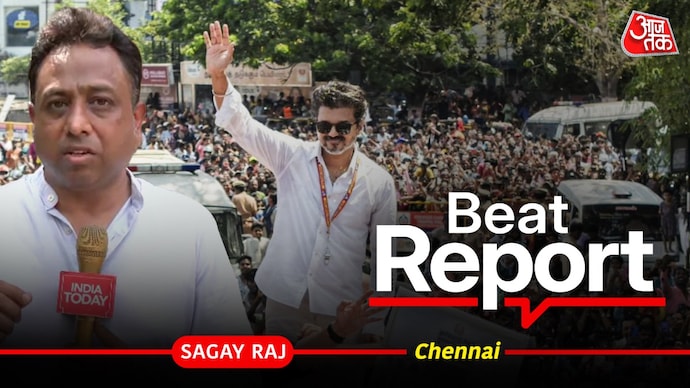
The headquarters of Tamilaga Vettri Kazhagam (TVK) in Chennai’s Panaiyur and the residences of Joseph Vijay in Neelangarai and Pattinampakam have evolved into something beyond political landmarks. They have become tourist attractions in their own right.
Despite no official confirmation of Vijay’s arrival, hundreds of supporters began gathering outside the TVK office from early morning, braving Chennai’s harsh summer heat after the actor’s party stormed to power in a stunning political delivery. Some stood behind barricades for hours, while others clicked selfies, recorded Instagram reels, and went live on social media simply to say they were standing outside Vijay’s office.
For an outsider from Karnataka deployed in Tamil Nadu to cover politics, the experience was nothing short of a cultural shock.
In Karnataka, celebrity politicians draw crowds, admiration, and curiosity. People click photographs, wave at convoys, and cheer. But what I witnessed in Tamil Nadu was far more intense, almost devotional.
Even during the election campaign, if Vijay’s scheduled arrival was at 3 pm, supporters would begin assembling as early as 10 am, waiting for hours in scorching 39°C and 40°C heat. This was at a time when most people avoided stepping outdoors because of the weather.
Yet they waited.
THE WAIT THAT NEVER ENDS
Over the past few days, I reported extensively from outside the TVK headquarters in Panaiyur and Vijay’s residences in Neelangarai and Pattinampakam. All three locations are part of Chennai’s affluent neighbourhoods, but what stood out was not the luxury, it was the people gathered outside.
At the TVK office, supporters had travelled from Krishnagiri, Bengaluru, Belagavi, Madurai, and several other districts across Tamil Nadu.
When I told many of them that Vijay was unlikely to come out, they refused to believe it.
One supporter told me, "Sir, you are here because it is your job. I left my job and came here just to see him. However long it takes, I will wait".
And he did, through the heat, sweat, and exhaustion.
A FAMILY THAT FLEW FROM SINGAPORE
Outside Vijay’s Neelangarai residence, I met a family with children taking photographs near the barricades. They told me they had flown from Singapore specifically to vote for TVK. Though employed in Singapore, they remain voters in Tamil Nadu.
The family said they had postponed their return tickets because they wanted to witness Vijay taking oath as Chief Minister.
That level of emotional investment is difficult to explain through conventional political analysis.
'MY GRANDDAUGHTER WOULDN’T LET ME EAT'
One of the most striking conversations was with a woman employed by a private cleaning agency in Neelangarai, an upscale locality where Vijay and several business tycoons reside. The streets there are maintained almost obsessively, with private sanitation workers routinely clearing garbage and stagnant rainwater.
The woman narrated a story that perfectly captured Vijay’s emotional pull across generations.
She said her granddaughter warned her on polling day that unless she voted for Vijay, she would refuse to eat.
When the grandmother returned home after casting her vote, the little girl reportedly blocked the entrance and first asked: “Did you vote for Vijay?”
Only after hearing “yes” did she allow her grandmother inside and agree to eat.
WAITING IN THE RAIN FOR A GLIMPSE
On May 9, heavy rain lashed Chennai outside Vijay’s Pattinampakam residence while political negotiations were still underway and he awaited letters of support from alliance partners.
Inside the tinted vehicle, visibility was poor. Vijay appeared visibly exhausted and upset. Even the usual focus lights inside the car had been switched off. Nobody could properly see him.
Yet hundreds continued standing in the rain.
A driver employed at IBM standing next to me said he had taken leave from work solely to wait there.
I stood under an umbrella and asked him why he did not move to a shelter.
He replied: "If I move, I may miss seeing him."
And he remained there in the pouring rain alongside children, women, and elderly supporters.
BEYOND TRADITIONAL VOTING PATTERNS
At the same location, I met a husband and wife drenched in rainwater while waiting for Vijay.
When asked whom they had voted for in the previous election, the husband said AIADMK and the wife said DMK. This time, both voted for TVK.
An intern from another news channel belonging to Chennai’s Marwadi community told me, "Traditionally, we always voted for BJP even knowing they may not win. But this time, most of us voted for TVK. I voted for TVK and convinced my family and friends too."
From hotel housekeeping staff and assistant managers to cab drivers, restaurant workers, police personnel deployed for security, and even ice cream vendors outside the TVK office, the response was strikingly similar everywhere: "We voted for TVK."
VIJAY CHANGED TAMIL NADU’S POLITICAL DYNAMICS
Beyond the emotional wave and celebrity appeal, Vijay’s political impact is equally significant. Joseph Vijay has fundamentally altered Tamil Nadu’s political dynamics.
For decades, the state’s politics revolved around two dominant poles – DMK and AIADMK. But the rise of TVK has fractured that traditional structure into a competitive three-way political space, similar to states like Maharashtra and Karnataka where multiple strong parties divide the vote base.
Going forward, as long as mass leaders continue to exist simultaneously in DMK, AIADMK, and TVK, Tamil Nadu could increasingly witness fractured mandates and tightly contested elections.
And if Vijay succeeds in governance while retaining public trust, he has the potential to consolidate the largest share of voters among the three.
That possibility alone has already reshaped the state’s political calculations.
MORE THAN POLITICS, IT IS EMOTION
The expectations from Vijay are enormous.
Tamil Nadu’s people appear emotionally invested in him in a way rarely witnessed in modern Indian politics. There is a sense that when they receive even “10 per cent love,” they return it with “110 per cent love.”
That emotional connection is what carried Vijay from the cinema into Fort St George.
Even when he asked people for time to fulfil promises and learn governance, many supporters responded with patience and understanding, a level of tolerance rarely extended to conventional politicians.
Most importantly, wherever Vijay travelled during the campaign, the crowds appeared organic. Not manufactured. Not mobilised through payments.
To many supporters, he still remains more cinema hero than politician.
Perhaps that explains why, even during the oath-taking ceremony, Vijay delivered his lines with the dramatic flair of a movie star delivering punch dialogues.
The crowd loved it.
They screamed, celebrated, and embraced the spectacle of a “celebrity Chief Minister”.
THE REAL TEST BEGINS NOW
But politics is a different ball game altogether. Reel heroism and real governance are not the same.
As Tamil Nadu Chief Minister, Vijay will now be watched relentlessly by both the DMK and AIADMK, parties that fully understand the scale of his public appeal.
For television channels, newspapers, and digital platforms, Vijay is already a TRP magnet. Every decision, statement, movement, and controversy involving him is likely to receive unprecedented coverage, perhaps more than any other Chief Minister in India today.
The frenzy is real. The affection appears unconditional.
But now comes the harder part – delivery.
If Vijay manages to convert this emotional wave into effective governance and offer a credible alternative political model in Tamil Nadu, his popularity could become untouchable for years to come.
Because what is unfolding in Tamil Nadu today is no longer just celebrity worship.
It is the emergence of a political phenomenon.
The headquarters of Tamilaga Vettri Kazhagam (TVK) in Chennai’s Panaiyur and the residences of Joseph Vijay in Neelangarai and Pattinampakam have evolved into something beyond political landmarks. They have become tourist attractions in their own right.
Despite no official confirmation of Vijay’s arrival, hundreds of supporters began gathering outside the TVK office from early morning, braving Chennai’s harsh summer heat after the actor’s party stormed to power in a stunning political delivery. Some stood behind barricades for hours, while others clicked selfies, recorded Instagram reels, and went live on social media simply to say they were standing outside Vijay’s office.
For an outsider from Karnataka deployed in Tamil Nadu to cover politics, the experience was nothing short of a cultural shock.
In Karnataka, celebrity politicians draw crowds, admiration, and curiosity. People click photographs, wave at convoys, and cheer. But what I witnessed in Tamil Nadu was far more intense, almost devotional.
Even during the election campaign, if Vijay’s scheduled arrival was at 3 pm, supporters would begin assembling as early as 10 am, waiting for hours in scorching 39°C and 40°C heat. This was at a time when most people avoided stepping outdoors because of the weather.
Yet they waited.
THE WAIT THAT NEVER ENDS
Over the past few days, I reported extensively from outside the TVK headquarters in Panaiyur and Vijay’s residences in Neelangarai and Pattinampakam. All three locations are part of Chennai’s affluent neighbourhoods, but what stood out was not the luxury, it was the people gathered outside.
At the TVK office, supporters had travelled from Krishnagiri, Bengaluru, Belagavi, Madurai, and several other districts across Tamil Nadu.
When I told many of them that Vijay was unlikely to come out, they refused to believe it.
One supporter told me, "Sir, you are here because it is your job. I left my job and came here just to see him. However long it takes, I will wait".
And he did, through the heat, sweat, and exhaustion.
A FAMILY THAT FLEW FROM SINGAPORE
Outside Vijay’s Neelangarai residence, I met a family with children taking photographs near the barricades. They told me they had flown from Singapore specifically to vote for TVK. Though employed in Singapore, they remain voters in Tamil Nadu.
The family said they had postponed their return tickets because they wanted to witness Vijay taking oath as Chief Minister.
That level of emotional investment is difficult to explain through conventional political analysis.
'MY GRANDDAUGHTER WOULDN’T LET ME EAT'
One of the most striking conversations was with a woman employed by a private cleaning agency in Neelangarai, an upscale locality where Vijay and several business tycoons reside. The streets there are maintained almost obsessively, with private sanitation workers routinely clearing garbage and stagnant rainwater.
The woman narrated a story that perfectly captured Vijay’s emotional pull across generations.
She said her granddaughter warned her on polling day that unless she voted for Vijay, she would refuse to eat.
When the grandmother returned home after casting her vote, the little girl reportedly blocked the entrance and first asked: “Did you vote for Vijay?”
Only after hearing “yes” did she allow her grandmother inside and agree to eat.
WAITING IN THE RAIN FOR A GLIMPSE
On May 9, heavy rain lashed Chennai outside Vijay’s Pattinampakam residence while political negotiations were still underway and he awaited letters of support from alliance partners.
Inside the tinted vehicle, visibility was poor. Vijay appeared visibly exhausted and upset. Even the usual focus lights inside the car had been switched off. Nobody could properly see him.
Yet hundreds continued standing in the rain.
A driver employed at IBM standing next to me said he had taken leave from work solely to wait there.
I stood under an umbrella and asked him why he did not move to a shelter.
He replied: "If I move, I may miss seeing him."
And he remained there in the pouring rain alongside children, women, and elderly supporters.
BEYOND TRADITIONAL VOTING PATTERNS
At the same location, I met a husband and wife drenched in rainwater while waiting for Vijay.
When asked whom they had voted for in the previous election, the husband said AIADMK and the wife said DMK. This time, both voted for TVK.
An intern from another news channel belonging to Chennai’s Marwadi community told me, "Traditionally, we always voted for BJP even knowing they may not win. But this time, most of us voted for TVK. I voted for TVK and convinced my family and friends too."
From hotel housekeeping staff and assistant managers to cab drivers, restaurant workers, police personnel deployed for security, and even ice cream vendors outside the TVK office, the response was strikingly similar everywhere: "We voted for TVK."
VIJAY CHANGED TAMIL NADU’S POLITICAL DYNAMICS
Beyond the emotional wave and celebrity appeal, Vijay’s political impact is equally significant. Joseph Vijay has fundamentally altered Tamil Nadu’s political dynamics.
For decades, the state’s politics revolved around two dominant poles – DMK and AIADMK. But the rise of TVK has fractured that traditional structure into a competitive three-way political space, similar to states like Maharashtra and Karnataka where multiple strong parties divide the vote base.
Going forward, as long as mass leaders continue to exist simultaneously in DMK, AIADMK, and TVK, Tamil Nadu could increasingly witness fractured mandates and tightly contested elections.
And if Vijay succeeds in governance while retaining public trust, he has the potential to consolidate the largest share of voters among the three.
That possibility alone has already reshaped the state’s political calculations.
MORE THAN POLITICS, IT IS EMOTION
The expectations from Vijay are enormous.
Tamil Nadu’s people appear emotionally invested in him in a way rarely witnessed in modern Indian politics. There is a sense that when they receive even “10 per cent love,” they return it with “110 per cent love.”
That emotional connection is what carried Vijay from the cinema into Fort St George.
Even when he asked people for time to fulfil promises and learn governance, many supporters responded with patience and understanding, a level of tolerance rarely extended to conventional politicians.
Most importantly, wherever Vijay travelled during the campaign, the crowds appeared organic. Not manufactured. Not mobilised through payments.
To many supporters, he still remains more cinema hero than politician.
Perhaps that explains why, even during the oath-taking ceremony, Vijay delivered his lines with the dramatic flair of a movie star delivering punch dialogues.
The crowd loved it.
They screamed, celebrated, and embraced the spectacle of a “celebrity Chief Minister”.
THE REAL TEST BEGINS NOW
But politics is a different ball game altogether. Reel heroism and real governance are not the same.
As Tamil Nadu Chief Minister, Vijay will now be watched relentlessly by both the DMK and AIADMK, parties that fully understand the scale of his public appeal.
For television channels, newspapers, and digital platforms, Vijay is already a TRP magnet. Every decision, statement, movement, and controversy involving him is likely to receive unprecedented coverage, perhaps more than any other Chief Minister in India today.
The frenzy is real. The affection appears unconditional.
But now comes the harder part – delivery.
If Vijay manages to convert this emotional wave into effective governance and offer a credible alternative political model in Tamil Nadu, his popularity could become untouchable for years to come.
Because what is unfolding in Tamil Nadu today is no longer just celebrity worship.
It is the emergence of a political phenomenon.

