The Bengal–Gujarat link that shaped the saree you know today
A debate over Bengal's aatpoure saree drape has reopened attention on Jnanadanandini Devi's reform-era styling. Her Bengal-Gujarat adaptation helped shape the modern saree silhouette now worn across India.
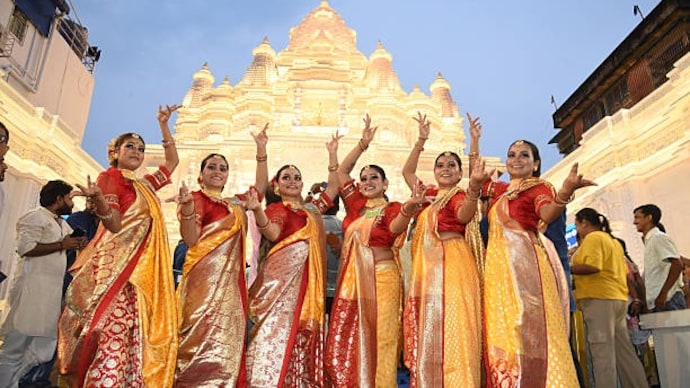
A saree drape has unexpectedly found itself at the centre of a cultural and political debate in Bengal. What began as social media admiration for women wearing the traditional aatpoure style soon spiralled into arguments over authenticity, identity and history. While some claimed this was the “real” Bengali culture reclaiming space, others pointed out that the modern saree silhouette itself was shaped by exchanges beyond Bengal, particularly with western India during the 19th century.
And that debate, interestingly, brings us to a woman from the Tagore household and a Bengal-Gujarat connection that quietly changed the way much of India wears a saree today.
For something we instinctively call “traditional,” the modern saree drape is surprisingly recent, and not entirely local.
What most of us recognise today as the standard saree — neat front pleats, pallu falling over the left shoulder, worn with a blouse and petticoat — didn’t emerge organically in one region. It was, in many ways, shaped and refined over time. And at the centre of that shift was Jnanadanandini Devi.
The history
Long before the saree became the singular garment we recognise today, clothing in the subcontinent was far less structured. Women wore variations of the antariya, uttariya and stanapatta — pieces of cloth draped around the body depending on climate and context. In many regions, especially in warmer parts of India, the upper torso was often left uncovered, something widely documented in temple sculptures and early art. The blouse, as we know it today, simply did not exist.
That shift came much later, shaped in part by colonial influence, changing social norms, and a growing need for women to occupy public spaces.
Which is where Jnanadanandini Devi enters the story.
Not aatpoure, but Brahmika
Let’s get one thing clear early — Jnanadanandini Devi did not invent the older Bengali aatpoure drape. What she is credited with popularising, however, is a reform-era style known as the Brahmika drape, distinct from earlier Bengali wrapping styles.
Introduced in the 1870s, the Brahmika drape was a more structured, public-facing way of wearing the saree that would go on to influence how much of India drapes it today.
Married into the Tagore household and wife of Satyendranath Tagore, Jnanadanandini Devi was already pushing boundaries in a society that expected women to remain within the home. When she moved to Bombay with her husband, her world expanded — and so did her wardrobe.
In western India, she observed how women draped their sarees differently, with the pallu brought around the body and thrown over the shoulder, creating a more structured silhouette. It was practical, allowed easier movement, and aligned more comfortably with the expectations of colonial public spaces.
There’s a moment often recalled in fashion history: Jnanadanandini was reportedly denied entry into a British club because of how she was dressed, as the traditional Bengali style at the time did not conform to colonial ideas of “proper” public attire. Instead of abandoning the saree, she adapted it.
As noted in Indian Fashion: Tradition, Innovation, Style, Jnanadanandini adopted elements of Gujarati-style draping, bringing the pallu around and placing it over the left shoulder — a style that also offered greater ease of movement.
This became the key crossover moment.
What she changed
When she returned to Calcutta, Jnanadanandini refined the drape further:
- She added front pleats tucked neatly for structure
- Standardised the use of a blouse and petticoat
- Styled the pallu over the left shoulder, often secured with a brooch
The result was a saree that looked sharper, stayed in place more easily, and allowed women greater mobility in public spaces.
This style came to be known by many names — Brahmika, Thakurbarir saree, even the “educated” drape — signalling its association with reformist Bengali elite circles. The rest, as they say, is history.
Interestingly, the term “Nivi drape”, commonly used today for the standard saree style, does not prominently appear in many early references, even though the structure is quite similar.
Today, whether you’re in Delhi, Mumbai, Kolkata or Chennai, the way a saree is commonly worn — pleats in front, pallu over the left shoulder — quietly traces back to that moment of exchange between Bengal and western India. Surprising, perhaps, for something we now simply call “traditional.”
A saree drape has unexpectedly found itself at the centre of a cultural and political debate in Bengal. What began as social media admiration for women wearing the traditional aatpoure style soon spiralled into arguments over authenticity, identity and history. While some claimed this was the “real” Bengali culture reclaiming space, others pointed out that the modern saree silhouette itself was shaped by exchanges beyond Bengal, particularly with western India during the 19th century.
And that debate, interestingly, brings us to a woman from the Tagore household and a Bengal-Gujarat connection that quietly changed the way much of India wears a saree today.
For something we instinctively call “traditional,” the modern saree drape is surprisingly recent, and not entirely local.
What most of us recognise today as the standard saree — neat front pleats, pallu falling over the left shoulder, worn with a blouse and petticoat — didn’t emerge organically in one region. It was, in many ways, shaped and refined over time. And at the centre of that shift was Jnanadanandini Devi.
The history
Long before the saree became the singular garment we recognise today, clothing in the subcontinent was far less structured. Women wore variations of the antariya, uttariya and stanapatta — pieces of cloth draped around the body depending on climate and context. In many regions, especially in warmer parts of India, the upper torso was often left uncovered, something widely documented in temple sculptures and early art. The blouse, as we know it today, simply did not exist.
That shift came much later, shaped in part by colonial influence, changing social norms, and a growing need for women to occupy public spaces.
Which is where Jnanadanandini Devi enters the story.
Not aatpoure, but Brahmika
Let’s get one thing clear early — Jnanadanandini Devi did not invent the older Bengali aatpoure drape. What she is credited with popularising, however, is a reform-era style known as the Brahmika drape, distinct from earlier Bengali wrapping styles.
Introduced in the 1870s, the Brahmika drape was a more structured, public-facing way of wearing the saree that would go on to influence how much of India drapes it today.
Married into the Tagore household and wife of Satyendranath Tagore, Jnanadanandini Devi was already pushing boundaries in a society that expected women to remain within the home. When she moved to Bombay with her husband, her world expanded — and so did her wardrobe.
In western India, she observed how women draped their sarees differently, with the pallu brought around the body and thrown over the shoulder, creating a more structured silhouette. It was practical, allowed easier movement, and aligned more comfortably with the expectations of colonial public spaces.
There’s a moment often recalled in fashion history: Jnanadanandini was reportedly denied entry into a British club because of how she was dressed, as the traditional Bengali style at the time did not conform to colonial ideas of “proper” public attire. Instead of abandoning the saree, she adapted it.
As noted in Indian Fashion: Tradition, Innovation, Style, Jnanadanandini adopted elements of Gujarati-style draping, bringing the pallu around and placing it over the left shoulder — a style that also offered greater ease of movement.
This became the key crossover moment.
What she changed
When she returned to Calcutta, Jnanadanandini refined the drape further:
- She added front pleats tucked neatly for structure
- Standardised the use of a blouse and petticoat
- Styled the pallu over the left shoulder, often secured with a brooch
The result was a saree that looked sharper, stayed in place more easily, and allowed women greater mobility in public spaces.
This style came to be known by many names — Brahmika, Thakurbarir saree, even the “educated” drape — signalling its association with reformist Bengali elite circles. The rest, as they say, is history.
Interestingly, the term “Nivi drape”, commonly used today for the standard saree style, does not prominently appear in many early references, even though the structure is quite similar.
Today, whether you’re in Delhi, Mumbai, Kolkata or Chennai, the way a saree is commonly worn — pleats in front, pallu over the left shoulder — quietly traces back to that moment of exchange between Bengal and western India. Surprising, perhaps, for something we now simply call “traditional.”

