Tamil Nadu | The tripolar contest
A DMK chief minister chasing the dream of a second consecutive term, an AIADMK boss out to reclaim his party's legacy, and a maverick superstar bent on playing spoilsport, Tamil Nadu gears for an epic battle
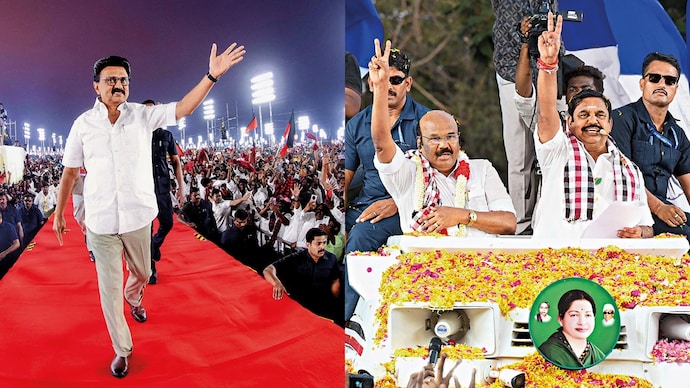
In its essence, the 2026 assembly election in Tamil Nadu is a battle to build legacies. On the one side is the ruling Dravida Munnetra Kazhagam (DMK) and its 73-year-old chief minister M.K. Stalin, who is attempting a remarkable feat for his party, a second consecutive term in power. On the other is their traditional rival, the All India Anna Dravida Munnetra Kazhagam (AIADMK) and its general secretary, Edappadi K. Palaniswami (EPS). For EPS, this is not just a battle to establish himself as a leader in his own right; it is also one to resurrect a party that has been braving many a storm since the death of its iconic leader, the late J. Jayalalithaa, in 2016.
In its essence, the 2026 assembly election in Tamil Nadu is a battle to build legacies. On the one side is the ruling Dravida Munnetra Kazhagam (DMK) and its 73-year-old chief minister M.K. Stalin, who is attempting a remarkable feat for his party, a second consecutive term in power. On the other is their traditional rival, the All India Anna Dravida Munnetra Kazhagam (AIADMK) and its general secretary, Edappadi K. Palaniswami (EPS). For EPS, this is not just a battle to establish himself as a leader in his own right; it is also one to resurrect a party that has been braving many a storm since the death of its iconic leader, the late J. Jayalalithaa, in 2016.
The contest itself is unfolding in a political landscape that is more fragmented and less predictable than at any point in recent years. While it continues to be framed as a familiar battle between the DMK and the AIADMK, shifts beneath the surface point to a more complicated, tripolar contest. The complication comes in the guise of superstar Vijay’s Tamilaga Vettri Kazhagam (TVK), which is positioning itself as an independent alternative to the two Dravidian majors. The TVK’s presence could disrupt established vote patterns, particularly among disaffected younger sections and urban voters, which, in turn, could rock the calculations of more than a few players on D-day, April 23, when the state goes to vote.
HISTORY BECKONS
The ruling DMK is hoping to break a jinx this election. The party has only once been voted back to power for a consecutive second term, and that was way back in 1971. Even the party patriarch, the late M. Karunanidhi, could not repeat the feat. It’s a pattern that his son Stalin, chief minister and DMK president, is determined to break this election.
The party entered the 2026 Tamil Nadu election season with what appears to be a carefully constructed strategy: a broad alliance, early organisational preparation, an attempt to recast itself in a more modern, youthful light, and some concentrated booth-level mobilisation. The DMK started poll preparations well in advance, in early 2025, with Stalin reviewing all the major welfare schemes that come under the party’s ‘Naan Mudhalvan (I am First)’ project. As has been the practice of all election-bound governments these past few years, the CM also ensured that all beneficiaries got their dues much before the poll dates were notified. Another small residue of being in power—anti-incumbency—was also addressed: a shake-up of the legislature party was deemed the answer—there are 60 new faces among the 164 candidates it is fielding.
The DMK also sewed up a far-ranging coalition, bringing in new partners while retaining older ones. This had as much to do with disrupting the rival AIADMK alliance as widening its own social base. Notable entries in this switchover were the late Vijayakanth’s Desiya Murpokku Dravida Kazhagam (DMDK), and former AIADMK grandee and ex-CM O. Panneerselvam (OPS). The DMDK, now headed by the actor’s wife Premalatha Vijayakanth, is well past its 2011 heyday when it was the second-largest party in the house, with diminishing returns each passing election. But it does help expand the DMK coalition’s vote base and, more importantly, weakens any Opposition consolidation in this regard. The seat-sharing formula has generated some unease within the alliance, especially since the DMDK has got more seats than old allies like the Left parties and the Viduthalai Chiruthaigal Katchi (VCK). But, as political analyst Mudhalvan says, “The alliance does have its differences, but on the ground, I feel it is united and working well. This has helped it pin the rival AIADMK-BJP front on controversial issues like delimitation, which is now making headlines.”
THE BIG BETS
Which is exactly what Stalin would be hoping for. The CM, of late, has become a ‘champion of the South’, be it in calling a meeting of the chief ministers of the states on central devolution and state finances, or “warning” the Centre about the perils of delimitation. In the poll campaign, though, he’s taken on the role of elder statesman, leaving the on-ground, tit-for-tat battles to son and deputy CM Udayanidhi and the second rung of the DMK. If there is one area where the DMK seems decisively ahead of rivals, it is in organisational preparation. The party launched the ‘Oraniyil Tamil Nadu (Tamil Nadu as one entity)’ campaign well in advance, aiming to expand the membership drive and build booth-level networks. Stalin had set ambitious targets on this, pushing the cadre into early election mode. This also helped the party identify weak pockets, negotiate alliance adjustments, and sharpen campaign messaging.
The DMK has also been very active on social media, with the CM himself leading the charge. The makeover even extends to the party symbol—reports have it that the yellow in the ‘Rising Sun’ is much brighter nowadays to align with the preferences of GenZ youth.
All this ostensibly puts the DMK in a markedly strong position. If the vote transfers work effectively, its rainbow coalition could be at an advantage. But if the disaffection among partners affects ground mobilisation, and the TVK cuts into key segments, the race could tighten considerably.
THE CHALLENGER’S COURT
The AIADMK finds itself at a particularly piquant crossroads as it heads into the 2026 Tamil Nadu assembly election. On the face of it, the party has massed a coalition that ticks many boxes, but these come with as many crosses. And what should be its greatest asset, proximity to New Delhi, is also its liability, “The AIADMK has faced several challenges since its inception in 1972,” says veteran journalist Durai Karuna, who has tracked the party since its initial days. “But this election could easily be its toughest by far.”
At the centre of the campaign is former chief minister EPS, projected as the principal face of the party. EPS has a few things going for him. He has the image of a good administrator, has been a relentless campaigner, and has taken the fight to the DMK camp on a number of issues, whether it be the plight of drought-affected farmers, police excesses, or the myriad corruption charges against the ruling party.
It might be late in the day, but EPS has also somewhat absolved himself of the DMK’s charge of being a “slave of the BJP”, especially in the way he handled seat distribution with the AIADMK’s national party ally. Very few of the BJP’s allotted 27 seats are in what they would consider their strongholds. Indeed, if the EPS camp is to be believed, they have also forced his old foe and ex-BJP state president K. Annamalai to sit out the election.
The saffron party, too, has been leaning towards its rarely seen pliant side, having learnt from the setbacks in 2021 and 2024. As one BJP source put it, the party has “moved from assertion to accommodation” in the state. It has also accepted its role as a junior partner, conceding ground to the AIADMK even in its key regions like the Kongu belt (particularly Coimbatore) in the larger interests of the alliance.
Where EPS has faltered is in the alliance consolidation that once defined the Jayalalithaa era. The post-2016 churn since her death has produced multiple power centres: former Jayalalithaa aide V.K. Sasikala, once a powerful entity in the AIADMK, has launched her own party. And OPS, the ex-CM handpicked by Jayalalithaa to fill her shoes, has switched sides and is now contesting as a DMK candidate. Karuna says Sasikala could chip away at some of the AIADMK votes in the south, mobilising sections of her Mukkulathor (Thevar) community, historically a key tonal strand on the Jayalalithaa rainbow. The AIADMK counter: Sasikala’s nephew, T.T.V. Dhinakaran, is on its side, but this still leaves a splintered vote base.
All this on the eve of the election gives an unsettled look to the AIADMK-led NDA alliance arithmetic, say observers. Even the party’s ties with the BJP have oscillated between cooperation and dissonance. On sensitive issues like delimitation and minority outreach, the AIADMK has been treading carefully, with EPS even declaring that the alliance with the BJP is only “for the election”.
Compounding this is the situation within the Pattali Makkal Katchhi (PMK), another NDA ally. Party founder S. Ramadoss and his son Anbumani Ramadoss are at odds with each other and the split in the ranks has raised questions about its support on the ground. Any haemorrhaging in the PMK’s base could affect the AIADMK’s plans in northern Tamil Nadu, where the former has a hold on sections of the Vanniyar vote.
Sasikala has also teamed up with Ramadoss Sr to put up joint candidates in some seats. The AIADMK also faces competition from newer political entrants. Actor Vijay’s TVK is expected to draw some of the anti-incumbency votes that might otherwise have gravitated toward the AIADMK.
Taken together, the 2026 election presents the AIADMK with a layered challenge: an uneasy alliance with the BJP, partial mobilisation by allies and the emergence of the TVK as a new pole. While the party seeks to frame the contest as a straight fight with the DMK and has hard-focused on anti-incumbency and farmers’ woes, the ground reality is that even small shifts in vote share across regions could significantly shape the outcome and determine the AIADMK’s trajectory in the post-Jayalalithaa era.
THE KNOWN UNKNOWN
When actor Vijay announced the formation of the TVK in February 2024, reactions ranged from curiosity to scepticism. Film stars entering politics is hardly new in Tamil Nadu. But two years on, the TVK has created enough buzz that the question now is less about whether the party matters and more about what kind of impact it will have on the DMK-AIADMK-dominated political landscape.
Like many other top Tamil film stars, Vijay has a structured fan base engaged in welfare activities and local mobilisation. But as other ill-fated star-neta runs have shown, such fan associations seldom translate into political capital. What distinguishes the TVK is the extent to which these networks appear to have been repurposed, participating in civic initiatives and electoral contests, and offering a tentative organisational starting point.
Vijay has positioned the TVK as an alternative to the Dravidian majors while also keeping some distance from the national parties. This will allow him to appeal to voters dissatisfied with the existing choices without being tied to any one bloc. His campaign style, however, largely centres on his own appeal. Many a time, the actor forgets to even mention the party candidate’s name in the constituency, only urging voters to support him and the TVK’s ‘whistle’ symbol.
This sort of messaging raises questions about how far the TVK’s organisational depth extends beyond Vijay’s popularity. Political scientist Ramu Manivannan frames this as a question of political grounding. “Good leaders come from the people and climb on to the bus,” he argues, adding that “a man who’s not even stepped out of the bus doesn’t seem like a leader of the people”.
The party’s political messaging also does not signal an ideological rupture. The rhetoric on governance, social justice and welfare aligns closely with the broad framework that has defined Tamil Nadu politics for decades. Rather than challenge the established model, the TVK appears to be positioning itself as a new executor of familiar priorities. The party’s support base also appears to draw from segments not tightly bound to existing party structures, including younger voters and those disillusioned with traditional choices.
For Vijay, the transition from cinematic icon to political leader represents a test of whether personal credibility can evolve into institutional authority. The early phases of TVK suggest an attempt to build that transition systematically. Sustaining the momentum, though, will require organisational consolidation, leadership development, and consistent political engagement.
At this stage, the TVK occupies a space between disruptor and contender. Whether it evolves into a durable third pole or remains a transitory force remains to be seen. But it has transformed the Tamil Nadu battle into a tripolar contest that makes it difficult for pollsters to predict the outcome.

