Diaspora | Wait, watch, worry
As war disrupts trade and travel routes in West Asia, India's vast diaspora trickles back home, threatened by stalled shipments and falling salaries
A day before the surprise US-Israel attack on Iran kicked off a war spiralling into chaos, Dubai-based trader Anish Tiwari sold top-of-the-line security devices to a customer in South Africa, with great expectations. A sum of Rs 2 crore was to land in his bank account on March 2, but by then, with the skies above full of warplanes and drones, business deals had little chance of success. The next day, a shipment of his, worth Rs 15 crore, paused on the high seas as the Strait of Hormuz closed and insurance agencies withdrew cover.
A day before the surprise US-Israel attack on Iran kicked off a war spiralling into chaos, Dubai-based trader Anish Tiwari sold top-of-the-line security devices to a customer in South Africa, with great expectations. A sum of Rs 2 crore was to land in his bank account on March 2, but by then, with the skies above full of warplanes and drones, business deals had little chance of success. The next day, a shipment of his, worth Rs 15 crore, paused on the high seas as the Strait of Hormuz closed and insurance agencies withdrew cover.
A fortnight later, with the conflict showing no signs of abating, he decided enough was enough. Tiwari bought a one-way ticket to India, and plans to return only when the Strait reopens. “Life for civilians is normal in the UAE, but the uncertainty is detrimental for business,” he says. He is still one of the privileged ones. White-collar workers like him are largely insulated from the turbulence of war, but two-thirds of the Indian diaspora in the Middle East—numbering some six million—are working lower-paying jobs in construction, logistics, travel and hospitality. In the past month, the Indian Government has repeatedly said that, alongside domestic gas supply, their well-being is the country’s top priority.
WHAT IS BEING DONE
India is among the top three suppliers of the global seafaring workforce, contributing some 13 per cent. An estimated 23,000 Indian seafarers have been impacted in the current crisis. The government of India has started a 24/7 helpline for all seafarers, irrespective of nationality. A dedicated control room and quick response team was instituted this month.
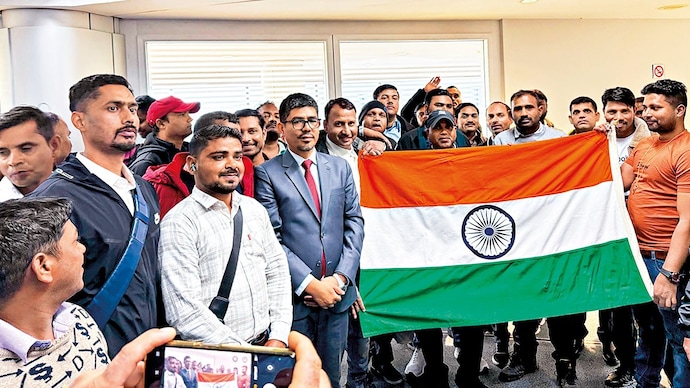
In Parliament, PM Narendra Modi recently said 375,000 Indians have returned from the Middle East since the war began. Saudi Arabia is a node for that endeavour. Paramita Tripathi, the Indian ambassador to Kuwait, says that Indian workers are being assisted with transit visas to Saudi Arabia, from where they can fly home. A permit has been granted to Kuwait-based Jazeera Airways to operate flights to six Indian airports. Around 1,100 residents and the mortal remains of 17 have made that journey. Workers from Iraq have been asked to reach Riyadh, from where the Indian embassy takes over their travel.
WHAT MORE NEEDS TO BE DONE
Job opportunities for the displaced will remain a concern as the war drags on, with $50 billion (Rs 4.66 lakh crore) worth of annual remittances from the Middle East at stake. Shobhankita Reddy, a research analyst at Takshashila Institution, says that while thousands of blue-collar workers have been sent on mandatory leave or are being called in for fewer hours, only a handful are returning to India. “Each blue-collar worker earns at least thrice as much as he would earn in India and supports a family back home. These are easily replaceable jobs, and the majority of them have chosen to stay put,” she says.
Staffing at oil and LNG refineries in Qatar, Saudi Arabia and the UAE will see a crunch due to the war wiping out facilities. Charith Konda, energy specialist (South Asia) at the Institute for Energy Economics and Financial Analysis, says, “Workforce composition will shift. Indians are employed across skill levels, but rebuilding will likely reduce high-value white-collar roles and increase blue-collar jobs.”
Shiv Agarwal, of ABC Consultants, an executive search and talent advisory firm, believes it could safely be another six months before a large-scale reverse migration begins. “As of now, the returns are a trickle, but there is certainly a hiring freeze. Besides, talent is unwilling to accept positions in GCC [Gulf Cooperation Council] countries currently,” he says. Lalu Samson, chairman of the Sharjah-based Indian Business and Professional Council, adds, “Tourism is indeed affected and staff has reduced shifts, but employers are keen to hold back trained workforce.”
Perhaps the only demographic that might be a smidgen pleased by the ongoing crisis are the Class 10 and 12 students of GCC countries—220 schools run by the Central Board of Secondary Education have had their annual exams cancelled.

