Masters in monochrome | Rohit Chawla's 'Portrait of an Artist'
Rohit Chawla provides a rare window into the private world of Indian artists through his striking portraits
Rohit Chawla joined JWT, the advertising titan, in the late 1980s—a decade and half after I had left its India version: HTA (Hindustan Thompson Associates). In this interim, everything had changed: the spray-painting of black-and-white photographs, the surgical precision of cut-and-paste typefaces from foreign magazines and the stark layouts that lacked the freedom of visual expression. Rohit was to become the mirror of that change. He used the mobility of his body and graphic ad-brain to invent original frames. He gave us new eyes like the images of Ashvin Gatha and Raghubir Singh had once done from abroad.
Rohit Chawla joined JWT, the advertising titan, in the late 1980s—a decade and half after I had left its India version: HTA (Hindustan Thompson Associates). In this interim, everything had changed: the spray-painting of black-and-white photographs, the surgical precision of cut-and-paste typefaces from foreign magazines and the stark layouts that lacked the freedom of visual expression. Rohit was to become the mirror of that change. He used the mobility of his body and graphic ad-brain to invent original frames. He gave us new eyes like the images of Ashvin Gatha and Raghubir Singh had once done from abroad.
It can’t be an easy choice to pick one of Rohit’s genres as a favourite, because he has excelled in several: the anthropological Rebari show; the re-imagining of the essence of Ravi Varma, Klimt and Kahlo’s art; the surreal fashion frames of his Wearable Art; the social activism of The Quiet Portrait and Untangling the Politics of Hair; the smoke of Havana cigars and the pathos of Rain Dogs.
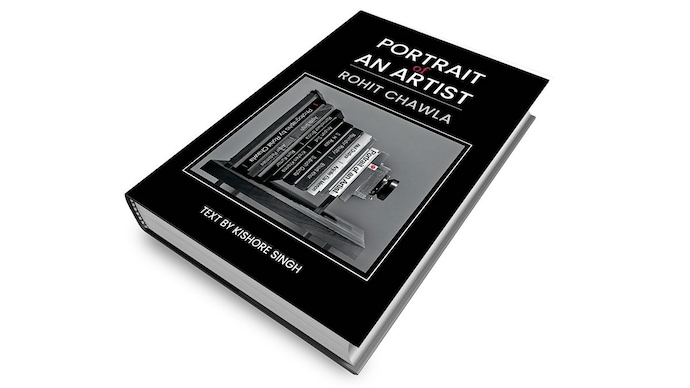
This little magic-box-of-a-book, mastered by the text of Kishore Singh, uses his own art journey to enter the green rooms of 68 artists who remain without make-up even as they appear in full view like a new wave of stark, cutting-edge cinematic images. Kishore writes about art and artists with conversational ease, not even trying to impress himself! He is aware that today, good jargon can sell bad art, while good art doesn’t need marketing explanations in any other language. Thanks to the duo, the portraits and their tales will enter posterity alongside their canvases.

