Congress | Patchwork strategy
Ahead of the April polls in four states and a Union Territory, the Congress is a study in contrasts—competitive in Kerala, peripheral elsewhere—undermined by decay, fragile alliances and defections
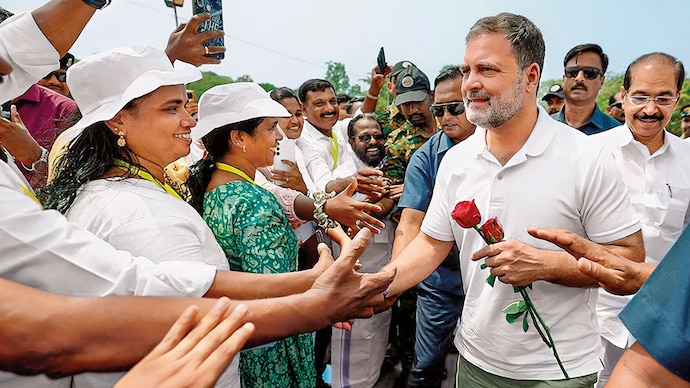
The Congress enters the April assembly elections across four states and one Union territory as a party fighting on radically different terms in each battleground. In Kerala, it’s a dominant coalition leader. In Tamil Nadu, it’s an embattled junior partner. In Assam, it struggles as a beleaguered Opposition. In West Bengal, it is barely visible, and in Puducherry, it is caught in an alliance deadlock.
The Congress enters the April assembly elections across four states and one Union territory as a party fighting on radically different terms in each battleground. In Kerala, it’s a dominant coalition leader. In Tamil Nadu, it’s an embattled junior partner. In Assam, it struggles as a beleaguered Opposition. In West Bengal, it is barely visible, and in Puducherry, it is caught in an alliance deadlock.
This asymmetry captures the paradox of India’s Grand Old Party. It’s nationally relevant but regionally fragmented, capable of flashes of brilliance yet structurally weakened by decades of organisational decay, defections, the rise of muscular regional competitors and the BJP’s polarising machinery.
The Congress’s electoral strategy is, by necessity, patchwork: consolidate anti-incumbency where it exists, lean on regional fronts where it must and paper over internal fissures with high-command oversight. But its revival remains uneven and perilously fragile.
ISLANDS OF HOPE
The Congress’s ambitions in five battleground states range from a bid for outright victory to staving off another complete wipeout
KERALA
Of all the states headed to polls, Kerala offers the Congress the most credible opportunity for government formation. The Congress-led United Democratic Front (UDF) enters the race buoyed by three consecutive electoral triumphs in the past five years: victory in four of five assembly bypolls since 2021, a sweep of 18 of 20 Lok Sabha seats in 2024 and control of 505 of 941 gram panchayats in the December 2025 local body elections.
However, Kerala’s three-cornered contest means anti-incumbency doesn’t flow cleanly to the Opposition. The BJP, which won its first-ever Kerala Lok Sabha seat in Thrissur in 2024 and targets 10-15 assembly seats in the 140-member House, is siphoning enough anti-Left Democratic Front (LDF) votes to potentially keep chief minister Pinarayi Vijayan in power despite a hostile electorate, claim several political observers.
Besides, the Congress’s internal dynamics in Kerala remain its Achilles’ heel. The party has not declared its CM candidate, though V.D. Satheesan, the leader of the Opposition, has emerged as the UDF’s de facto campaign face, leading the 25-day ‘Puthuyuga Yatra’ that covered 121 public meetings before culminating in an address by senior leader Rahul Gandhi in Thiruvananthapuram on March 7. There are two other serious contenders—AICC general secretary in-charge of organisation, K.C. Venugopal, and Ramesh Chennithala. Another episode laid the party’s tensions bare. Former KPCC president K. Sudhakaran demanded to contest the Kannur assembly seat, despite a high command edict barring sitting MPs from state elections. After days of public brinkmanship, Sudhakaran relented only on March 19, but not before the crisis delayed the Congress’s second candidate list and exposed the factional fault lines between the Venugopal-Satheesan axis and the Chennithala-Sudhakaran alignment.
The campaign itself is sharply focused on anti-incumbency against the LDF’s decade-long rule (2016-2026), spotlighting the Sabarimala gold theft allegations, Kerala’s fiscal crisis, welfare pension delays and the controversy over the proposed K-Rail corridor, opposed for land acquisition, ecological risks and its heavy cost. Rahul, the former MP from Wayanad, has been deployed extensively, framing the election as a vote for ‘change’. The appointment of election strategist Sunil Kanugolu, who was the architect of the Congress victories in Karnataka and Telangana, signals the seriousness of the ‘Mission 2026’ effort.
However, the historical parallel that should concern UDF strategists is 2010-11: the front swept local body elections even more decisively than in 2025, yet failed to translate that momentum into a commanding assembly victory. The compressed 25-day campaign window, the shortest in the history of assembly elections in Kerala, also disadvantages challengers over incumbents.
ASSAM
Here, the Congress campaign is a study in organisational haemorrhage. In the run-up to the polls, the party has lost its former state president, a sitting Lok Sabha MP, three sitting MLAs and its former vice president, all to the BJP. Against this backdrop, 43-year-old Gaurav Gogoi has been thrust into the role of electoral anchor. Appointed state president in May 2025, he is contesting his first-ever assembly election from Jorhat, with constituent Raijor Dal chief Akhil Gogoi publicly endorsing him as the Opposition’s CM face.
The Congress has stitched together a six-party coalition, the Asom Sonmilito Morcha, and the party’s bet in Upper Assam rests on the convergence of three leaders from the Ahom community: Gaurav, Akhil and Asom Jatiya Parishad chief Lurinjyoti Gogoi. Together, they hope to consolidate non-BJP votes in a region where Ahoms have traditionally been decisive in at least eight seats, though various observers argue that the delimitation exercise has significantly diluted that influence.
Equally significant is that the party has refused an alliance with Badruddin Ajmal’s All India United Democratic Front (AIUDF), reversing the 2021 strategy that backfired spectacularly when the BJP branded the Congress a ‘Muslim party’, costing it seats across Upper Assam. The 2026 calculus is different: absorb AIUDF’s Muslim vote base organically, without a formal tie-up, replicating the 2024 Lok Sabha pattern when Rakibul Hussain crushed Ajmal in Dhubri by over a million votes. But delimitation has reduced Muslim-decisive assembly seats from roughly 35 to 24, narrowing the returns. And vote-splitting remains a real risk, with AIUDF in the fray and NDA partner Asom Gana Parishad (AGP) fielding 13 Muslim candidates, including defectors from both the Congress and AIUDF.
The party’s 20-point ‘chargesheet’ against CM Himanta Biswa Sarma, released by Priyanka Gandhi Vadra in February in Guwahati, targets what the Congress calls ‘Syndicate Raj’, alleging systematic corruption through illegal mining, drug trafficking corridors and toll collection networks. The campaign also hammers the BJP on the implementation of the Citizenship (Amendment) Act, unemployment and the eviction drives that allegedly displaced genuine Indian citizens. The Congress has announced candidates in 94 of 126 seats. Priyanka’s appointment as chair of the screening committee, a first for a Gandhi family member in candidate selection, reflects the leadership’s investment in Assam.
TAMIL NADU
The Congress was allocated 28 assembly seats in the Dravida Munnetra Kazhagam (DMK)-led Secular Progressive Alliance, three more than in 2021 and the largest allocation among all DMK allies, but the deal came perilously close to falling apart. It initially demanded 40-plus seats and a share in the state cabinet, invoking the ‘Jharkhand formula’ of coalition power-sharing. The DMK flatly rejected both demands.
The tension escalated when Praveen Chakravarthy, the Congress’s data analytics head and a Rahul confidant, met actor-turned-politician Vijay of the Tamilaga Vettri Kazhagam (TVK) in December 2025, triggering fury in the DMK over what it saw as the Congress exploring an alternative alliance. The DMK responded with a ‘take it or leave it’ deadline of March 3, backed by pointed data: the Congress won only 5 of 63 seats when it last contested independently in 2011, and its standalone vote share in the 2014 Lok Sabha was a mere 4.5 per cent.
The alliance was ultimately rescued by Sonia Gandhi’s direct intervention. She dispatched P. Chidambaram as her personal envoy to meet M.K. Stalin, the DMK chief and CM. The March 4 deal—28 seats plus one Rajya Sabha berth—reflected a pragmatic compromise, though it fell far short of the party’s ambitions.
The Congress’s electoral prospects in Tamil Nadu are almost entirely a function of the DMK’s performance. In 2021, the party won 18 of 25 allocated seats, a 72 per cent strike rate powered entirely by the DMK’s organisational machinery and vote transfer. If the DMK support base holds, the Congress should comfortably win a majority of its 28 seats. If anti-incumbency bites, or TVK emerges as a serious third force, even the alliance’s overall seat count could wobble.
WEST BENGAL
The Congress’s decision to contest all 294 seats independently in West Bengal is perhaps the most audacious of its 2026 strategies. The 2021 Congress-Left alliance produced a total wipeout. The party did not win a single seat and its vote share was a catastrophic 2.94 per cent. This time, the ruling Trinamool Congress (TMC) showed no interest in seat-sharing, with national general secretary Abhishek Banerjee suggesting the Congress should ‘unilaterally support’ the TMC.
Adhir Ranjan Chowdhury, the former five-term Baharampur MP who lost his Lok Sabha seat to TMC in 2024, is expected to contest from the Baharampur constituency, his first state-level contest since 1996. At 70, he remains the party’s most recognisable face in Bengal, particularly in the Murshidabad-Malda belt where the Congress retains residual organisational strength. State president Subhankar Sarkar has restructured the party organisation, expanding district units from 28 to 33 and constituting formal political affairs and election committees. But as of March 21, the Congress had still not released its candidate list, the last major party to do so.
The four-cornered fight dynamics (TMC vs BJP vs Congress vs Left) create a scenario where the Congress’s presence primarily affects the margins. The party won 21 seats going solo in 2006, a distant high-water mark it hopes to eventually approach again. For now, even winning a handful of seats in Murshidabad, Malda and select pockets of North Bengal would be considered a meaningful step back from oblivion.
PUDUCHERRY
The most immediate crisis unfolded in this small Union territory, where a seat-sharing agreement with the DMK was finalised only on the last day of nominations, March 23. Under the deal, the Congress will contest 16 seats and the DMK 14 of the 30. In 2021, the DMK won six seats to the Congress’s two. But the Congress is banking on its 2024 Lok Sabha performance, leading in 28 of 30 assembly segments; converting that momentum into assembly victories will require alliance chemistry to work on the ground. The delay in seat-sharing has already affected the preparations of several candidates and caused heartburn among those denied party tickets. In constituencies where victory margins are often just a few hundred votes, such ruptures could hand an advantage to the incumbent.
Across all five battlegrounds, a clear pattern stands out: the Congress’s national brand and its ability to frame issues are far stronger than its organisational capacity on the ground. As a result, it enters 2026 as a party fighting for relevance state by state.

