The king in crisis | Alphonso mangoes
Maharashtra's famed mango faces one of its worst seasons, hitting yields and rural incomes in the Konkan region
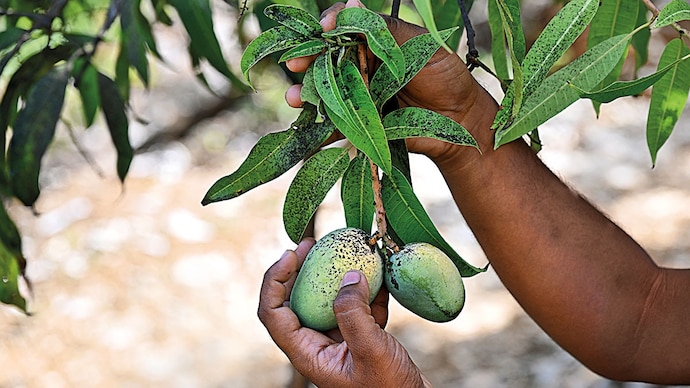
Worry etched large across his face, Omkar Kulkarni points to a sprawling mango tree in his orchard in Nivendi village, near the pilgrimage centre of Ganpatipule in Maharashtra’s Ratnagiri district. “This tree dates to my grandfather’s time. Till recently, it would yield around 70 crates of Alphonso [popularly called Hapus]. This time, I will get barely 10,” says Kulkarni. Around 200 km away in Malvan in neighbouring Sindhudurg district, farmer Sanjay Nare echoes Kulkarni’s concern. In a normal year, he sells about 25,000 boxes of the prized fruit, each with a dozen; this season, he will be fortunate to reach even 5,000.
Worry etched large across his face, Omkar Kulkarni points to a sprawling mango tree in his orchard in Nivendi village, near the pilgrimage centre of Ganpatipule in Maharashtra’s Ratnagiri district. “This tree dates to my grandfather’s time. Till recently, it would yield around 70 crates of Alphonso [popularly called Hapus]. This time, I will get barely 10,” says Kulkarni. Around 200 km away in Malvan in neighbouring Sindhudurg district, farmer Sanjay Nare echoes Kulkarni’s concern. In a normal year, he sells about 25,000 boxes of the prized fruit, each with a dozen; this season, he will be fortunate to reach even 5,000.
The Konkan coast, where the ‘King of Fruits’ is grown, is grappling with an unprecedented crop failure this year, leaving mango connoisseurs to contend with scarce Alphonso supplies and exorbitant prices—the mango is retailing in Mumbai at Rs 800-2,000 per dozen, compared to Rs 600-1,000 last year. “Alphonso production is expected to fall by 80 per cent of the Konkan’s average of 250,000 tonnes,” says Shivaji Amale, joint director, agriculture, Konkan division. The crisis has been driven by a mix of factors: erratic weather—delayed monsoon withdrawal, intense winter cold, with temperatures dipping below 10°C and disrupting pollinator activity, and wide day-night temperature variations—along with dew and mist that damaged the first flush of flowering; overuse of growth regulators, pesticides and fertilisers; and a decline in pollinators and cross-pollination.
In 2025, the Konkan had 129,427.22 hectares under mango plantations, with Ratnagiri and Sindhudurg at 68,550 and 34,598 hectares, respectively. The region produced 274,949 tonnes of mangoes, of which these two districts led with 184,602 and 38,058 tonnes, respectively. Notably, the Alphonsos grown in Ratnagiri and Sindhudurg are much sought-after for their thin skin and distinctive aroma and taste—a result of local climatic and geological conditions.
In Malvan, Nare says, the first flush of flowering around December was so intense that “it was impossible to see the leaves on mango trees”. This led to expectations of a bumper crop. However, the flowering went to waste, with just a minuscule amount maturing into fruits due to the vagaries of the weather. Contract farmers like Nare, who take orchards on lease, stand to lose the most, as they need to pay the landowner in spite of any losses. Even a government compensation goes to the original landowner.
At Sindhudurg’s Devgad, home of the famed Devgad Alphonso, former MLA and third-generation farmer Ajit Gogate says this has been the “worst season” for mango growers. “While farmers have spent on growth regulators, pesticides and manpower, poor yields have shrunk their earnings,” says Gogate, chairman of the Devgad Taluka Amba Utpadak Sahakari Sanstha Maryadit. Other growers point to compounding setbacks. Jaywant Lad, for instance, says the failure of the first flush has come as a double whammy, as mangoes that reach the market in February-March command a premium.
ROOTS OF THE CRISIS
Experts and growers trace the current crisis to a mix of climatic shifts and flawed practices. Dr Vivek Bhide, president, Konkan Hapus Amba Utpadak Aani Vikrete Sahkari Sanstha, Ratnagiri, says this disaster was in the making for years. “The onset of Cyclone Phyan in 2009 had led to rapid changes in climatic conditions. Mango production has been fluctuating since 2010,” he adds. “Since the 1990s, mango plantations have grown. But while the acreage increased, the yield has failed to keep pace,” explains Bhide, adding that modern methods of grafting are faulty. Bhide also blames the excessive use of pesticides and growth regulators, which boost reproductive growth while hindering vegetative growth, for the situation, noting that it has harmed pollinators like bees. He also points to the unbridled felling of raywal (wild/desi) mango trees—for timber, Hapus monoculture and even during the Holi festival—which has reduced cross-pollination.
Kiran Malshe, a horticulturist at Dapoli-based Balasaheb Sawant Konkan Krishi Vidyapeeth, echoes Bhide’s argument on the harm to pollinators. He also attributes lower fruiting to the monsoon, which lasted till November, and a drop in the minimum temperature in winter. Since the first flowering had been intense, the ability of the trees to bear fruit in the next two flushes had declined. But Chandrakant Mokal, president of the Maharashtra State Mango Growers Association, cites rising pollution, including emissions from local chemical industries, as a key factor for the crisis. Kulkarni in Nivendi vouches for that, linking his crop failure to a coal-based thermal power plant in the vicinity.
In March, thousands of angry mango cultivators blocked the arterial Mumbai-Goa highway in Sindhudurg, protesting the state government’s compensation of Rs 22,000 per hectare, which translates to a meagre Rs 220 per tree, given that a hectare has about 100 trees. Claiming that maintaining an acre of orchards with 40 trees costs over Rs 3 lakh—including labour, fertilisers and multiple rounds of pesticide spraying to tackle recurring infestations of pests such as the mango hopper and thrips—farmers demanded Rs 5 lakh per hectare and threatened to march to chief minister Devendra Fadnavis’s residence in Mumbai in protest. Nitesh Rane, minister for ports and fisheries, and guardian minister for Sindhudurg, said he had urged Fadnavis to increase the compensation, but a decision is still pending.
The fallout is visible in the market. Traders at the Agricultural Produce Market Committee in Vashi, Navi Mumbai, which handles around 60 per cent of the Konkan’s mango arrivals, say average daily volumes had fallen to about 40,000 boxes early this month, from 80,000 last year. Though volumes have improved to around 60,000 boxes this week, the supply is expected to taper beginning mid-May. Farmers allege that traders are citing the war in the Middle East and disrupted logistics lines as a pretext to buy mangoes at lower prices. Arrivals are expected to pick up for less than a month after the fourth week of April, but growers fear this brief window will allow middlemen to squeeze prices, given the fruit’s perishable nature.
Alphonsos grown in the Konkan’s Ratnagiri, Sindhudurg, Palghar, Thane and Raigad have a Geographical Indication (GI) tag, which certifies their origin and protects their unique characteristics. Stakeholders complain that despite this, cheaper mangoes grown in states like Karnataka, Kerala, Gujarat and Tamil Nadu are sold to unsuspecting consumers as the original Hapus. The shortage of the Alphonso is expected to boost this ‘counterfeiting’.
THE DOMINO EFFECT
The crop failure is expected to have a cascading effect on the local economy and beyond. In Ratnagiri’s Pawas, Amar Desai, CEO of Desai Products, points to a room in his facility storing around 40 crates of mangoes. “Normally, it would have been full with around 300 crates,” he says. Apart from the whole fruit, the company also sells mango products under the Desai Bandhu Ambewale Amar brand. He says poor availability is likely to push canning-grade mango prices by Rs 30-40 per kg this year. Mangoes that cannot be sold as table fruit are usually sent for canning. Ratnagiri has over 100 canning units, on which an estimated 25,000 people depend.
Farmer Makarand Kane, who runs a canning unit at Reel in Ratnagiri, says he now has a staff of 45, down from 60, and plans to trim it further. Transporter Kaustubh Suhas Gogate from Jamsande, who picks up consignments from farmers, says margins are shrinking due to lower loads even as overheads like fuel and manpower costs continue to pinch. Similarly, pesticide and fertiliser vendors fear defaults, as many farmers buy inputs on credit. The ripple effects run even deeper. Vidyadhar Thakur, who makes jhelas or mango pluckers, has been able to sell just 200 this season, as against the average of 1,500. Nare, who owns a corrugated box manufacturing unit and purchased paper in large quantities, says he has material for around 250,000 boxes lying idle. The ripening chamber for which he charges Rs 80-100 per crate lies vacant, too.
PROMISES AMID PANIC
For decades, the Konkan and nearby areas were known as a ‘money-order economy’, with blue-collar workers from Mumbai sending remittances home for sustenance. That began to change in the 1990s, with the rise of Alphonso cultivation, which found markets in India and abroad. This, along with the growth of fisheries, tourism and cashew cultivation, transformed the region’s economy. The Konkan and its mango orchards are now a magnet for migrants from states such as Uttar Pradesh and Jharkhand, and even Nepal, who work as labourers and watchmen in orchards. However, even as the region draws in migrant workers, many local youngsters are moving out. Farmers say the unpredictability of the business, the lack of dignity for physical labour and the pull of urban life have pushed them towards Mumbai and other cities—a trend the current crisis may hasten.
Minister Rane has a solution. Stating that climate change has affected all three mango flowering cycles, he says the government is tying up with the Agricultural Development Trust, Baramati, to incorporate Artificial Intelligence in mango cultivation. “This will help tackle the impact of climate change by ensuring weather forecasts, information on the crop, and on pesticide use.” Amale says they will also promote the cultivation of black pepper—a climate-resilient crop—among mango farmers, and launch an awareness campaign urging cultivators to opt for agricultural insurance as a buffer against losses.
Despite these plans and promises, there is panic on the ground. In Kunkeshwar, farmer Eknath Teli says how there is a lot riding on the Konkan’s Hapus. “If the king is dethroned, then what will happen to us?” he asks.

