Voice of the multiverse | Asha Bhosle (1933-2026)
Asha Bhosle's ghazals stirred an eternal autumn of yearning; her nightclub/ cabaret songs ignited an aural euphoria like no other
The biggest and only thrill as I watched Dhurandhar last year was when I heard Asha Bhosle sing the line ‘pyaase, pyaase in mere labon ke liye’. Her vocals tore through the streets on screen as a bike chase ensues and Yalina (Sara Arjun) clings to Hamza (Ranveer Singh). The image of Helen writhing across the dance floor in a scarlet sequined outfit was not the first one that came to my mind, even though the actor was the centrepiece of this cabaret hit from Caravan (1971) composed by R.D. Burman. And I doubt that my visual narrative will ever include Ranveer and Sara, riding the Triumph Bonneville T120 Black, when I hear ‘Piya tu ab toh aaja’. When did Bhosle’s aural stardom outshadow the visual aspects of a film?
The biggest and only thrill as I watched Dhurandhar last year was when I heard Asha Bhosle sing the line ‘pyaase, pyaase in mere labon ke liye’. Her vocals tore through the streets on screen as a bike chase ensues and Yalina (Sara Arjun) clings to Hamza (Ranveer Singh). The image of Helen writhing across the dance floor in a scarlet sequined outfit was not the first one that came to my mind, even though the actor was the centrepiece of this cabaret hit from Caravan (1971) composed by R.D. Burman. And I doubt that my visual narrative will ever include Ranveer and Sara, riding the Triumph Bonneville T120 Black, when I hear ‘Piya tu ab toh aaja’. When did Bhosle’s aural stardom outshadow the visual aspects of a film?
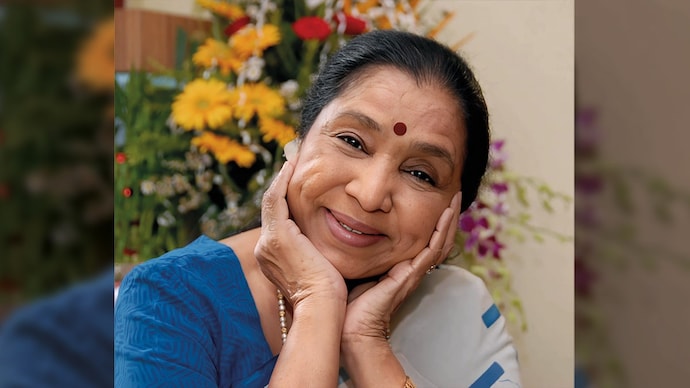
Every time I’ve listened to an Asha Bhosle hit, I would picture the singer draped in a pastel-hued cotton silk Paithani, with yellow magnolia pinned neatly to the side of her bun and a strand of pearls wrapped around her neck. This is also the enduring memory from my first meeting with Bhosle ahead of her 70th birthday. She came across as someone who loved life, a belief that was reaffirmed when she said that she might just celebrate her birthday by rewatching one of her favourite films, The Birdcage, starring Robin Williams.
The singer was readying for a tour abroad and a quick rehearsal run was on the day’s agenda. The troupe that would travel with her had gathered at an apartment-turned-studio close to Burman’s home in Khar. Bhosle picked out one note on the trumpet that hit two or three octaves lower than it should have. “This would work if Usha (Uthup) was going on tour with me. Why are you going so low?” she asked the musician as she effortlessly swapped her vocal timbre for Uthup’s. In a video interview from 1988, Burman and Bhosle are seen rehearsing the track ‘Chal saheli jhoom ke’ from Anokha Rishta (1986). Says Burman of Bhosle in the interview, “She has a tremendous knack of (sic) copying people. If she talks to you, she will mime you. She will try to copy your voice, the way you talk... That must have helped her. She knows the person who has composed the music and how he has imagined (the song) and she follows his way of singing, the way of diction...That’s why she does so well.” Bhosle recalled how the composer’s interest in multiple genres from across the world, including bossa nova and jazz, inspired her to reinvent her vocal delivery to suit the Western musical arrangements.
‘LIKE NO OTHER’
Just as she dominated the 1970s with Burman’s nightclub hits, she also owned the ’50s and ’60s with O.P. Nayyar’s signature melodies driven by tonga gaadi (horse cart) beats. “The artistes that I chose to work with made my songs original... But Asha was like no other. She could sing any kind of song,” Nayyar told me in an interview in 2004. Bhosle credited Nayyar for drawing her out of her shell in Raju Bharatan’s Asha Bhosle: A Musical Biography. Their collaboration led to some of her earliest hits, including ‘Leke pahla pahla pyaar’ from C.I.D. (1956). The song featured other playback stars from that time, including Shamshad Begum and Mohammed Rafi, but Bhosle would not remain on the sidelines for long. In the same year, her solo with music director S.D. Burman, ‘Ae jani jeene mein kya hai’ from Funtoosh, would mark what was perhaps her earliest nightclub hit.
Composers like A.R. Rahman would later seek out Bhosle for the frantic breathwork that she made famous in her cabaret songs, to voice a modern-day siren in the Tamil romantic drama, Alaipayuthey (2000), starring Shalini Ajith and R. Madhavan. Bhosle sings ‘September Madham’, a song that only half-jokingly mourns the end of bachelorhood, with a throaty sensuousness that lends VJ-turned-actor Sophiya Haque a sexual charge that filmmaker Mani Ratnam uses as a musical plot device.
If it wasn’t the cabaret girls, it would be the courtesans confined inside their kothas who found a voice in Bhosle. Music director Khayyam, who gave Bhosle her first nightclub track in ‘Suhana hai ye mausam’ in Footpath (1953), is also credited with establishing Bhosle’s prowess as a ghazal singer. When composing for Umrao Jaan (1981), Khayyam had a singular vision. “It was Asha or no one. To this day, I cannot imagine anyone else singing ‘In ankhon ki masti’ or ‘Dil cheez kya hai’. She had heard my early ghazals like ‘Sham-e-gham ki qasam’, so she immediately understood what I was looking for,” the composer told me in an interview. Only rarely, as with Umrao Jaan, did the courtesan play a pivotal role, but Bhosle’s voice ensured that subaltern female characters were charged with a kind of atypical stardom that took on a life outside of their films. Actor Helen, upon whom several songs rendered by Bhosle were pictured, said after Bhosle’s passing: “I am who I am because of her.”
In the 1998 film Saaz, directed by Sai Paranjpye, Bansi, a character portrayed by Shabana Azmi and loosely based on Asha Bhosle, has a breakdown after she sings her first film song alongside her more famous older sister, Mansi, played by Aruna Irani. Mansi, of course, was meant to depict Lata Mangeshkar. Bansi is inconsolable and resentful because Mansi monopolises the song ‘Baadal chaandi barsaaye’, only allowing her to participate as a backup vocalist. A slighted Bansi tells her older sister: “Agar tumhare sahaare rahi toh sada shuruwat hi rahegi meri. Hamesha rim jhim rim jhim hi gaati rahoongi (If I depend on you, I will always remain at the starting point and forever be humming ‘rim jhim rim jhim’). Unsurprisingly, both Lata and Asha distanced themselves from the film. However, it is evident from Bharatan’s biography that Bhosle’s need to make a space for herself compelled her to make the choices that she did while building her repertoire.
AN INDIPOP STAR
The music video generation enabled Bhosle’s ambition to soar higher. Bhosle’s appearance in the video for ‘Jaanam samjha karo’, a Hindi pop track composed by Leslie Lewis in 1997, was the beginning of the singer’s reinvention as an Indipop star. It was also in the mid-’90s that Bhosle was sought out by Rahman for the soundtrack of Rangeela (1995). The lusty open-throated vocals, once reserved for cabaret songs, were now recast for the film’s main heroine as she celebrated life (‘Rangeela Re’) and wanted to find love (‘Tanha Tanha’). In a video interview commemorating its 25th anniversary, Bhosle said, “It was tough to sing the title track as I was accustomed to singing with an orchestra. But here I was, singing along just to a rhythm and pitch track. Also, some parts were very high-pitched and I thought would be difficult, but I managed. When I went back to sing ‘Tanha Tanha’, Rahman asked me if I wanted to listen to ‘Rangeela Re’, and I was speechless when I heard it. I could hear strings, a drum section, and it all sounded perfect. I realised that I was working with an artist par excellence.” Bhosle went on to sing for Rahman for the soundtracks of other films, including Lagaan (2001) and Taal (1999).
Bhosle’s stardom also drew some of the most eclectic international artistes. Brit pop singer Boy George persuaded her to lend vocals to his track ‘Bow Down Mister’ in 1991. While it got a lot of attention, its racialised music video and lyrics were overlooked, making Bhosle’s alaap perhaps its only redeeming quality. But later international collaborations were far from questionable. San Francisco-based string ensemble, Kronos Quartet, who worked with Bhosle for the album You’ve Stolen My Heart (2005), a collection of rearranged string versions of Burman’s biggest hits, received a Grammy nomination in the Best Contemporary World Music Album category. But it’s Bhosle’s most recent association with Gorillaz that underlines her enthusiasm for creating new music. The 92-year-old featured on the track ‘The shadowy light’, on the band’s ninth studio album The Mountain. While it is a reflection on life and death, Bhosle’s lines—‘Chal mere maajhi/ gehra hai paani, mujhe jaana uss paar/Jahan sukh ho, naa dukh ho/ Jahan jai ho, naa haar ho (Come, boatman, I’ve to cross these deep waters/ where there is happiness, not grief, victory, not defeat)’—sound like she was bidding farewell in the way she knew best: with a song.
—The author is the former editor of Rolling Stone India magazine who has written about music in the subcontinent for over two decades and is currently pursuing a doctorate in English at Michigan State University
‘She was a genre herself’
—by Adnan Sami, Singer and musician
For me, Ashaji was far more than a legend. I met her for the first time when I was about 10. She was touring London with R.D. Burman. I remember she opened the concert with ‘Chura liya hai’. So overwhelmed was I by the aura of her voice that I started crying. I just looked up and said, “God, please one day make me worthy enough to be able to sing and perform with her.” She created a beautiful persona on stage.
I remember when we were recording ‘Kabhi to nazar milao’. She was uncharacteristically quiet. I asked her why. She said she was thinking if she’d able to pull it off. She said every work is a new challenge and there’s lot more for her to learn. But the moment she came in front of the microphone, a melodious monster would emerge. She would give you variations to the point where you would feel like a kid in a candy shop. The kind of training she had, one could make her do all those things that nobody else could pull off.
There were some fascinating things about her—zeal for life, strength, determination, an eternally youthful soul. Apart from the professional lessons I learnt from her—how to face the microphone, how to express—she taught me a lot about life. The foundations she laid down for Indian music and her contribution can never be over emphasised. She was a genre unto herself.

