Bihar | Weighty crown for the new samrat
The Nitish era ends. Samrat Choudhary inherits the crown and—as Bihar's first BJP CM—also its complex riddles
It’s a historic change of guard. For 20 years, barring a brief interlude of 278 days in 2014-15, Nitish Kumar had made the helm of governance his own space. On April 15, as Samrat Choudhary took oath as Bihar’s 24th chief minister, the state crossed a threshold it had long approached. For the first time, the Bharatiya Janata Party (BJP) is in charge of the state. In material and symbolic terms, an epoch has ended, and another perchance begun. The ‘Nitish way’ was built around soft-spoken but canny politics: a flair for coalition-building, calibrated social arithmetic, an ability to balance opposites. Will that end?
It’s a historic change of guard. For 20 years, barring a brief interlude of 278 days in 2014-15, Nitish Kumar had made the helm of governance his own space. On April 15, as Samrat Choudhary took oath as Bihar’s 24th chief minister, the state crossed a threshold it had long approached. For the first time, the Bharatiya Janata Party (BJP) is in charge of the state. In material and symbolic terms, an epoch has ended, and another perchance begun. The ‘Nitish way’ was built around soft-spoken but canny politics: a flair for coalition-building, calibrated social arithmetic, an ability to balance opposites. Will that end?
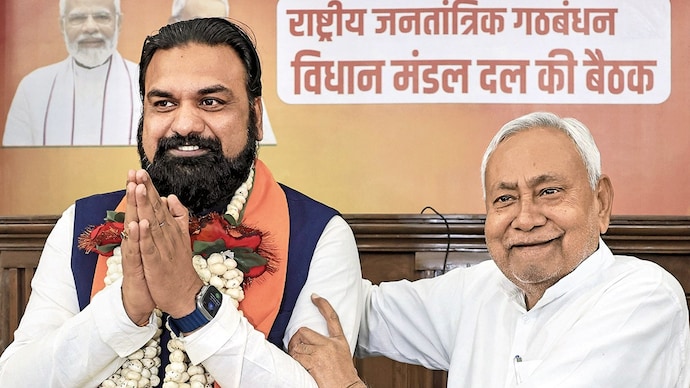
Yes and no. The latter is on view presently, as the change of guard gets presented with the elements of continuity, rather than disruption, in the foreground. Once his exit was scripted, it’s Nitish who gestured at his preferred successor—and the BJP found wisdom in accepting it. On April 14, at the ruling coalition’s legislature party meeting, Nitish, who had resigned earlier that day, placed a garland around Choudhary’s neck, and the 57-year-old inheritor bent to touch the octogenarian’s feet. Two senior leaders of the Janata Dal (United), or JD(U)—Bijendra Prasad Yadav and Vijay Kumar Choudhary—were named as deputy CMs on April 15, preserving coalition equilibrium.
DEFERRED SONRISE
Equally significant was what did not occur: Nitish chose not to elevate his son, Nishant Kumar, despite his formal entry into politics. Continuity did not entail family lineage, at least for now. But it does endure in the arithmetic of coalition politics that Nitish has crafted and refined, and now bequeathed. The BJP, with 89 MLAs in a House of 243, is just 33 short of the simple majority mark of 122. The more dramatic projections after last November’s assembly poll had modelled the saffron party as poised for its more aggressive template, splitting other parties, predating upon MLAs, and mustering enough for a solo run. Instead, it has gone for the calmer option, prolonging its partnership with the JD(U): its 85 legislators bring substantial ballast to the ship.
That gives the National Democratic Alliance (NDA) regime an air of rock-solid stability rather than chaos. Opting for Choudhary enabled this—the BJP had no shortage of contenders, those born and bred within its organisational structure and ethos, but it has chosen to go for partnership over partisanship. It has to resolve any internal friction that flows from this, especially among a segment of leaders who regard themselves as the party’s “originals” and view Choudhary—a relatively recent entrant—as a political migrant. This may not erupt into open dissent right now, but it forms a latent pressure point.
For now, Choudhary seems insulated—the current assembly has over four years left, and via Nitish’s good offices, he can claim the backing of a mammoth 202 MLAs. What works for him, and the reason for Nitish’s preference, is his identity as a Kushwaha (Koeri) leader. The caste group, though only over 4 per cent of Bihar’s population, is the most significant non-Yadav OBC bloc. It’s also the second part of the hyphenated dyad that Nitish created out of two fraternal groups, the “Luv-Kush” arc of Kurmis and Koeris, which is what sailed his boat for years against the deep Muslim-Yadav currents of the Rashtriya Janata Dal (RJD). Choudhary, at the helm, preserves the framework. That has its strategic uses for the BJP, till such time that it can appropriate that axis, or even erode its potency.
A NEW STYLE
Questions about Choudhary’s administrative capacity will soon be asked. He hit the ground running—holding a meeting with top officers shortly after taking oath, giving the impression that he meant business. The most immediate change Bihar is likely to witness is one of tone. Offering a contrast to his predecessor Lalu Prasad Yadav, Nitish had governed through understatement. Choudhary appears poised to be a throwback to the era when Bihar had an outspoken and forceful chief minister. Besides sharper messaging, one may reasonably expect a closer alignment with the Centre’s political idiom.
Questions linger about his administrative depth. His tenure as home minister, a portfolio of considerable weight, did not produce outcomes commensurate with the scale of its promise. To put it mildly, visible transformation was limited. Nitish had a near-forensic familiarity with governance processes. Choudhary is likelier to be more heavily dependent on his officers. Whether that translates into efficiency or stagnancy and diffused accountability is what has to be watched. For a state with an embarrassment of riches in terms of unattained development goals, that leaves a good part of the future open-ended.
BALANCING OPPOSITES
But how he manages the disruption for a bureaucracy used to Nitish’s predictable decision-making pathways will be an episode to watch later. Presently, the politics beckons urgently. A cabinet reshuffle looms. This is a tricky art that he has never had to learn before. To salve potentially aggrieved segments within the BJP, more core organisational figures will have to be accommodated. New Delhi’s line will need to be read and translated, not just stenographed.
But no constituency within the JD(U) can be allowed to drift into aloofness either—that party is, ironically, his indemnity against any internal corrosion. At the same time, he will want to assert authority by getting in his loyalists. A history of muscular politics may not have equipped him with the skills required to marry mutually contrary imperatives. A touch of mentoring by Nitish could help.
Bihar gave India its first emperors. But Choudhary has become the samrat in a democratic setup, in a state that exceeds Japan in population—and ticks all its other indices in inverted fashion. Is he up for the job? We’ll know soon. Else, Bihar’s politics is never static.

