Chhattisgarh | An Idol Comes Home...
But its custodian museum cannot claim the stolen 7th century statue the US has returned because termites have eaten up the papers
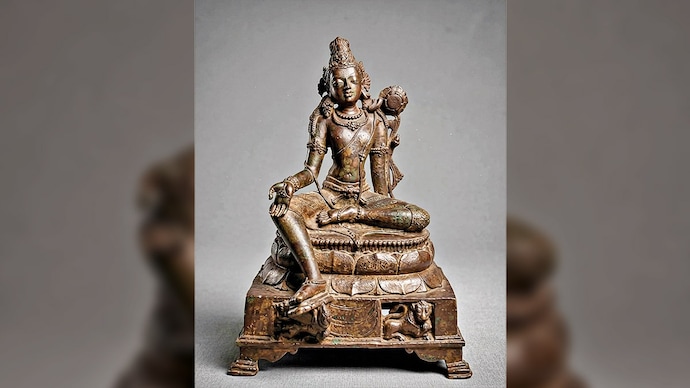
Imagine an exquisite 7th century bronze, an Avalokiteshwara, the work of a master craftsman called Dronaditya who lived in Sirpur. Not too far from the capital of modern Chhattisgarh, but from another universe in terms of cultural habits and discipline. Dronaditya’s name is inscribed on the double-lotus pedestal on which the Bodhisattva is seated, allowing us a precise time-space map of what Chhattisgarh was in the Late Gupta period, under the Pandavavamshis: a hub of marvellous Buddhist statuary. Now, in several jump-cuts, leap forward to today.
Imagine an exquisite 7th century bronze, an Avalokiteshwara, the work of a master craftsman called Dronaditya who lived in Sirpur. Not too far from the capital of modern Chhattisgarh, but from another universe in terms of cultural habits and discipline. Dronaditya’s name is inscribed on the double-lotus pedestal on which the Bodhisattva is seated, allowing us a precise time-space map of what Chhattisgarh was in the Late Gupta period, under the Pandavavamshis: a hub of marvellous Buddhist statuary. Now, in several jump-cuts, leap forward to today.
First, 1875. Still the good days. The Mahant Ghasidas Smarak Museum comes up in Raipur, only the eleventh of its kind in India, and the first one to be set up with private support. On International Museum Day, May 18, it may be well to spare a thought for the Rajnandgaon ruling family, which had the foresight even back then to invest in preserving India’s heritage. “Raipur was the smallest town in India to have a museum, in the company of Madras, Bombay, Trivandrum, Lahore, Nagpur, Lucknow et al,” says Rahul Singh, former director, culture, Chhattisgarh. Today, it has over 15,000 exhibits.
One of them is the Avalokiteshvara. Discovered in a hoard of bronzes near Sirpur’s Lakshmana temple in 1939, it wanders into the Ghasiram Museum’s corridors after 13 years, and earns three decades of meditative repose. That’s cut rudely in 1982: the Avalokiteshvara is stolen from the museum. For 40 years, it floats in the grey channels of America-linked antique smuggling networks. Next cut: April 2026. An investigation by a well-meaning Manhattan District Attorney has tracked down the haplessBodhisattva, and it becomes part of the 657 antiquities, valued at $14 million (Rs 134 crore), that the US returns to India. It alone is worth $2 million (Rs 19 crore).
AN UNEXPECTED MISCREANT
Happy ending? Not quite. The museum has lost its Accession Register to termites, and the management is flailing about for a surrogate document. The Accession Register is the single most important document for a museum. It records artifacts’ identification marks, provenance, vintage, size and general condition. Each year, the management is also supposed to carry out a physical verification of artifacts and record that in the Accession Register, usually on the last day of the financial year. Dronaditya, back in the 8th century, dutifully recorded his name on a pedestal. His modern-day custodians are without recorded history. In strict legal terms, the museum cannot authenticate its claim on something like the Avalokiteshvara. Something else can get stolen, and no one would even know.
What’s the Accession Register story? On May 6, Dr J.R. Bhagat, the museum’s curator in-charge, wrote it down for the state’s director, archaeology and museums. He had been carrying out physical verification of artifacts every year, his letter said, affirming that rare artifacts are kept in a room with a double lock system. The Accession Register, too, is kept there. During a visit of President Droupadi Murmu in 2023, he wrote, this room was opened to show her the Sirpur bronzes—including the ‘Manjushree’ that has travelled to various Festivals of India.
That day, wrote Bhagat, the register was intact. But on May 6, when he opened the room to prepare for handing over charge on his upcoming superannuation, Accession Registers numbers 2 to 6 were found eaten up by termites. Number 1 seems to have survived safely. Perhaps some version of the registers, Bhagat suggested, are in Bhopal—from before the state division—and could be sought to make fresh copies. It’s not clear whether the Madhya Pradesh government has responded to Chhattisgarh’s request, or whether a request has been made at all. Nor is it clear that the mandated physical verification was happening annually. Termites usually take a long time to destroy something. By now, they seem to have got at India’s memory of itself.

