Rajasthan | Udta Rajasthan, with help from drones
The narco trade is evolving dangerously, with drones dropping drugs and arms. A spate of cases shows Rajasthan is a new consumption, manufacturing hub
Opium was hardly an unknown commodity in old Rajasthan—space existed for it in social rituals and life’s ceremonies, in norms of hospitality, in medicine. What’s been stalking the land of late, though, are modern mutants, capable of producing hell on an industrial scale. The desert frontier, always a passage as much as a barrier, is turning into an illicit superhighway for drugs and arms—with unmanned aerial delivery. And Rajas-than is transiting fast into a key hub in a transnational narco-terror network.
Opium was hardly an unknown commodity in old Rajasthan—space existed for it in social rituals and life’s ceremonies, in norms of hospitality, in medicine. What’s been stalking the land of late, though, are modern mutants, capable of producing hell on an industrial scale. The desert frontier, always a passage as much as a barrier, is turning into an illicit superhighway for drugs and arms—with unmanned aerial delivery. And Rajas-than is transiting fast into a key hub in a transnational narco-terror network.
That is altering the state’s behaviour. On the narcotics trade map, it used to be mostly a production and transit zone for opium and poppy husk. But it’s transforming into a full-blown consumption market and manufacturing base for synthetic drugs such as mephedrone (MD) and MDMA, a conduit in a widening network that links India’s eastern and western borders.
THE AERIAL DELIVERY
If synthetic drugs arrived first, the real accelerant has been drone technology. Border fencing had, for years, restricted traditional smuggling from Pakistan. But traffickers have adapted faster than enforcement. Since 2023, low-flying drones have begun dropping “composite payloads” of narcotics and weapons into Rajasthan’s border districts, a pattern first seen in Punjab.
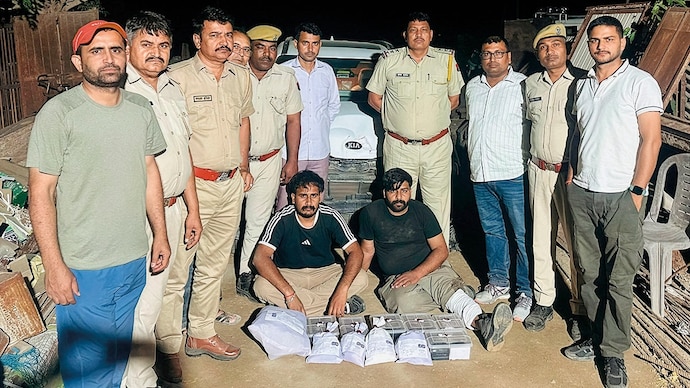
A snapshot came on May 4, with inputs that a Pakistani drone had dropped contraband in Sameja Kothi in Sri Ganganagar district. A high-speed chase led to two smugglers from Punjab, 1.5 kg of heroin and a kilo of opium. These came with five foreign-made pistols—four stamped ‘Made in Pakistan’, one ‘Made in China’—10 magazines and 72 live cartridges.
Earlier this year, the BSF shot down a Chinese-made drone that had crossed over in Bikaner’s Khajuwala sector. Its payload included five pistols and 325 cartridges. Vikas Kumar, I-G, Anti-Narcotics Task Force (ANTF), says: “Earlier, drones were used to push heroin. Now, we are seeing weapons.”
Early April saw one of the largest air mails so far: 12.167 kg of heroin, in 23 packets, dropped by a large quadcopter into a kinnow orchard in the Karanpur area of Sri Ganganagar. It’s a long litany of chases, arrests, hauls worth tens of crores. On April 25, an ANTF operation near Balesar, Jodhpur, even turned into a gunfight. Commandos crawled over 1.5 km to raid an under-construction building that housed an MD lab and came under fire from the rooftop.
It led to the seizure of 176 kg of MD precursors worth about Rs 90 crore. These are not old-style smugglers. “They are armed and organised,” says Kumar. In every way. In Barmer, a 5 kg meth stash was linked to a Pakistan-based handler who used digital payments.
Drone data tell the story. The three years up to February 2023 had recorded 28 drone recovery incidents along the India-Pakistan border. By 2024, that had jumped to 179 in a single year. Rajasthan’s share is rising. From virtually zero before 2023, the state saw 15 drone drops in 2024. In 2026, it has already touched at least 10. NDPS cases have climbed from 123 in 2023 to 1,604 in 2024, 2,069 in 2025—and 2,558 in just the first four months of 2026! Kumar says the ANTF has carried out nearly 300 raids in the past six months, seizing drugs worth over Rs 600 crore.
The western frontier is only one piece of a larger grid. Even consign-ments from the Golden Triangle on the east are washing up here. That’s not counting what’s getting ‘Made in Rajasthan’—33 labs for MD were busted recently, mostly makeshift units in the Jodhpur-Jalore-Barmer rural belt that turn precursors sourced from industrial supply chains in Gujarat and Maharashtra into MD within 24-48 hours. The profits have pulled in chemists, transporters and local operatives across states, with old liquor smuggling routes doubling up as narco channels.
Prohibitory changes in the law and in social attitudes are actually pushing users towards synthetics. The ban on poppy husk, once sold through licensed shops, and tighter enforcement around cannabis have reduced access to traditional, lower-potency intoxicants. The effect: a rather more vicious circle.

