Gujarat | One county for cats of all stripes
A tiger wanders in from nearby Madhya Pradesh and settles down—offering a local sighting after 40 years. But the excitement is muted by caution as conservationists ponder the complexities
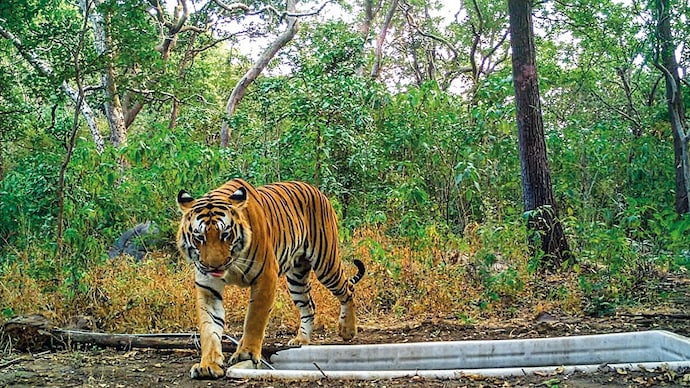
It’s the one state that famously has exclusive bragging rights on owning the biggest of the big cats within India, even figuratively. Now, as if with a nod of its feline head at recent political developments, the Bengal Tiger, too, has fallen to the charms of this western state. To be sure, it’s a homecoming. The tiger did once roam Gujarat’s forests, but was declared locally extinct four decades ago. So, when a solitary tiger travelled through the Vindhyachal ranges, a historic forest pathway linking Madhya Pradesh’s tiger-rich reserves to the Ratanmahal Wildlife Sanctuary in Dahod, eastern Gujarat, it was a reclaiming of lost territory. And ecology foreshadowed human affairs. February 2025 marked its first confirmed presence, and since then the male cat has marked his territory and made a few kills—the first step in applying for naturalised citizenship. The National Tiger Conservation Authority (NTCA) has duly added Gujarat to the tiger census 2025-26. The exercise will be held next in June 2026.
It’s the one state that famously has exclusive bragging rights on owning the biggest of the big cats within India, even figuratively. Now, as if with a nod of its feline head at recent political developments, the Bengal Tiger, too, has fallen to the charms of this western state. To be sure, it’s a homecoming. The tiger did once roam Gujarat’s forests, but was declared locally extinct four decades ago. So, when a solitary tiger travelled through the Vindhyachal ranges, a historic forest pathway linking Madhya Pradesh’s tiger-rich reserves to the Ratanmahal Wildlife Sanctuary in Dahod, eastern Gujarat, it was a reclaiming of lost territory. And ecology foreshadowed human affairs. February 2025 marked its first confirmed presence, and since then the male cat has marked his territory and made a few kills—the first step in applying for naturalised citizenship. The National Tiger Conservation Authority (NTCA) has duly added Gujarat to the tiger census 2025-26. The exercise will be held next in June 2026.
With its wild Asiatic Lions in the Saurashtra peninsula, Gujarat now has the unique distinction of hosting three big cats, counting the tiger along with the leopard. It will soon be welcoming on board the cheetah too, as a portion of the Banni grasslands in Kutch is readied to host a breeding centre, with a planned release into the wild in that region’s Narayansarovar sanctuary.
IS THERE SPACE?
This embarrassment of riches comes with a hard question for Gujarat: how far will its crowded, infrastructure-hungry landscape go to secure tiger habitat? These stand only temporarily deferred amidst the celebrations. “There was once a wide presence of tigers in Gujarat, so it’s a joyous occasion that they have returned,” says Arjun Modhwadia, state environment and forests minister. But the excitement is tempered with a good measure of apprehension—what the tiger has wandered into is now a landscape rife with human presence, farmlands, as well as a high premium on space for infrastructure projects like expressways and railway lines.
The tiger, meanwhile, has its own space crunch. Dahod borders Madhya Pradesh, which is seeing a boom in tiger population—785, at last count. This is pushing sub-adult animals out to seek new territories with a reliable, competition-free prey base. This one is believed to have dispersed thus from a designated reserve, most likely in Kathiwada, Alirajpur or Jhabua, in that search.
“The corridor he has been moving through is a patchwork of forest, farmland, villages and highways,” says a senior forest officer. Another senior official sounds the warning more clearly: “We need to go about it very, very carefully.”
In a tragic 2019 episode, a tiger from Ratapani sanctuary in Madhya Pradesh trekked 300 km and entered Mahisagar, central Gujarat, but was found dead within 20 days. The post-mortem reported death due to starvation, but sources suspect he was poisoned by locals and the case not probed due to local political pressure, a claim denied by the forest department.
This tiger is still a fresh migrant, having trekked only about 60 km. Even after a year, no signs yet exist of a tigress—the final document, as it were, for domicile status. Some officers are surprised at this, and suspect an itinerant paramour that hasn’t been recorded yet. Foresters have sought guidance from biologists over relocating a tigress, but the sentiment is split over fast-forwarding the big cat’s settlement.
CONFLICTING PICTURES
Ratanmahal, spread over 55.5 sq. km, with adjoining forests to its northeast and southeast, has been potentially earmarked as a formal tiger habitat. Its hills are home to 101 sloth bears, besides leopard, hyena, jackal, four-horned antelope, mongoose, porcupine, civet, jungle cat, langur et al. The sanctuary has been supplemented with additional herbivore populations like sambar and chital, with a detailed plan to relocate more during the monsoons from Gir.
“The NTCA will conduct a scientific sweep of the region, tag the tiger and christen it with a number,” says Jaipal Singh, principal chief conservator of forest (wildlife). The tiger has been tiptoeing across 90 sq. km, mostly through reserve forests. About 150-250 villages are potentially impacted, most of them tribal settlements with cattle dependence and high forest-use. Conservators are anxious about conflict with the humans and cattle kills in the region.
A few of the dozen-odd villages inside the sanctuary might need to be relocated, but that conversation is the elephant in the room authorities would rather not address till they have to. “We have started sensitising and training villagers on tiger behaviour,” Singh says, adding it has been preying on stray cattle, goats, nilgai and wild boars, but not entered a village yet.
What if it does? Gujarat needs a strategy beyond hope. “All excitement is futile if local communities are not prepared. They are the biggest stakeholders,” says a forester. “We need a detailed tiger conservation plan on a war footing. The seriousness is either underestimated or understated. For now, there’s more need to worry than celebrate.” Gujarat is a vastly transformed, urbanising landscape. Rehabilitating the tiger within it will need a collective attitude that values the ecology as much as the economy.

