Madhya Pradesh | Faith, history & a verdict
The MP court order on the sensitive Bhojshala issue sees the Hindus celebrating and the Muslims planning to appeal
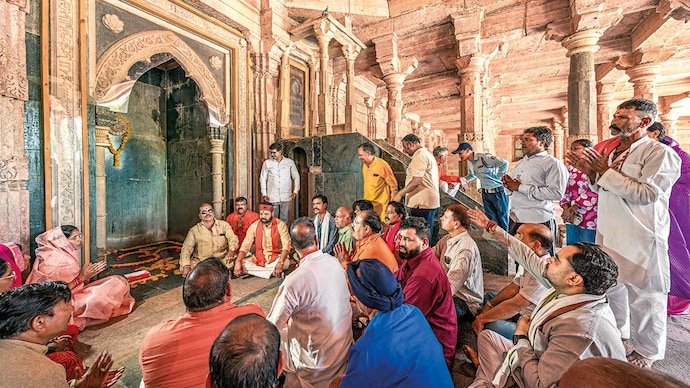
A judicial ruling on May 15 seems to have settled—albeit for the time being—a long-standing religious dispute in Madhya Pradesh over rights to worship at the Bhojshala temple-Kamal Maula mosque structure in Dhar district. The Indore bench of the MP High Court ruled that the Archaeological Survey of India (ASI)-protected monument was a temple—as claimed by the Hindu side—dismissing contrary claims by the Muslim group (and of late even that of a Jain grouping). Delivering the judgment, the division bench of Justices V.K. Shukla and Alok Awasthi also asked the government to make efforts to bring back an idol of Vagdevi lodged at the British Museum in London, besides allotting the Muslim group alternate land to build a mosque. The court also quashed a 2003 ASI order that had specifed days of the week for Hindus and Muslims to offer prayers at the structure. Celebrations broke out among Hindu groups at the Bhojshala immediately after, and a prayer was organised the next day, which was attended, among others, by the Dhar district magistrate and superintendent of police.
A judicial ruling on May 15 seems to have settled—albeit for the time being—a long-standing religious dispute in Madhya Pradesh over rights to worship at the Bhojshala temple-Kamal Maula mosque structure in Dhar district. The Indore bench of the MP High Court ruled that the Archaeological Survey of India (ASI)-protected monument was a temple—as claimed by the Hindu side—dismissing contrary claims by the Muslim group (and of late even that of a Jain grouping). Delivering the judgment, the division bench of Justices V.K. Shukla and Alok Awasthi also asked the government to make efforts to bring back an idol of Vagdevi lodged at the British Museum in London, besides allotting the Muslim group alternate land to build a mosque. The court also quashed a 2003 ASI order that had specifed days of the week for Hindus and Muslims to offer prayers at the structure. Celebrations broke out among Hindu groups at the Bhojshala immediately after, and a prayer was organised the next day, which was attended, among others, by the Dhar district magistrate and superintendent of police.
A LONG-RUNNING DISPUTE
As in other disputed sites, the Hindu litigants contend that the Bhojshala is an 11th century Saraswati (Vagdevi) temple-cum-centre of learning built by Paramara ruler Raja Bhoj. The Muslims claim the mosque was built in the 14th century by a prominent Khilji-era general, Ain-ul-Mulk Multani, which was renovated a century later by Dilawar Khan Ghauri, who established the Malwa sultanate. The complex houses the Kamal Maula mosque and the tomb of Sufi saint Kamal Malawi. Prior to 2003, the structure was used only by the Muslims.
The 2003 ASI order also allowed Hindus to pray on Basant Panchami which, when it fell on a Friday a few times in the past 23 years, triggered communal tensions and turned Dhar into a fortress of the law enforcement agencies. Both communities also have differing views on the many structures inside the 17-acre complex. For example, a depression in the main quadrangle is claimed as a havankund (sacred yagna pit) by Hindus and a wazukhana (ablution pond) by Muslims. The Hindus cite a number of Prakrit inscriptions, including a reference to the Kurmavtara—the tortoise avatar of Vishnu—besides the design and pillars, in their claim. The Muslim side says the mosque was rebuilt using previously used construction material, which was a common practice back then.
Acting on a petition by the ‘Hindu Front for Justice’, a division bench of the HC had in March 2024 ordered a scientific survey of the complex by the ASI. The survey findings have been extensively quoted in the HC judgment, but it did not get into issues of ownership/civil suit, instead looking at the matter from the lens of protecting the right to worship as enshrined in Article 226 of the Constitution.
Drawing from the 2019 Ayodhya judgment, the court listed 10 principles enumerated by the MP advocate general in the case, prominent among them being the ‘preponderance of probability’ or that judges should decide such issues not on absolute facts but on whose version is more believable. Besides this, the other principles cover aspects such as continuity of use of a space as a religious structure, archaeological evidence, as well as government gazettes and notifications. A key conclusion was that a missing idol does not mean the structure cannot be a temple. The court observed that continuous prayers at the site are an indication of its sanctity and mentions ‘pious purpose’ as the concept that protects the place and not just the idol. The Vagdevi idol at the British Museum that was taken to London in 1903 by Lord Curzon was also cited by the Hindu side and in the petition by the Jain cohort. They cited the inscription on the idol to suggest that it was not of Saraswati but of Jain deity Ambika. The court dismissed the Jain petition, saying the latter was “in fact, a branch of Hinduism”.
Legal experts on the Muslim side had also raised the applicability of the Places of Worship Act, 1991, Section 4 of which mandates that the religious identity of all places must remain as it was on August 15, 1947. The court ruling said the act does not apply to ASI-protected monuments as it exempts places of worship in determining the nature of their religious character.
WHEELS OF JUSTICE
So, what next? “We have always respected the courts. We presented evidence in the case, but the court ruled otherwise. We will now appeal in the Supreme Court and hope justice will be done,” says Islamic cleric and Dhar sheher qazi Waqar Sadiq. The lawyer for the Hindu Front for Justice, Vishnu Shankar Jain, says they have “already filed a caveat in this regard in the SC”.
Bhojshala is the third prominent disputed site where the courts are adjudicating to ascertain historical veracity of claims, the others being the Gyanvapi Mosque-Shiv Temple in Varanasi and the Shahi Idgah Mosque-Keshavdev Temple in Mathura. Ashhar Warsi, lawyer for Dhar Muslim residents Jibran Ansari and others, says, “The high court has in effect ruled on a PIL and given the outcome of a civil suit. We had informed the court that a civil suit for title and possession of the structure is pending at the Dhar district court, but this aspect was also not considered.”
The Bhojshala judgment, banking as it does on writ jurisdiction rather than a treating it as a property ownership dispute, is likely to have far-reaching consequences on other cases as well. Even the Taj Mahal, built by Shah Jahan as a mausoleum, is now being claimed by a group of Hindus, saying it was built over a Shiva temple.

