Karnataka | Team DKS: Form and formula
Caste rebalancing was tough, but fiscal balancing may be tougher as the new CM enters office with a fresh manifesto
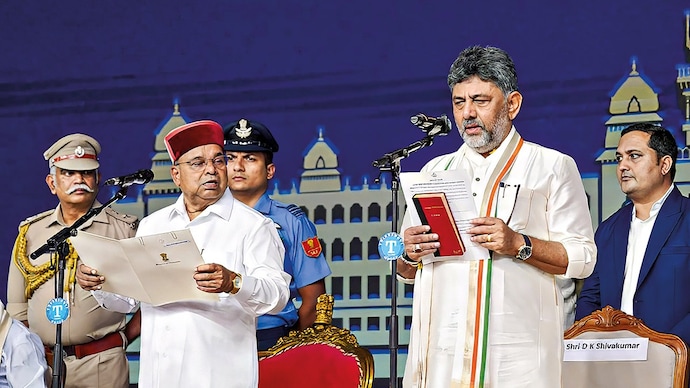
Karnataka’s power transition was like making the beads in a kaleidoscope move between two arrangements. The first pattern had to be gently disturbed—done on May 28, with the resignation of Siddaramaiah. Then a brief phase of flux had to be endured before coaxing it into a new pattern, equally symmetrical to the observing eye. That came about on June 3 as D.K. Shivakumar, 64, was sworn in as the new Congress chief minister. Party senior Dr G. Parameshwara came in as deputy CM—the relative weight of beads was crucial. A team of 12 ministers rounded off the ensemble.
Karnataka’s power transition was like making the beads in a kaleidoscope move between two arrangements. The first pattern had to be gently disturbed—done on May 28, with the resignation of Siddaramaiah. Then a brief phase of flux had to be endured before coaxing it into a new pattern, equally symmetrical to the observing eye. That came about on June 3 as D.K. Shivakumar, 64, was sworn in as the new Congress chief minister. Party senior Dr G. Parameshwara came in as deputy CM—the relative weight of beads was crucial. A team of 12 ministers rounded off the ensemble.
Shivakumar, aka DKS, got a more muted coronation than he desired; a ‘victory rally’ was cancelled, giant posters were taken down, the oath-taking happened at the governor’s house, not the Vidhana Soudha’s grand steps. The high command reportedly felt a gala event would look indecorous in times of austerity. DKS scaled things back, reined in his supporters, and instead chose to reserve his front-foot play for the policy arena. It was literally time for the big sixes—a sextet of announcements that signalled he would push ahead with his party’s welfarism while steering his pet project of revamping Bengaluru.
But first, the caste balance needed to be fashioned anew after Siddaramaiah’s exit. Born in the Kuruba shepherding community, he was a living totem of backward class politics whose clout came from the collective mobilising of minorities, OBCs and Dalits, known by the Kannada acronym AHINDA. Shivakumar, on the other hand, is a Vokkaliga, one of the state’s two dominant caste blocs. Between them and the Lingayats, they have supplied Karnataka with eight and nine chief ministers, respectively. How was this tilt towards the ancien rgime to be counterbalanced?
THE DALIT DEPUTY
As a solid Dalit face of the party, Parameswara fits the bill. After a PhD in Plant Physiology from Adelaide, he was groomed back in the day by Rajiv Gandhi. As a young sprinter, he had once done 100 metres in 10.9 seconds. At 75, he has taken his time to rise to the top. He was deputy CM once in 2018, but returns at a time when Rahul Gandhi is giving a pro-Ambedkarite depth to Congress politics. A party rejig was due too, since DKS was also state Congress chief. In steps another OBC leader to fill that post: AICC veteran B.K. Hariprasad, a member of the state legislative council. Siddaramaiah, who declined the offer of a Rajya Sabha seat, preferring to remain an MLA, has been named to the Congress Working Committee.
A TEAM AND A JOB
His imprint is preserved in another way too. The first list of Team DKS largely mirrors the outgoing cabinet, but a notable addition is Siddaramaiah’s son Dr Yathindra Siddaramaiah, who makes his ministerial debut. The rest—a mix of veterans and GenNext—have three Vokkaligas, Lingayats and Dalits each, two Kurubas, and one ST, Christian and Muslim each.
Emulating his predecessor, DKS lost no time in getting down to business. Soon after his oath-taking, he convened his first cabinet meeting. On the agenda was a mix of populism and pragmatism: employment exchanges for private sector jobs; Rs 2,000 crore to fix Bengaluru’s roads; a one-time amnesty for building bye-law violations; free bus passes for all students up to PG; an extended “Bhu-guarantee” campaign to regularise property titles.
In his maiden press conference, DKS spoke of rural development, farmers’ livelihood and urbanisation. “A big shift is taking place with people migrating to towns for work—42 per cent of people live in cities,” he said.
His schemes seek to chart a fresh course beyond the Congress’s five big-ticket welfare guarantees from 2023. But with a cumulative outgo of Rs 1.21 lakh crore in three years, those have left little fiscal wiggle room. “We will face it, how many ever crores it works out to,” says DKS. How those beads fall will be the pattern to watch.

