Maharashtra | A harvest of tears stalks onion county
War, weather and a wholly self-made export muddle combine to bring ruin to a vast belt of small farmers
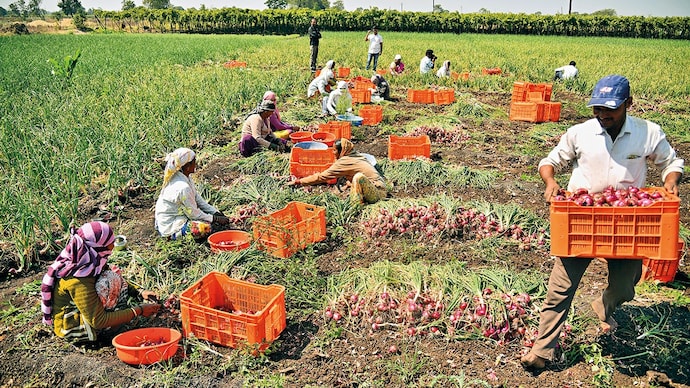
It may be inflating prices all around, but the West Asia crisis has brought tears to the eyes of Maharashtra’s onion farmers for the opposite reason. There’s a glut in the local market. The high-volume, low-cost commodity gets exported mostly by ships, so emergency surcharges have choked the sealanes to the massive Gulf market. Overland, Bangladesh’s protectionist policies block another destination. Adding to the pain of fickle export policies, unseasonal rains amidst a superhot summer have spoilt crop quality. Net effect: farmers in the onion belt around Nashik are getting as low as Re 1 per kg.
It may be inflating prices all around, but the West Asia crisis has brought tears to the eyes of Maharashtra’s onion farmers for the opposite reason. There’s a glut in the local market. The high-volume, low-cost commodity gets exported mostly by ships, so emergency surcharges have choked the sealanes to the massive Gulf market. Overland, Bangladesh’s protectionist policies block another destination. Adding to the pain of fickle export policies, unseasonal rains amidst a superhot summer have spoilt crop quality. Net effect: farmers in the onion belt around Nashik are getting as low as Re 1 per kg.
So that tragic sight is at hand again: farmers dumping their unsold harvest outside mandis. Those who manage to offload their crop are forced to sell for Rs 100-200 per quintal (100 kg)—far below break-even, given their rising input costs. This is playing out across the vast onion-cultivating belt of north and western Maharashtra. Nashik district is its core, with 22 wholesale markets, including Agricultural Produce Market Committee (APMC) outlets and private entities. But layers of geography are packed around it: Dhule, Ahilyanagar, Pune, Nandurbar, Jalgaon, Beed, Solapur and Buldhana.
Onions are grown by small and marginal farmers who till unirrigated land. State interventions have not helped them. The National Cooperative Consumers Federation of India (NCCF) and National Agricultural Cooperative Marketing Federation of India (NAFED) are offering Rs 1,235 per quintal. On May 26, this was hiked to Rs 1,580 per quintal for Nashik district. But even this forces farmers to book a guaranteed loss of up to Rs 1,000 per quintal. And the procurement target is a mere 200,000 tonnes, a fraction of the millions of tonnes harvested here.
Bharat Dighole, founder-president, Maharashtra Onion Producers Association, says the average production costs have risen to Rs 2,200 per quintal, counting purchase of seeds, sowing, inputs, harvesting, packing, labour and transport. “When market prices rise, the state intervenes to protect consumers. Now, prices have fallen. It should step in to aid onion cultivators,” he says, seeking a subsidy of Rs 1,500 per quintal for all affected farmers.
Upstream, the issue is quality. Nitin Jain, an onion exporter and trader from Lasalgaon, says: “Some 10-15 per cent of the produce is damaged due to heat and rain, and there are complaints from buyers.” Lasalgaon is one of Asia’s largest spot markets for onions, with around 900 tractors of onions chugging in daily, each with 10-30 quintals. Jaydutta Holkar, director, Mumbai and Lasalgaon APMCs, sympathetic to the farmers, says there’s little response to the offer of Rs 1,580. Only 48 tonnes have been procured in a fortnight. The catch: it covers only quality onions. He advocates a “cost-plus” payout.
The opposition Maha Vikas Aghadi has hit the streets in protest. Bhaskar Bhagare ‘Guruji’, NCP (SCP) MP from Dindori, a constituency that covers onion-rich Lasalgaon, Kalvan, Deola, Chandwad, Yevla, Niphad, Nandgaon and Malegaon, backs the demand for state support. He says the Centre’s fickle export policies over the years have hurt the interests of farmers. “We have lost access to markets like Bangladesh, now there’s the war in the Gulf. The Centre must tap newer markets like Europe,” he adds. “It’s unfortunate that we cultivate the highest amount of onions in the world, yet fail to export it properly.”
FADNAVIS STEPS IN
CM Devendra Fadnavis, with his deputy CMs, has met Union home minister Amit Shah and agriculture minister Shivraj Singh Chouhan in New Delhi on the issue. Fadnavis says their demand for NAFED/NCCF to purchase directly from farmers has been approved. Besides traders, Chouhan has also agreed to eliminate graders by mechanising procurement so that crop is not rejected on the pretext of quality. The CM wants procurement targets to go up tenfold to 2 million tonnes, with prices hiked beyond Rs 1,580. Another snafu: India cannibalised its export markets by selling its high-quality seeds to global competitors. Fadnavis says this must be capped with a surcharge.
The onion is grown in three cycles. The rabi variety, ‘unhali’, is harvested in March-April. The kharif variety, ‘pol’, is sown at the onset of the monsoons and harvested by October. Then comes the late kharif ‘rangda’ variety. The latter two can’t be stored for long due to high moisture content; the ‘unhali’ is durable and stays for up to six months. But the farmer has to endure first for that. Peel back the layers, and one gets an issue of great political pungency: it was a fall in onion prices, caused by an export ban, that birthed Sharad Joshi’s Shetkari Sanghatana, back in the late 1970s.

