Beyond the Crease | Ankon Mitra at Galeries Lafayette Mumbai
From a broke backpacker staring at the gates of Galeries Lafayette in Paris to reskinning its historic Mumbai flagship, it's a full circle moment for Ankon Mitra
In 2008, Ankon Mitra was a design student on a shoestring budget, trekking from London to Paris. Standing before the Haussmann-style grandeur of the Galeries Lafayette flagship, he felt like a ghost in the machine. “I felt completely out of place,” Mitra recalls. “I half-expected the staff to tell me I didn’t belong. My entire trip probably cost less than a single item in that store.”
In 2008, Ankon Mitra was a design student on a shoestring budget, trekking from London to Paris. Standing before the Haussmann-style grandeur of the Galeries Lafayette flagship, he felt like a ghost in the machine. “I felt completely out of place,” Mitra recalls. “I half-expected the staff to tell me I didn’t belong. My entire trip probably cost less than a single item in that store.”
Fast forward to today, and the intimidation has turned into an invitation. In a definitive “full circle” moment, Mitra was commissioned to design the visual identity for the brand’s entry into India, housed in the heritage Turner Morrison and Voltas House buildings, near Elphinstone Circle in Mumbai. He isn’t just a visitor anymore; he is the visionary tasked with “reskinning” an icon.
A DIALOGUE BETWEEN TWO CITIES
Mitra’s evolution mirrors the very buildings he works on. Trained as a modernist, his early work had clean lines with very little ornamentation. However, the ghost of Parisian Baroque, its ornate, over-the-top richness, lingered in his mind for years. “Now materials and materiality have themselves become an opportunity for creating ornamentation.” For the Mumbai project, this manifested as a high-stakes race against time. Mitra had to marry the exacting standards of French luxury with Indian grit. The brief was strict: the French tricolours of red, white and blue. “It was hectic,” Mitra admits. “You don’t always get those exact shades in off-the-shelf paper.” When global shipping timelines threatened the project, his team pivoted to a bespoke, hands-on approach: hand-dyeing paper to achieve the precise depth of French Blue and Flag Red.
THE SECRET INDIAN SOUL
While the facade screams Parisian chic, a closer look reveals a subtext that is purely Indic. Mitra didn’t just want to paint the store in foreign hues; he wanted to tuck a local narrative into the geometry. “My technique is a chameleon,” he explains. “It can look international or it can feel deeply local.” Hidden within the sharp, contemporary folds are abstracted references to the lotus and the conch shell. These aren’t obvious motifs; they are Easter eggs for the observant viewer. You see the architecture of the fold first, and then, as you linger, the Indian soul reveals itself.
SHOPFRONTS TO SANCTUARIES
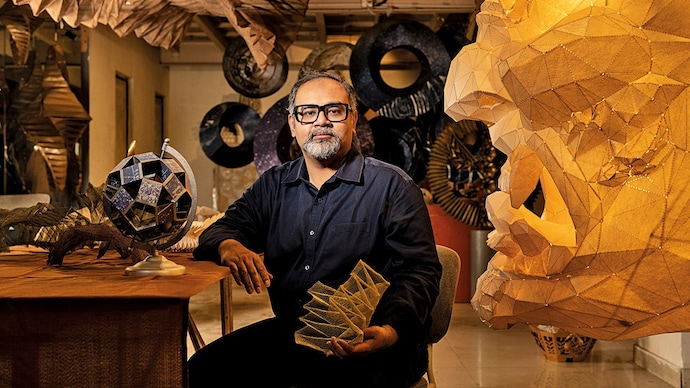
For 15 years, Mitra has been on a mission to blow up origami, to take it off the coffee table and turn it into a spatial experience. “I want you to walk through the geometry, not just look at a folded bird,” he says. While the Galeries Lafayette project is a public wow moment, Mitra is increasingly bringing this sculptural language into the private home. However, the energy shifts when moving from a storefront to a living room. In a retail space, the paper must perform; in a home, it must breathe. “In a residence, it’s about the inhabitant’s personality,” Mitra notes. For an extroverted homeowner who hosts often, the installation might be a bold, jostling ceiling that mimics the energy of a city street. For others, it’s a tool for intimacy—a textured wall in a quiet nook designed for meditation and shadow-play.
FOLDING YOUR OWN SPACE
Bringing origami architecture into a home is a blend of art commission and structural renovation. Mitra’s work typically begins in intimate 8x8-foot zones, yoga rooms or reading nooks where folded material envelopes the occupant to help the mind expand. For those looking for a grander statement, the work scales into double-height lounges where the ceiling becomes a folded skyscape.
As for the cost, custom lighting pieces or smaller, intimate instal-lations typically start around `4 lakh to `5 lakh. Large-scale spatial interventions for lounges and entertainment zones scale upwards based on complexity and material, often reaching into the high double digits as they transform from decor into permanent architectural art.
By transforming humble folds into monumental architecture, Mitra (now 45) has proved that the ancient art of origami is no longer confined to a tabletop, it is a living, breathing language that can be translated into any material. All you need is the right vision.

