Blueprint for better taste | The kichens of chefs Radhika Khandelwal, Nitin Mathur & Maxime Montay
Step inside the high-performance cooking zones to learn why visibility, precision and zero-clutter are the secret ingredients to great food
ALL ABOUT EFFICIENCY
ALL ABOUT EFFICIENCY
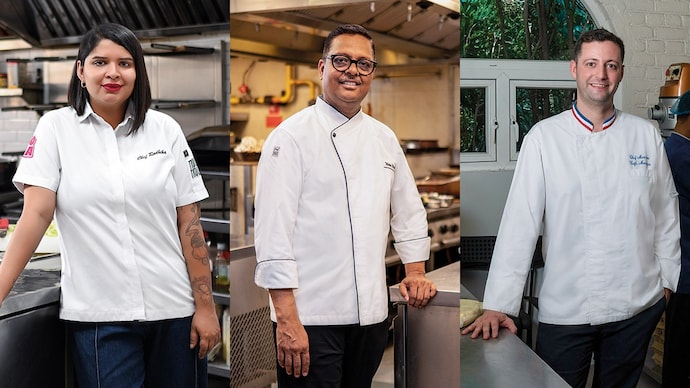
Chef Radhika Khandelwal doesn’t just run kitchens; she engineers ecosystems. As the force behind Trouble Trouble, Kona and Three Little Figs, Khandelwal balances a high-profile roster—ranging from private jets and embassies to brands like Spotify and Huda Beauty—with a grounded, producer-first philosophy. For her, the ultimate kitchen design is a marriage of industrial efficiency and raw seasonal transparency.
OPEN SHELVES AND ISLAND VIBES
Khandelwal champions a domestic layout that prioritises visibility. Her ideal space swaps bulky cabinets for open shelving. “I like to see what I can grab at all times,” she says. To elevate a home kitchen, she suggests, hanging pan racks to avoid stacking to maintain the longevity of your cookware; dedicated spice zones to keep your aromatics organised but accessible; and island cooking, shifting the stove to a central island turns cooking into a shared, social activity rather than a solitary chore.
THE SHOWSTOPPER
The crown jewel of her redesigned space is the Churrascaria, a custom-built Brazilian grill designed alongside Anirudh Singhal of SpeedX. Unique to the Delhi culinary scene, this four-level grill is a masterclass in efficiency. The vertical heat management allows for simultaneous techniques and styles of cooking.
Khandelwal remains proudly cuisine agnostic, focusing on decade-long ties with local farmers rather than culinary labels. “What drives food is seasonality,” she explains. For her, the chef is merely the final link between exceptional produce and the guest, a role she considers a privilege.
THE ALCHEMY OF SLOW COOKING
For Chef Nitin Mathur, the Executive Chef at Taj Palace, New Delhi, a kitchen is more than a workspace; it is a meticulously choreographed stage. Steering the culinary narrative at Loya, the hotel’s flagship North Indian destination, Mathur brings 32 years of Taj legacy to the beautifully laid out table.
ANATOMY OF A CRAFT KITCHEN
We found that the kitchen at Loya is a blend of high-tech efficiency and primordial heat, designed with distinct zones that cater to specific culinary disciplines. It features a dedicated curry section and a high energy live kitchen where the drama unfolds in full view of the diners. “We have a live kitchen, which denotes sigri, tandoor, a tawa and the pots where slow cooking happens, which is visible from the restaurant,” shares Mathur.
BOTTOM’S UP
When discussing essential equipment, Mathur bypasses flashy modern gadgets in favour of the humble heavy-bottomed pan. He explains that the quality of the brass or metal vessel matters most because a thick base acts as a natural heat regulator. “The heavier the bottom of the pan the more evenly and slowly it heats, instead of buring the food,” he explains, adding that the, “Quality of the pan and the pot what you are cooking matters the most.”
GEOMETRY OF A DREAM KITCHEN
For the professional and the home enthusiast alike, Mathur’s vision of a dream kitchen centres on ergonomics and environmental comfort. He envisions a space where movement is minimised and everything is within arm’s reach. “Moreover, modern kitchens have shifted away from being stuffy,” he says, highlighting the importance of superior exhaust and HVAC systems.
Mathur’s final advice for home cooks is to look past the overwhelming number of internet recipes and focus on the why behind the techniques. He points out that understanding the specific role of an ingredient is what truly defines a dish. “If you understand the dishes, it is easier to go because the recipe will always say saut the onions, but you need to know how much.”
FINE ART OF FINESSE
For Maxime Montay, Executive Chef at Monique, the kitchen is a precision-tuned laboratory where engineering meets artistry. With a background as a Food Process Engineer, Montay brings a clinical discipline to his French bakeries across Delhi NCR. At Monique, the philosophy is simple, a kitchen must be spotless to be soulful. “I believe it’s important to keep your main work areas very tidy and clean as it makes one more efficient and it also opens your creativity somehow,” he says. By merging rigorous French technique with a minimalist aesthetic, he ensures finesse is baked into the very layout.
ENGINEERING THE FLOW
Montay’s design DNA is rooted in a clean freak approach to organisation, viewing a well-ordered workspace as the primary fuel for innovation. He prioritises high ceilings and natural light. “It’s a choice one makes because keeping a space for a window is that much space less for a storage rack,” he explains. In fact, he utilises Vastu principles as a practical tool for functional design. He creates equilibrium by separating fire elements like ovens from water stations like sinks. By placing heavy storage in the south west and keeping north east walls light, he ensures a natural flow. “I also avoid black or dark tones in the kitchen which gives that feeling of an enclosed space and prefer beige or white,” he notes.
TECH THESE OUT
While the soul of his bakery is a massive, 10-tray oven (the best corner for its warmth and fragrance), Montay’s engineer heart beats for high-tech gadgets. He is currently experimenting with a Martello Spinner, an electric turntable for avant-garde piping.
Montay’s final advice for any kitchen is to prioritise accuracy and visibility over clutter. He advocates for a kitchen built on cleanliness and the total elimination of hidden storage. “Accuracy, quality and consistency are key, everything else is just noise,” says the chef.
Photographs by Arun Kumar

