Textiles sector | A looming crisis
India's textiles sector is struggling to recover from the recent geopolitical disruptions and meet its export target of $100 billion by 2030. Revival will require leveraging trade agreements, policy support and upgradation
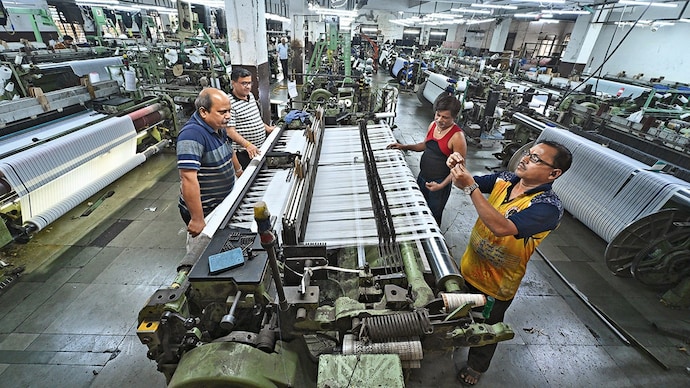


April and May are traditionally the cruellest months for Bhiwandi, the sprawling textile town in Thane near Mumbai. Home to nearly 50,000 factories—largely traditional power loom units that convert yarn into fabric—the town witnesses a predictable workforce exodus every summer as temperatures climb past 40 degrees Celsius and migrant workers head back to their home states. Most of Bhiwandi’s 1.5-2 million workers come from Bihar and Uttar Pradesh. This year, however, nearly half of them began leaving as early as March, throwing production completely out of gear.
April and May are traditionally the cruellest months for Bhiwandi, the sprawling textile town in Thane near Mumbai. Home to nearly 50,000 factories—largely traditional power loom units that convert yarn into fabric—the town witnesses a predictable workforce exodus every summer as temperatures climb past 40 degrees Celsius and migrant workers head back to their home states. Most of Bhiwandi’s 1.5-2 million workers come from Bihar and Uttar Pradesh. This year, however, nearly half of them began leaving as early as March, throwing production completely out of gear.
The trigger was the war in West Asia. The exodus, says Uchit Shah, director of Optimum Silk Mills, began after cooking gas shortages hit migrant settlements in the region. At the same time, exports ground to a halt. “I had goods worth over Rs 3 crore lying since insurers were not willing to cover shipments that went to or via the Middle East,” says Shah, whose company exports largely to West Asia and Africa. With consignments stuck and orders disrupted, he was forced to offload part of his inventory in the domestic market at steep discounts.
The disruptions witnessed in Bhiwandi were mirrored in Surat, another major textile hub. During the four weeks of conflict before the ceasefire, Surat’s 25,000 textile units are estimated to have suffered losses of nearly Rs 5,000 crore. That was because the conflict triggered a spike in crude oil prices, directly impacting the production of man-made fibres or MMF (synthetics derived from crude oil and cellulosic fibres made from wood pulp), transportation and logistics. Polyester and nylon yarn prices rose by 50 per cent or roughly Rs 10-40 per kg, while grey fabric became costlier by Rs 3-5 per metre. Dyes and chemicals surged by as much as 60 per cent, industrial coal prices rose 35 per cent, and freight costs increased nearly 400 per cent. Transport charges climbed from Rs 400 to more than Rs 600 per truckload, severely squeezing already thin margins. “Our products became uncompetitive at such costs. We had to curtail production. Every day of war added Rs 100 crore losses,” says Ashok Jirawala, president of the Federation of Gujarat Weavers Welfare Association.
The situation has eased somewhat since the ceasefire between the US, Israel and Iran allowed some movement of consignments to resume, albeit slowly. But the problems in India’s textile industry did not begin with the crisis in West Asia. The Gulf conflict only aggravated an industry already under pressure from rising costs, outdated production systems, labour inefficiencies, financing constraints and an inability to compete effectively in newer segments of the global apparel market.
The paradox confronting India’s textile industry is stark. Despite being a $179 billion (Rs 17 lakh crore) industry that employs nearly 45 million people and supports over 5 million MSMEs, the textile and apparel sector has been steadily losing competitiveness for years. India today possesses one of the world’s largest textile ecosystems and a domestic apparel market valued at nearly $100 billion (Rs 9.5 lakh crore), growing at 7-9 per cent annually and occasionally touching double digits. Yet overall exports have been stuck at $35-37 billion (Rs 3.3-3.5 lakh crore) in the past decade. Meanwhile, apparel exports have stagnated at roughly $13-16 billion (Rs 1.2-1.5 lakh crore) for nearly five to six years. In contrast, competitors such as China, Vietnam and Bangladesh have steadily expanded their global market share.
THE COTTON TRAP
The bigger problem predates the Gulf crisis by several years. India’s first big disadvantage was self-inflicted when it largely missed the global shift towards MMF. Textile exports continue to remain heavily dependent on cotton, with cotton garments accounting for nearly 85 per cent of exports. But global demand has increasingly shifted towards MMF-based apparel, which dominate categories such as sportswear, winterwear, athleisure and technical textiles. While the global cotton-to-MMF consumption ratio stands at roughly 25:75, India’s domestic ratio remains almost the reverse at 60:40.
Rahul Mehta, chief mentor of the Clothing Manufacturers Association of India (CMAI), says this has significantly constrained India’s export diversification. “As a result, Indian textiles remain skewed towards spring-summer wear, with limited presence in MMF-based winter and technical segments,” says Aman Peshawari, CEO of Noida-based garment and home furnishings manufacturer Meenu Creation. “This restricts participation in high-value markets.” China, by contrast, built an integrated and highly competitive MMF ecosystem decades ago, enabling it to dominate global synthetic textile exports. Vietnam aggressively leveraged MMF manufacturing to integrate itself into global fast-fashion supply chains. India, meanwhile, remained tied to cotton.
Even India’s cotton sector has begun showing signs of stress. “Cotton productivity has been declining,” says Saket Jaipuria, director at Noida-based Ginni Filaments. Despite accounting for nearly 40 per cent of global cotton acreage, India’s yield stands at only around 450 kg per hectare, compared with nearly 2,000 kg in several competing countries. To meet quality and export requirements, India has increasingly relied on imports of superior cotton, bringing in nearly 2 million bales annually. Yet these imports attract an 11 per cent duty. Government interventions, including the production-linked incentive scheme for MMF apparel and fabrics, have had limited impact. With initial investment thresholds as high as Rs 300 crore—later reduced to Rs 150 crore—the scheme largely benefited bigger firms, leaving out vast segments of the MSME-driven textile industry.
On May 5, the government approved the Mission for Cotton Productivity with an outlay of Rs 5,659 crore for 2026-31, aligned with its 5F vision—from Farm to Fibre to Factory to Fashion to Foreign. The mission is expected to benefit 3.2 million cotton farmers by distributing climate-smart, pest-resistant seeds, boosting incomes and helping standardise premium Indian cotton for global markets.
SCALE DISADVANTAGE
India’s second major disadvantage lies in scale. Most factories operate with 100-500 machines, while competing factories in Bangladesh often run 2,000-5,000 machines under integrated facilities. Large global buyers prefer fewer suppliers capable of delivering high volumes within tight timelines and with consistent quality standards. Rajeev Gupta, Joint Managing Director of RSWM Limited, says the scale mismatch is stark. Domestic orders typically run at 200,000-300,000 pieces per month, while international buyers often seek at least 1 million pieces at a time.
The problem is compounded by India’s fragmented textile geography. “While cotton is largely grown in Gujarat and Maharashtra, yarn spinning mostly takes place in Tamil Nadu, fabric is processed in Gujarat or Maharashtra, and garment manufacturing is scattered nationwide,” says Mithileshwar Thakur, secretary general of the Apparel Export Promotion Council. “This disaggregation increases logistics costs and hampers operational efficiency.” China and Vietnam, in contrast, built highly integrated textile clusters where spinning, weaving, processing and garmenting operate within tightly linked industrial ecosystems. This reduces transportation costs, improves coordination and enables much faster turnaround times.
The third major hindrance is that India’s technology deficit has widened over time. Arif Ansari, 70, who owns Mishi Fabrics in Bhiwandi, says the town’s gradual decline reflects the industry’s failure to modernise. “Twenty-five years ago, Bhiwandi used to have 700,000-800,000 looms. Today there are around 400,000-500,000 only,” he says. Of his own 120 looms, only 20 are modern. The rest date back to 1948. Imported yarn from China is often nearly 25 per cent cheaper than domestic yarn, making Indian production less competitive. “Over the past 20 years, the textile sector did not upgrade itself technologically enough,” says Jaipuria.
LOW PRODUCTIVITY
China’s advantage today is no longer simply cheap labour. It is productivity, automation, technological depth and integrated supply chains. Labour productivity in India remains significantly lower. “Even today, one worker manages one embroidery machine, whereas in China, one person can manage four,” says Peshawari. Labour itself remains another structural weakness. Textile manufacturing hubs such as Delhi-NCR, Bengaluru, Chennai and Tiruppur are located far from major labour catchment regions, increasing costs for both housing and wages. Skill development programmes have also struggled to deliver adequately trained workers for increasingly sophisticated manufacturing requirements.
At the policy level, the industry argues that India has often made exporting harder for itself. While finished garment imports remain relatively open, duties on critical raw materials and machinery raise domestic production costs. High-end textile machinery is largely imported, increasing dependence on foreign suppliers. Industry leaders argue that temporarily reducing customs duties on such machinery could accelerate modernisation. Consumer trends have also shifted unfavourably. According to CMAI’s Mehta, discretionary spending is increasingly moving towards travel and lifestyle experiences rather than apparel purchases. An 18 per cent GST on garments priced above Rs 2,500 has further affected demand in the mid-range segment. “This is based on a mistaken belief that the middle class buy clothes only up to Rs 2,500,” Mehta says.
THE BIG POLICY PUSH
Recognising that India has steadily lost global market share, the government has attempted to reset the sector through an aggressive trade and industrial policy push. The recent FTAs with the European Union and the UK are central to this strategy. These agreements promise duty-free access to key export markets, helping Indian exporters overcome the 9-12 per cent tariff disadvantage they currently face against countries such as Bangladesh, Vietnam and Turkey. The India-UK FTA, signed in July 2025, grants duty-free access for nearly 99 per cent of Indian exports and is expected to significantly benefit textiles. The India-EU FTA similarly opens up one of India’s largest apparel markets, where readymade garments account for nearly 60 per cent of textile imports.
The government has also set an ambitious target of increasing textile exports from $35.7 billion (Rs 3.4 lakh crore) today to $100 billion (Rs 9.5 lakh crore) by 2030. The strategy includes focusing on high-value segments such as GI products, carpets, silk and handlooms, while also converting non-exporting districts into export hubs. The PM MITRA (Pradhan Mantri Mega Integrated Textile Region and Apparel) Parks scheme aims to create integrated textile ecosystems by bringing spinning, weaving, processing and garmenting together at single locations to reduce logistics costs and improve economies of scale.
But trade access alone cannot solve a competitiveness problem. Countries such as Bangladesh continue to enjoy lower labour costs and preferential trade access in several markets. Vietnam has emerged as a preferred sourcing destination because of its integrated supply chains, stronger MMF ecosystem and faster execution capabilities. China, despite rising wages, continues to dominate through scale, technology and efficiency. India also continues to export large quantities of yarn and fabric to countries such as Bangladesh and Vietnam, where these materials are converted into garments for global brands. In other words, India often exports the lower-value stages of the supply chain while competitors capture the far more profitable garmenting segment.
DIVERSIFICATION GOAL
Industry leaders argue that if India wants to truly benefit from the ‘China Plus One’ strategy increasingly adopted by global retailers, it must urgently strengthen downstream manufacturing capacity. Gupta points out that while spinning and weaving are capital-intensive industries requiring investments of Rs 300-400 crore, garmenting can begin with investments as low as Rs 1-2 crore, generating significantly higher employment and value addition.
Diversification is equally critical. Expanding aggressively into MMF-based products, technical textiles and fast-fashion categories will be essential. Industry leaders also say India should move beyond competing purely on low costs and instead position itself as a supplier of sustainable, high-quality and fast-delivery products. At the same time, improving reliability is essential. “You need reliability across the value chain to cater to large customers,” says Jaipuria, pointing to inconsistencies in processing and finishing that often undermine orders.
The Gulf crisis may have exposed the cracks in India’s textile industry, but those cracks appeared over years of neglect. The opportunity before India remains enormous. International brands are actively diversifying away from China, new FTAs are opening access to key markets and demand for alternative supply chains continues to rise. Unless India addresses the deeper structural weaknesses that have long held back the sector, the country risks watching competitors capture the very markets it hopes to dominate. For one of India’s largest employers and most strategically important manufacturing sectors, the challenge now is not simply exporting more. It is becoming globally competitive again.
CASE STUDY | DINESH DHANKANI, 50
Reaghan Fashions, Surat
Revenue: Rs 1,750 cr.
In Sachin GIDC, a major industrial hub on the outskirts of Surat, Dinesh Dhankani is unsure of what to make of the India-US trade deal reducing tariffs on Indian goods to 18 per cent. “We have several legacy issues to take care of before we can be happy about these trade deals,” he says.
Dhankani, whose firm has been manufacturing and trading in fabrics and yarns for fashion and allied industries since 1964, is grappling with a skills shortage, labour attrition among his 600 staff, and a lack of export competitiveness due to gaps in quality, compliance and training. His company’s overseas business collapsed post-COVID due to tensions with Pakistan, instability in Bangladesh and unfavourable trade duties, forcing a complete shift to the domestic B2B market.
However, the strain comes from delayed payments, credit cycles, GST mismatches and regulatory gaps that lock up working capital. He proposes tightening of GST reporting—from a 180-day reversal to 90 days, and eventually 45 days—to enforce credit discipline and improve cash flow.
Automation and high-speed AI-driven machines in Surat’s textile industry could reduce his unit’s labour dependence by 30-40 per cent, he admits. But the shortage of skilled operators continues.
CASE STUDY | UCHIT SHAH, 36
Director, Optimum Silk Mills, Bhiwandi, Mumbai
Revenue: Rs 34 crore
When Uchit Shah joined his father and uncle in their family business 15 years ago, the textile industry in Bhiwandi was already on the wane. From what was a sellers’ market, it had become a buyers’ market, with textile firms here accumulating inventories of 4-5 months in their factories. The West Asia war came as a double whammy for him. “Not only did input costs rise sharply—polyester and nylon yarn prices jumped by 50 per cent and freight costs surged—but exports to the region came to a complete halt in March,” says Shah. As much as 70 per cent of his company’s exports go to West Asia.
Shah plans to enter the European market, now that an FTA is in place. “Luckily, Europe is an unexplored territory. The quality or grading system of fabric followed in Europe is similar to Latin America [he exports to Peru, Mexico, Colombia and Brazil],” he says. But for now, Shah is busy trying to reach across the existing export orders to his clients in West Asia and Africa.

