Industrial labour | Unrest over wages
A surge of protests across industrial clusters highlights mounting anger over low wages, inadequate social security and denial of basic workplace rights
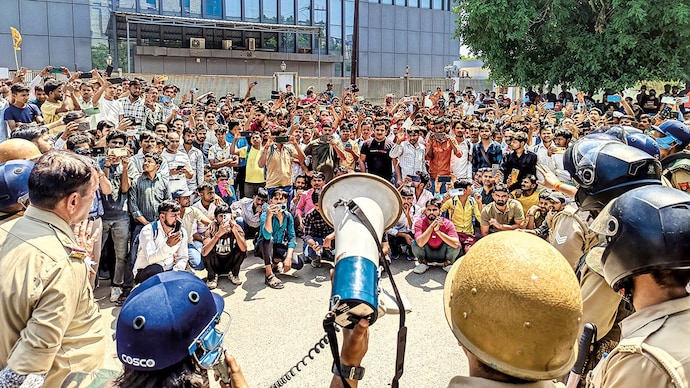
What began as a minor flare-up at a state-owned refinery in Bihar in February has spread into a wider wave of labour unrest. Across several parts of industrial India, thousands of workers—contractual, temporary and migrant—have taken to the streets. Their strikingly similar demands expose strains in the country’s industrial system: higher minimum wages in line with the rising cost of living, social security benefits such as provident fund and Employees’ State Insurance, better working conditions, weekly offs, overtime pay and basic amenities like toilets.
What began as a minor flare-up at a state-owned refinery in Bihar in February has spread into a wider wave of labour unrest. Across several parts of industrial India, thousands of workers—contractual, temporary and migrant—have taken to the streets. Their strikingly similar demands expose strains in the country’s industrial system: higher minimum wages in line with the rising cost of living, social security benefits such as provident fund and Employees’ State Insurance, better working conditions, weekly offs, overtime pay and basic amenities like toilets.
The first burst of discontent appeared in February near the Indian Oil Corporation refinery in Barauni, in Bihar’s Begusarai district. Similar protests soon surfaced at the company’s Panipat refinery in Haryana, before spreading to Manesar in the same state, then to Noida and Ghaziabad in Uttar Pradesh, and more recently to Surat in Gujarat, Bhiwadi in Rajasthan and Haldwani in Uttarakhand.
However, it was the protests in Noida—beginning outside factories in the Hosiery Complex and spreading across other nearby clusters—that caught the nation’s attention. On April 13, around 45,000 workers took to the streets. Violence followed: stones were thrown, vehicles were torched and roads were blocked, bringing traffic to a halt. Police used tear gas to disperse the crowds.
Meanwhile, the UP government has implemented a 21 per cent wage hike for workers in Gautam Buddha Nagar district and parts of neighbouring Ghaziabad, effective April 1, with payments due between May 7 and May 10. In Gautam Buddha Nagar, a government-appointed committee recommended the revision on April 10, says Rakesh Dwivedi, additional labour commissioner. Before the protests, minimum wages in the state stood at Rs 11,313.65 and Rs 13,940.37 per month for unskilled and skilled workers, respectively. After the agitation, these were raised to Rs 13,690 and Rs 16,868, respectively, as interim relief. Following the Manesar protests, Haryana raised minimum monthly wages for unskilled workers to Rs 15,220.71 (from Rs 11,274.60) and for skilled workers to Rs 18,500.81 (from Rs 13,704), effective April 1, 2026—the first revision since October 2015.
EXTERNAL HAND?
Rajeev Narain Mishra, additional commissioner of police (law & order), Noida, says the protests were peaceful until “outside leadership” intervened. He alleges that Rupesh Rai and Aditya Anand, an NIT-Jamshedpur-trained engineer, both associated with the left-wing working-class organisation Mazdoor Bigul Dasta, created several WhatsApp groups across organisations, and sent messages to provoke workers. Mishra claims these individuals, who have been arrested, were behind the violence in Manesar and Noida. “We are investigating how far back this trail goes,” he says.
What further fuelled the fire, Dwivedi says, was an active rumour mill. A message circulating on social media, featuring images of Prime Minister Narendra Modi and Union home minister Amit Shah and claiming ‘Salary Boost Coming’, said that, as per a court order, minimum wages in India would rise from April 1, 2026. It claimed daily rates for central sector workers would range from about Rs 783 for unskilled workers to Rs 1,035 for highly skilled workers—implying monthly wages of around Rs 20,358-Rs 26,910, driven by a revised Variable Dearness Allowance (VDA). This, Dwivedi says, created the perception that higher wages had been announced but were being denied by states and employers. Eleven FIRs have been registered, and 353 people arrested.
Dwivedi identifies three reasons behind the Noida unrest. First, the demonstration effect from Haryana, where a sharp wage increase encouraged workers elsewhere. Second, rising household costs, including cooking gas and rents, in the Delhi-NCR region. “No worker has said anything against any company or administration, or that they are not getting wages. What they want is a proportionate hike in minimum wages to meet the increased cost of living,” he says. A third factor, he says, is the role of “miscreants” seeking to disrupt the rapid industrial growth that UP has seen in the past five-six years. A view similar to that of chief minister Yogi Adityanath, who has described the protests as an attempt to revive Naxalism in the country and disturb law and order.
THE WORKERS’ CASE
Trade unions have rejected allegations of Pakistan links or any other external interference. Amarjeet Kaur, national general secretary of the All India Trade Union Congress, says, “The disturbance and unrest occurred due to the desperation of workers who were pushed to the brink by repeated labour law violations. Moreover, the government does not allow company unions, and there is no dialogue between employees and employers.” Unions also oppose the four new labour codes that they argue will normalise fixed-term employment, longer hours and weaker job security.
Kaur says workers’ demands across states are similar: an eight-hour workday, double pay for extra work, social security, job cards, payslips and weekly leave. There are also demands to increase minimum wages and ensure basic rights around workplace safety and dignity. Women workers have also raised concerns about harassment and the lack of toilets. In Uttar Pradesh, she adds, minimum wages have not been revised since 2012.
Minimum wages comprise a basic component, revised every five years, and a VDA, adjusted twice a year based on the CPI-IW (Consumer Price Index for Industrial Workers), says labour economist K.R. Shyam Sundar. “While VDA is revised on April 1 and October 1, its increase is often marginal, just a few hundred rupees, sometimes it decreases too. Also, the basic wage component was left unchanged for over a decade, leading to insufficient growth in wages to meet the rising inflation.” The way forward, then, is fixing the wage floor to keep up with inflation, not lag behind it.

