NEET paper leak | Warnings ignored
Despite two committees prescribing reforms, NEET (UG) collapsed again because the National Testing Agency adopted visible safeguards while ignoring structural fixes
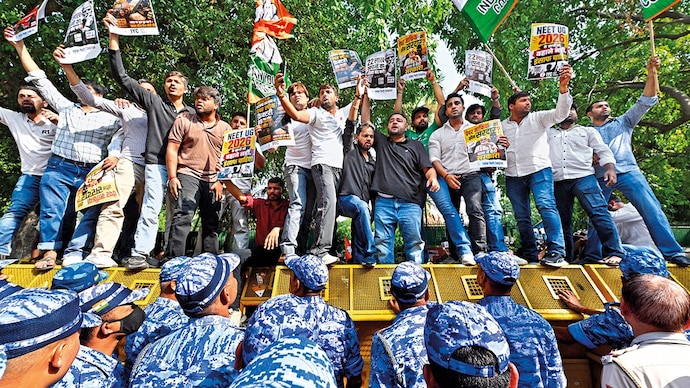
On May 12, the National Testing Agency (NTA) cancelled the National Eligibility cum Entrance Test (Undergraduate), or NEET (UG), conducted nine days earlier for more than 2.2 million medical aspirants. It was the first outright cancellation in the test’s history and arrived after the agency had spent two years promising it had been reformed. The exam will be held again.
On May 12, the National Testing Agency (NTA) cancelled the National Eligibility cum Entrance Test (Undergraduate), or NEET (UG), conducted nine days earlier for more than 2.2 million medical aspirants. It was the first outright cancellation in the test’s history and arrived after the agency had spent two years promising it had been reformed. The exam will be held again.
But the country has not stumbled into the same disaster twice by accident. It has produced an executive culture in which the recommendations meant to prevent it can be selectively adopted or politely ignored. Two high-powered committees have already written the autopsy.
The first was the High-Level Committee of Experts, chaired by Dr K. Radhakrishnan, former ISRO chairman, constituted by the Union ministry of education on June 22, 2024, after the NEET (UG) paper leaks. Its mandate, widened by the Supreme Court that August, ran the full length of the examination chain. The committee submitted its report on October 21, 2024, with 101 recommendations. The ministry made it public only in April 2025, with many to take effect from the 2026 cycle.
The second came from the 371st Report of the Department-related Parliamentary Standing Committee on Education, chaired by Digvijaya Singh, tabled in the Rajya Sabha on December 8, 2025. Of 14 NTA examinations in 2024, at least five failed; six months later, NEET-UG 2026 was cancelled.
THE PRESCRIPTION
The Radhakrishnan committee’s first proposition was that the NTA could not continue to outsource its own purpose. The agency had been built as a procurement office: it indented exams from the University Grants Commission (UGC) and Council of Scientific & Industrial Research (CSIR), contracted out printing, transport, invigilation and evaluation and held the press conferences when things went wrong. The committee asked for the opposite—a professional testing institution with in-house domain expertise, an empowered governing body, and leadership that understands the science of testing.
The panel also recommended multi-stage and multi-session testing for any test above 200,000 candidates, with transparent normalisation, and a ‘Digi-Exam’ identity layer modelled on Digi Yatra, linking application to admission through biometrics and AI verification. Its third proposal was a hybrid ‘Computer-assisted Secure PPT’ model in which encrypted question papers would be transmitted digitally to confidential servers inside examination centres and printed on site under controlled conditions.
On the ground, the panel proposed an election-style apparatus: district-level coordination committees under collectors, with police, intelligence and technical officers, CCTV and audit logs, an online malpractice portal, and a network of 1,000 secure standardised testing centres, with mobile units for the Northeast and the Himalayan states.
The Parliamentary Standing Committee added the administrative steel. It noted that the NTA had accumulated a surplus of about Rs 448 crore over six years and asked that the money be used to build in-house capacity. It recommended a nationwide registry of blacklisted firms, and asked the agency to align question papers more closely with the school curriculum to weaken the grip of coaching.
Some were acted upon. The ministry told the panel that 94 per cent of NEET-UG centres were now in state or government-owned buildings, and district collectors chaired coordination committees. This year, the agency deployed GPS-tracked vehicles, biometric verification, AI-assisted CCTV monitoring, a centralised monitoring room in Delhi, and 5G jammers. Weeks before the leak, the NTA publicly claimed to have built “an absolute fortress” around the exam with AI.
The structural reforms, however, were quietly shelved. The High-Powered Steering Committee meant to monitor implementation was never formed, the hybrid encrypted-printing model was never piloted, the shift to multi-session computer-based testing is stuck because the Union health ministry insists on a single shift while the NTA says it would need about 20 shifts for 2.2 million candidates. The agency itself is hollowed out: only three of 16 sanctioned permanent posts are filled, there was no full-time chief between June 2024 and October 2025, and contractual workers continue to set question papers.
THE SYSTEM AT FAULT
What the May 2026 breach demonstrates is a failure at the source. According to the Rajasthan Special Operations Group and early CBI threads, the question paper was compromised at or near the printing press in Nashik, then duplicated through a network passing through Gurugram and Jaipur before reaching Rakesh Mandawaria, an MBBS counselling agent in Sikar. The material was sold for amounts ranging from Rs 30,000 to Rs 28 lakh. Investigators found that all 90 Biology questions and all 45 Chemistry questions of the actual paper appeared in the ‘guess paper’; the chemistry questions in identical sequence, down to the punctuation, precisely what the Radhakrishnan committee had tried to prevent.
NEET is more leak-prone than the Joint Entrance Examination or JEE (also conducted by the NTA for Engineering): any leak in the single-shift, pen-and-paper, Biology-heavy, nationwide NEET compromises the whole exam, while JEE Main’s multi-shift computer-based format contains damage to one session. The contrast with China’s Gaokao is starker—13.35 million candidates are managed annually, papers classified a state secret, drafted in isolated facilities, printed in high-security prisons, transported under armed escort, monitored by drones and AI, with only three confirmed leaks since 1949.
The Indian system absorbed the most procurable reforms— the buildings, the cameras, the biometrics—and deferred the structural ones. The Federation of All India Medical Association has now moved the Supreme Court seeking a structural revamp or replacement of the NTA. The agency’s own May 12 statement conceded the predicament without naming it: the cancellation had been ordered “in recognition of the trust on which the national examination system rests”.
NEET runs on an unspoken contract of trust between Indian parents and the state, in which families absorb the emotional and financial brutality of the system on the assumption that the exam itself will be fair. That contract is now visibly broken and the morale of 2.2 million aspirants with it.

