India-US ties | The Rubio repair mission
The US Secretary of State brought warmth, reassurance and a touch of Trump theatre to a strained partnership, but tensions over China, Pakistan, trade tariffs and migration remain far from resolved
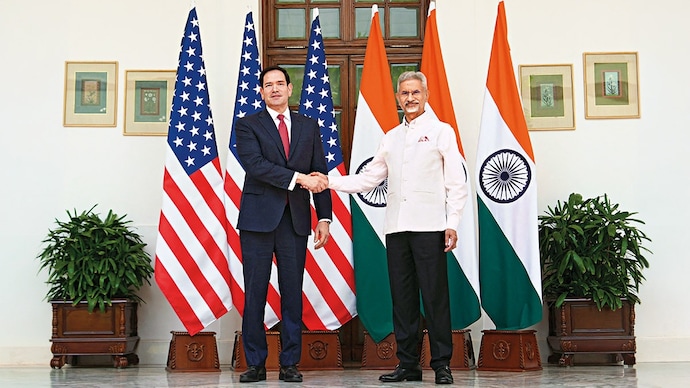
When US secretary of state Marco Rubio arrived in India for his first official visit, Washington clearly intended it to be a re-set moment. It needed one, as Indo-US relations had drifted into an uncomfortable limbo in the past year despite the new US ambassador Sergio Gor’s efforts to inject vitality into ties by putting key outstanding issues on a bullet-train track. Mostly because US president Donald Trump was preoccupied. When not mired in the Middle East crisis, he was building bridges with Chinese president Xi Jinping—or leaning on Pakistan for diplomatic access to Iran. The perception, as a former Indian diplomat put it, was that America was “sleeping with our enemies and the trust had worn thin”.
When US secretary of state Marco Rubio arrived in India for his first official visit, Washington clearly intended it to be a re-set moment. It needed one, as Indo-US relations had drifted into an uncomfortable limbo in the past year despite the new US ambassador Sergio Gor’s efforts to inject vitality into ties by putting key outstanding issues on a bullet-train track. Mostly because US president Donald Trump was preoccupied. When not mired in the Middle East crisis, he was building bridges with Chinese president Xi Jinping—or leaning on Pakistan for diplomatic access to Iran. The perception, as a former Indian diplomat put it, was that America was “sleeping with our enemies and the trust had worn thin”.
Meanwhile, trade talks were stuck in the fog of a tariff confusion after India had spent months securing a framework for an interim trade agreement, only to see the US Supreme Court recently upturn all of Trump’s tariff policies. Apart from geopolitics and trade, the third pillar that gave ballast to Indo-US relations—people-to-people ties, which is regarded as “the living bridge”—was under immense strain, with the Trump administration pushing new tough policies on H-1B visas, green cards and legal migration that created big hurdles for Indian IT professionals, academics and students.
The optics for the secretary of state’s visit, therefore, were carefully choreographed. Rubio, along with his wife Jeanette, sweated his way through Kolkata, Delhi, Agra and Jaipur in the punishing summer heat, leading a foreign policy wonk to joke: “Earlier, it was said that only mad dogs and Englishmen wandered around in this heat. Now, Americans can be added to the list.” To his credit, Rubio got the rhetoric right, praising India as an indispensable global partner and assuring Delhi that the US-Pakistan relationship was “tactical”, not strategic. He underlined America’s commitment to a strategic partnership, telling india today, “We deal with a lot of countries, but we have a handful of really important strategic alliances, and India is one of them. We have so many areas of overlap that we care about what India cares about, and that we both have capabilities to contribute, so it makes sense.” (See interview.)
There was theatre of another kind, too. At the US embassy’s celebration in the capital marking 250 years of American independence, where Grammy award winner A.R. Rahman was invited to belt out his hits, Gor pulled off the sort of political stagecraft that the Trump universe understands best. The ambassador got Trump on a cellphone, live, to say warm things about Prime Minister Narendra Modi and India. It was a neat encapsulation of the moment that was personalised, performative and pleasingly over the top. Trump’s words helped the mood music. Rubio’s visit supplied the diplomatic melody.
CONFLICTING SIGNALS
While the visit restored some warmth, it also underscored a larger reality: the tensions in Indo-US ties are structural. As Congress leader and foreign policy expert Shashi Tharoor wrote in a newspaper column, “A single successful visit cannot completely undo a year of systemic whiplash. While Rubio effectively managed the acute symptoms of the crumbling partnership, the underlying disease—the radical unpredictability of Washington’s transactional MAGA foreign policy—remains uncured.”
When it comes to geopolitics, the glue holding India and the US together is coming unstuck. The two countries were never allies in the formal sense, but both increasingly viewed Beijing’s rise and assertiveness as a challenge to stability in the Indo-Pacific. Today, India is uncertain about where exactly Washington stands. The Trump administration has sent conflicting signals on China—at times confrontational, at times transactional. That naturally raises concerns in New Delhi about whether India’s strategic importance could fluctuate depending on the state of US-China ties.
Some strands signal stability. As former Indian ambassador to the United States Meera Shankar put it, “While the White House often appears unpredictable, the broader American establishment, particularly the Pentagon and State Department, continues to strongly support deeper engagement with India. Years of investment in defence cooperation, intelligence-sharing and technology partnerships have created institutional momentum that survives political turbulence. That continuity may prove more important than presidential rhetoric.”
On trade, the other major irritant, Rubio optimistically suggested that an agreement could be concluded “within weeks”. But the ground reality is far more complicated. The US Supreme Court struck down Trump’s reciprocal tariffs as exceeding executive authority, throwing Washington’s tariff architecture into uncertainty. For now, a temporary uniform 10 per cent tariff structure applies and Indian policymakers face an obvious question: why voluntarily lock ourselves into an 18 per cent tariff regime negotiated under February’s interim agreement when the eventual US tariff framework itself remains unsettled?
On the sensitive issue of immigration, Rubio reiterated that these are global policies rather than India-specific measures. Technically, that may be true. But India inevitably feels the consequences more sharply because Indians have been among the largest beneficiaries of America’s legal migration ecosystem. Ironically, despite all the political friction, actual economic integration continues to deepen. Bilateral trade in goods and services crossed $212 billion (Rs 20.3 lakh crore) in 2025. The lesson for India is clear. It must not merely trade more with the US; it must build leverage in select sectors where America needs India as much as India needs America.
A MORE PRACTICAL QUAD
If bilateral ties remain complicated, the Quad grouping (India, Australia, Japan and the US) may ironically have emerged as the steadier framework. Rubio remains one of its strongest advocates, having hosted multiple Quad ministerial meetings. But the Quad itself is evolving. Instead of grand ideological ambitions, it is becoming more practical and focused. That is why the most meaningful outcomes from Rubio’s visit came in areas like critical minerals, maritime security, infrastructure and emerging technologies. The new critical minerals initiative that was signed in this round is especially important. China’s dominance over global critical mineral supply chains has given Beijing enormous geopolitical leverage. Building alternative supply chains through the Quad countries directly reduces that dependence.
New Delhi’s approach, therefore, has become pragmatic: keep negotiations alive, avoid public confrontation, but delay final commitments until there is greater clarity. This reflects India’s broader management of Trump-era diplomacy, which Shankar describes as “no confrontation, but no capitulation either”. She points out, “Overall, India’s handling of the relationship has been notably mature. It remained engaged, avoided excessive rhetoric, but defended core interests.” For India, the challenge will be to build upon the damage repair that Rubio’s visit achieved and deepen cooperation with the US while insulating itself from the volatility of American domestic politics. As Pankaj Saran, seasoned diplomat and a former deputy national security advisor, puts it, “India will have to proceed with eyes wide open and hands on the wheel.”
Marco Rubio: ‘India & the US are entering an era of limitless opportunities’
On his first visit to India as US Secretary of State, Marco Rubio spoke to India Today’s Rohit Sharma. Excerpts:
On relations with India
We deal with a lot of countries, but we have a handful of really important strategic alliances, and India is one of them. There are so many areas of overlap that we care about what India cares about, and we both have capabilities to contribute, so it makes sense. We are here really just to continue to build upon that relationship, because in every new era, there are new opportunities and new challenges that emerge around the world, and India is one of the countries we work closest with on all of these.
On the US-India trade deal
We all have a lot of reason to be optimistic that we’re on the verge of a trade deal. It’ll be a great thing because it’ll be good for both countries. It will increase both US investment here and Indian investment in the United States. It’ll create a platform for more co-investment and more cooperation between our companies. Obviously, you know, things like tariffs and all that sit on top of the broader relationship and affect all of it. The sooner we can put that to rest with a good trade deal that’s good for both countries, the opportunities are limitless.
On the Trump-Xi summit
Here’s the bottom line. The US and China are the two largest economies in the world, and we also have powerful militaries. Our countries have to have relations as we want to avoid anything that could lead to destabilisation in any part of the world. So, it was an important visit in the sense that our countries have to be able to speak to one another. But it’s also clear that there are specific issues in which we’re not going to agree, specific things that we’re going to have to address that they probably don’t like, such as our over-dependence on them for critical minerals and supply chains.
On dealing with terror emanating from Pakistan
We want to deal with terrorism, no matter where it’s emanating from. If there are armed groups that are seeking to kill people and conduct acts of terrorism and they’re operating within the national space of any country in the world, we need to address it. We’ve had to address it in our own hemisphere. I would hope that we would be able to work with Pakistani authorities to go after these dangerous groups who ultimately pose a threat to the state itself but, in the short term, pose a threat to people in the region, as well as to the interests of the United States. So, anywhere where terrorism is a threat to our national interests, we want to address it, ideally in cooperation with the country they are located in.

