Can Vijay turn borrowed MGR symbolism into real political power?
Vijay invoked MGR at a TVK conference as his party entered its first Assembly election. The comparison highlights how closely Tamil cinema, symbolism and political credibility remain tied in the state.
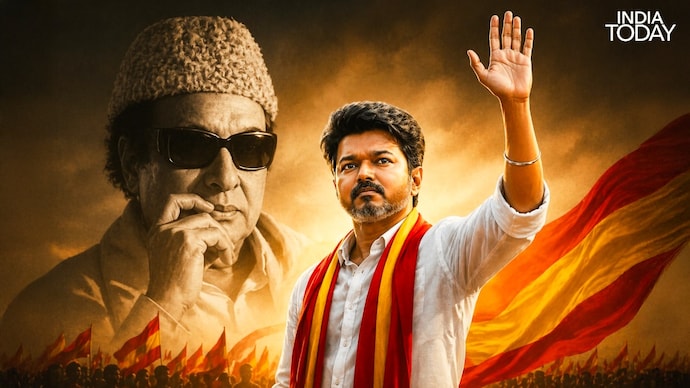
When actor Vijay, fondly called Thalapathy Vijay, addressed thousands of red-and-yellow flag-waving supporters at a state-level conference of his Tamilaga Vettri Kazhagam (TVK) in August 2025, he invoked a name that made the crowd roar louder than anything else he said that evening: MGR.
"As long as he was alive, no one could even think about the chief minister's seat, they couldn't even dream of it," Vijay told the gathering. "He made his political opponents beg before the people for his seat."
The crowd's reaction was immediate and electric — thousands of flags waving in unison, a collective acknowledgement that the name MGR carries a weight unlike any other in Tamil politics. That Vijay chose to open with this tribute was no accident. It was, like so much of what Vijay does - deliberate, layered, and deeply cinematic. The question Tamil Nadu is now asking — especially as Vijay's TVK contested in its first-ever assembly elections — is whether the tribute is earned, or whether it is simply borrowed mythology.
The short answer is complicated. The blueprint exists. The question is whether Vijay can achieve a similar success like MGR did, which immortalised him in the minds and hearts of Tamil Nadu.
The longer answer requires going back to where it all began: with a boy from a drama troupe, a whip, and a promise to the poor.
MGR: The architecture of a political God
Maruthur Gopalan Ramachandran aka MG Ramachandran was born in 1917 in Kandy, British Ceylon, into a Tamil family that would soon return to India and poverty in equal measure. After his father's death, young Ramachandran — who would later sharpen his name into the initials that an entire state would worship — joined the Madurai Original Boys Company, a travelling drama troupe, as a child performer. He needed to eat. He needed money. Theatre was survival, not ambition.
But Ramachandran was building something, even then. His first film role came in 1936 with Sathi Leelavathi. He spent the next decade in minor parts, learning the grammar of the cinema, before breaking through as a lead in Rajakumari in 1947. From there, he built his career image by image, song by song, film by film — until he was something that Tamil Nadu had never seen before and has never quite replicated since: a man whose reel life and real life had become indistinguishable.
By the 1950s and 1960s, MGR had developed what can only be described as a political philosophy expressed through cinema. His films were not mere entertainment. They were, as the Google Arts & Culture archive on his legacy describes, vehicles for kolgai paadal — songs that spoke of ideology, a "typical feature of his films" — that put forward "the vision of a fair and just world that the Dravidian movement intended to create." In role after role, MGR appeared as a farmer, a rickshaw-puller, a cowherd, a fisherman: always the man of the people, always incorruptible, always fighting upward against an unjust system.
The 1965 film Enga Veetu Pillai remains the most vivid crystallisation of this image. MGR played dual roles, but it was the film's signature song — "Naan aanaiyittal athu nadanthuvittal, ingu ezhaikal vedanai padamaatar" ("If I take an oath and if that happens, the poor will not suffer hereafter") — that lodged itself permanently in the Tamil political consciousness. And still remains iconic after six decades. The song, penned by lyricist Vaali, was not just a movie song. It was, in retrospect, a manifesto. It marked his rise as a leader of the masses.
Then there was Nadodi Mannan (1958), a film MGR produced and directed himself. The film is about a revolutionary commoner who takes the place of his lookalike prince to thwart a corrupt priest's coup, eventually rescuing the true heir and transforming the kingdom into a democracy. The allegory was unmistakable. In Sarvadhikari (1951), his character exposed a corrupt minister attempting to turn a kingdom into a dictatorship — anti-establishment dialogues that resonated with audiences who saw their own social conditions reflected on screen. In Vettaikaran, the song Unnai Arindhaal — "If you know yourself, you can fight the world" — turned self-knowledge into a political creed.
The craft was deliberate. MGR had significant control over the making of his films, shaping narratives, approving scripts, and curating the precise image he wished to project. The films had sentimental mother-son bonds, thrilling fight sequences, philosophical songs for the oppressed, and a hero who always — always — triumphed on the right side of justice. This was not an accidental formula. It was carefully constructed brick by brick.
Fan clubs to party cadres: The political machine
MGR joined the Dravida Munnetra Kazhagam (DMK) in 1953, at the invitation of M Karunanidhi. The DMK, under CN Annadurai, had already understood something fundamental about Tamil politics: as Annadurai himself said, if it took 10,000 political meetings to deliver one message, a single hit film could do the same. The party had been using cinema as a political tool, but MGR was its most potent instrument.
He was first elected to the Tamil Nadu Legislative Council in 1962 and to the Legislative Assembly in 1967, at the age of fifty — years of patient cultivation before assuming formal office. When the assassination attempt on his life in the mid-1960s put him in hospital, images of his recovery were deployed, effectively, in the 1967 assembly elections.
The fallout with Karunanidhi came in 1972, when MGR accused the DMK leadership of corruption following the death of Annadurai, and demanded ministers declare their assets publicly. He was expelled from the DMK on October 10, 1972 — at first temporarily, then permanently four days later. On October 17, 1972, he became the leader and general secretary of the newly formed All India Anna Dravida Munnetra Kazhagam (AIADMK), retaining the name of Anna — CN Annadurai — as a signal of ideological continuity.
What happened next was unprecedented. According to political columnist Kalyani Shankar, author of Gods of Power: Personality Cults & Indian Democracy, MGR's fan clubs were converted into AIADMK branches almost overnight. Within two months, the party had recruited two million members and went on to win every by-election between 1972 and 1977.
This was the harvest of decades of systematic image-building. The fans who had worshipped MGR on screen did not merely transfer their affection to him as a politician — they already believed he was the politician he had been playing for thirty years. In 1977, the AIADMK swept the Tamil Nadu assembly elections, winning 144 out of 234 seats. MGR became Chief Minister of Tamil Nadu, the first film actor in India's history to do so.
As Chief Minister, he governed largely as he had acted: with a focus on the poor, the marginalised, and especially women. He re-introduced and expanded the mid-day meal scheme in government schools, dramatically improving both enrolment and nutrition. He introduced free electricity for farmers, distributed free sarees, created marriage assistance funds for poor women and expanded pensions for widows, among other welfare schemes. He was re-elected in 1980 and 1985, ruling until his death.
The love and respect that people had on MGR knew no bounds. According to R Kannan's biography MGR: A Life, offerings to temples rose by 40 per cent when MGR fell ill in 1985. When he died on December 24, 1987, twenty-two fans had immolated themselves and twenty more had attempted suicide in the days of his illness, unable to bear the weight of losing him.
He was posthumously awarded the Bharat Ratna in 1988. MGR had become not just a politician, but in the truest Tamil sense, a Makkal Thilagam — the jewel of the people.
The latecomer's blueprint
Decades later, Vijay's path to politics follows a recognisable template. But it is a compressed version of that template. What MGR spent decades building organically, Vijay has attempted to compress into a few years of deliberate cinematic signalling. And before Vijay, many actors, including Vijayakanth, Rajinikanth and Kamal Haasan, tried the same route. However, not everyone was able to achieve what MGR did in his time.
Born in 1974 as the son of Tamil film director SA Chandrasekhar, Vijay entered films as a child actor before making his debut as a hero in Naalaiya Theerpu (1992), which flopped. His career found its footing through the 1990s, and it was the 2004 action film Ghilli that launched him into superstardom. For most of the 2000s, however, Vijay remained primarily a masala entertainer, his films built on action, romance, and mass appeal rather than social messaging.
The pivot came gradually and then all at once. Beginning around 2013 with Thalaivaa (Leader) — released with the explicit tagline 'Time to Lead' — came at a pointed moment: Jayalalithaa, herself a film personality, was then Chief Minister. The film witnessed bomb threats and delays too. It was reported that Vijay then sought Jayalalithaa's intervention to release the film.
Since then, Vijay began engineering his on-screen persona into something more overtly political. His films started addressing real public issues: farmer suicides (Kaththi), demonetisation (Mersal) and the freebies debate (Sarkar). By the time Mersal (2017) and Bigil (2019) arrived, the MGR references had become impossible to miss.
In Mersal, Vijay's introduction scene plays out against MGR's song Unnai Arindhaal from Vettaikaran — the same song about self-knowledge and conquest. MGR's photograph hangs in a frame in the film. In Bigil, during a key fight sequence, Vijay's character Rayappan breaks spontaneously into Ennathaan Nadakkum Nadakattume (Whatever happens, let it happen) — an MGR song used here as a statement of political inevitability. MGR's photograph appears in Bigil as well. These were not Easter eggs for film buffs. They were clear statements.
In 2009, Vijay borrowed the title of MGR's 1964 blockbuster Vettaikaaran — a film that had run for twenty-five weeks in theatres — for one of his own productions. At the audio launch of Sarkar (2018), a film explicitly about electoral politics, Vijay told his audience: "I am not playing a Chief Minister in Sarkar, but I will not act like one (if I become) the Chief Minister. I meant I will be honest."
It was the kind of line that would have been quoted during a political campaign, except Vijay was delivering it at a film event in 2018, deploying precisely the blurred boundary between actor and aspiring leader that MGR had pioneered.
More recently, one of his promotional posters of Jana Nayagan showed Vijay wielding a whip, stamped with the words Naan Aanai Ittal — "If I order" — a direct echo of MGR's Enga Veetu Pillai and its famous song about commanding justice for the poor. Jana Nayagan, which loosely translates to People's Hero, was billed as Vijay's last film before he becomes a full-time politician. The makers and Vijay planned to release the film in January, three months before the election. The film, which is said to have political undertones, was postponed after the censor board flagged certain lines that could potentially affect people's sentiments.
Actor Kasthuri Shankar, after watching some of the leaked clips of Jana Nayagan, claimed that the film was a three-hour propaganda to TVK. This is seen as one of the major reasons for the film's hold-up at the censor level.
MGR vs Vijay: The fundamental difference
And yet, the comparison has its limits — and those limits matter enormously as Tamil Nadu is waiting for the results of the Tamil Nadu Assembly Elections.
MGR's political identity was not constructed for politics. It emerged from decades of inhabiting roles that directly spoke to the people, backed by an authentic relationship with the Dravidian movement's social justice ideology from his earliest days as a DMK member. By the time he formed the AIADMK, he had been a legislator for a decade and an active party worker for nearly two. His screen persona and his political persona had developed together, in parallel, each feeding the other, until they were the same thing.
Vijay, by contrast, began inserting political messaging into his films only in the last decade of an already long career, working backward from a political ambition that preceded a coherent ideology. When his party, TVK, unveiled its ideological framework in September 2024, it declared alignment with the ideas of Ambedkar, Periyar, and Kamaraj — a broad Dravidian umbrella, but one that people note is difficult to distinguish from what the DMK already occupies.
MGR built his fan clubs into a party. Vijay is, in a sense, doing the same — his Vijay Makkal Iyakkam, founded in 2009, won 115 of 169 seats it contested in the 2021 local body elections before being converted into the TVK in 2024. But MGR's fans believed they already knew him — that the man fighting for the poor on screen was the man who would fight for them in office. Vijay's fans know they are watching their star make a promise. Whether he would deliver on the promise is left to be seen. It's the answer that the 2026 elections will answer on May 4.
Senior political analysts claim that Vijay "can at best be a disruptor" in what has become a three-cornered contest between TVK, AIADMK and Dravida Munnetra Kazhagam (DMK). But, if you ask whether he could be another MGR, then there's a long way to go.
The whip, the photograph, the songs borrowed from a legend — all of it is real enough as a tribute. MGR's lesson, however, is more difficult to replicate: that politics is not performance, even when performed by the best in the business. MGR succeeded because, for the people of Tamil Nadu, the performance had long ago become the truth. Vijay is still asking them to believe it will.
When actor Vijay, fondly called Thalapathy Vijay, addressed thousands of red-and-yellow flag-waving supporters at a state-level conference of his Tamilaga Vettri Kazhagam (TVK) in August 2025, he invoked a name that made the crowd roar louder than anything else he said that evening: MGR.
"As long as he was alive, no one could even think about the chief minister's seat, they couldn't even dream of it," Vijay told the gathering. "He made his political opponents beg before the people for his seat."
The crowd's reaction was immediate and electric — thousands of flags waving in unison, a collective acknowledgement that the name MGR carries a weight unlike any other in Tamil politics. That Vijay chose to open with this tribute was no accident. It was, like so much of what Vijay does - deliberate, layered, and deeply cinematic. The question Tamil Nadu is now asking — especially as Vijay's TVK contested in its first-ever assembly elections — is whether the tribute is earned, or whether it is simply borrowed mythology.
The short answer is complicated. The blueprint exists. The question is whether Vijay can achieve a similar success like MGR did, which immortalised him in the minds and hearts of Tamil Nadu.
The longer answer requires going back to where it all began: with a boy from a drama troupe, a whip, and a promise to the poor.
MGR: The architecture of a political God
Maruthur Gopalan Ramachandran aka MG Ramachandran was born in 1917 in Kandy, British Ceylon, into a Tamil family that would soon return to India and poverty in equal measure. After his father's death, young Ramachandran — who would later sharpen his name into the initials that an entire state would worship — joined the Madurai Original Boys Company, a travelling drama troupe, as a child performer. He needed to eat. He needed money. Theatre was survival, not ambition.
But Ramachandran was building something, even then. His first film role came in 1936 with Sathi Leelavathi. He spent the next decade in minor parts, learning the grammar of the cinema, before breaking through as a lead in Rajakumari in 1947. From there, he built his career image by image, song by song, film by film — until he was something that Tamil Nadu had never seen before and has never quite replicated since: a man whose reel life and real life had become indistinguishable.
By the 1950s and 1960s, MGR had developed what can only be described as a political philosophy expressed through cinema. His films were not mere entertainment. They were, as the Google Arts & Culture archive on his legacy describes, vehicles for kolgai paadal — songs that spoke of ideology, a "typical feature of his films" — that put forward "the vision of a fair and just world that the Dravidian movement intended to create." In role after role, MGR appeared as a farmer, a rickshaw-puller, a cowherd, a fisherman: always the man of the people, always incorruptible, always fighting upward against an unjust system.
The 1965 film Enga Veetu Pillai remains the most vivid crystallisation of this image. MGR played dual roles, but it was the film's signature song — "Naan aanaiyittal athu nadanthuvittal, ingu ezhaikal vedanai padamaatar" ("If I take an oath and if that happens, the poor will not suffer hereafter") — that lodged itself permanently in the Tamil political consciousness. And still remains iconic after six decades. The song, penned by lyricist Vaali, was not just a movie song. It was, in retrospect, a manifesto. It marked his rise as a leader of the masses.
Then there was Nadodi Mannan (1958), a film MGR produced and directed himself. The film is about a revolutionary commoner who takes the place of his lookalike prince to thwart a corrupt priest's coup, eventually rescuing the true heir and transforming the kingdom into a democracy. The allegory was unmistakable. In Sarvadhikari (1951), his character exposed a corrupt minister attempting to turn a kingdom into a dictatorship — anti-establishment dialogues that resonated with audiences who saw their own social conditions reflected on screen. In Vettaikaran, the song Unnai Arindhaal — "If you know yourself, you can fight the world" — turned self-knowledge into a political creed.
The craft was deliberate. MGR had significant control over the making of his films, shaping narratives, approving scripts, and curating the precise image he wished to project. The films had sentimental mother-son bonds, thrilling fight sequences, philosophical songs for the oppressed, and a hero who always — always — triumphed on the right side of justice. This was not an accidental formula. It was carefully constructed brick by brick.
Fan clubs to party cadres: The political machine
MGR joined the Dravida Munnetra Kazhagam (DMK) in 1953, at the invitation of M Karunanidhi. The DMK, under CN Annadurai, had already understood something fundamental about Tamil politics: as Annadurai himself said, if it took 10,000 political meetings to deliver one message, a single hit film could do the same. The party had been using cinema as a political tool, but MGR was its most potent instrument.
He was first elected to the Tamil Nadu Legislative Council in 1962 and to the Legislative Assembly in 1967, at the age of fifty — years of patient cultivation before assuming formal office. When the assassination attempt on his life in the mid-1960s put him in hospital, images of his recovery were deployed, effectively, in the 1967 assembly elections.
The fallout with Karunanidhi came in 1972, when MGR accused the DMK leadership of corruption following the death of Annadurai, and demanded ministers declare their assets publicly. He was expelled from the DMK on October 10, 1972 — at first temporarily, then permanently four days later. On October 17, 1972, he became the leader and general secretary of the newly formed All India Anna Dravida Munnetra Kazhagam (AIADMK), retaining the name of Anna — CN Annadurai — as a signal of ideological continuity.
What happened next was unprecedented. According to political columnist Kalyani Shankar, author of Gods of Power: Personality Cults & Indian Democracy, MGR's fan clubs were converted into AIADMK branches almost overnight. Within two months, the party had recruited two million members and went on to win every by-election between 1972 and 1977.
This was the harvest of decades of systematic image-building. The fans who had worshipped MGR on screen did not merely transfer their affection to him as a politician — they already believed he was the politician he had been playing for thirty years. In 1977, the AIADMK swept the Tamil Nadu assembly elections, winning 144 out of 234 seats. MGR became Chief Minister of Tamil Nadu, the first film actor in India's history to do so.
As Chief Minister, he governed largely as he had acted: with a focus on the poor, the marginalised, and especially women. He re-introduced and expanded the mid-day meal scheme in government schools, dramatically improving both enrolment and nutrition. He introduced free electricity for farmers, distributed free sarees, created marriage assistance funds for poor women and expanded pensions for widows, among other welfare schemes. He was re-elected in 1980 and 1985, ruling until his death.
The love and respect that people had on MGR knew no bounds. According to R Kannan's biography MGR: A Life, offerings to temples rose by 40 per cent when MGR fell ill in 1985. When he died on December 24, 1987, twenty-two fans had immolated themselves and twenty more had attempted suicide in the days of his illness, unable to bear the weight of losing him.
He was posthumously awarded the Bharat Ratna in 1988. MGR had become not just a politician, but in the truest Tamil sense, a Makkal Thilagam — the jewel of the people.
The latecomer's blueprint
Decades later, Vijay's path to politics follows a recognisable template. But it is a compressed version of that template. What MGR spent decades building organically, Vijay has attempted to compress into a few years of deliberate cinematic signalling. And before Vijay, many actors, including Vijayakanth, Rajinikanth and Kamal Haasan, tried the same route. However, not everyone was able to achieve what MGR did in his time.
Born in 1974 as the son of Tamil film director SA Chandrasekhar, Vijay entered films as a child actor before making his debut as a hero in Naalaiya Theerpu (1992), which flopped. His career found its footing through the 1990s, and it was the 2004 action film Ghilli that launched him into superstardom. For most of the 2000s, however, Vijay remained primarily a masala entertainer, his films built on action, romance, and mass appeal rather than social messaging.
The pivot came gradually and then all at once. Beginning around 2013 with Thalaivaa (Leader) — released with the explicit tagline 'Time to Lead' — came at a pointed moment: Jayalalithaa, herself a film personality, was then Chief Minister. The film witnessed bomb threats and delays too. It was reported that Vijay then sought Jayalalithaa's intervention to release the film.
Since then, Vijay began engineering his on-screen persona into something more overtly political. His films started addressing real public issues: farmer suicides (Kaththi), demonetisation (Mersal) and the freebies debate (Sarkar). By the time Mersal (2017) and Bigil (2019) arrived, the MGR references had become impossible to miss.
In Mersal, Vijay's introduction scene plays out against MGR's song Unnai Arindhaal from Vettaikaran — the same song about self-knowledge and conquest. MGR's photograph hangs in a frame in the film. In Bigil, during a key fight sequence, Vijay's character Rayappan breaks spontaneously into Ennathaan Nadakkum Nadakattume (Whatever happens, let it happen) — an MGR song used here as a statement of political inevitability. MGR's photograph appears in Bigil as well. These were not Easter eggs for film buffs. They were clear statements.
In 2009, Vijay borrowed the title of MGR's 1964 blockbuster Vettaikaaran — a film that had run for twenty-five weeks in theatres — for one of his own productions. At the audio launch of Sarkar (2018), a film explicitly about electoral politics, Vijay told his audience: "I am not playing a Chief Minister in Sarkar, but I will not act like one (if I become) the Chief Minister. I meant I will be honest."
It was the kind of line that would have been quoted during a political campaign, except Vijay was delivering it at a film event in 2018, deploying precisely the blurred boundary between actor and aspiring leader that MGR had pioneered.
More recently, one of his promotional posters of Jana Nayagan showed Vijay wielding a whip, stamped with the words Naan Aanai Ittal — "If I order" — a direct echo of MGR's Enga Veetu Pillai and its famous song about commanding justice for the poor. Jana Nayagan, which loosely translates to People's Hero, was billed as Vijay's last film before he becomes a full-time politician. The makers and Vijay planned to release the film in January, three months before the election. The film, which is said to have political undertones, was postponed after the censor board flagged certain lines that could potentially affect people's sentiments.
Actor Kasthuri Shankar, after watching some of the leaked clips of Jana Nayagan, claimed that the film was a three-hour propaganda to TVK. This is seen as one of the major reasons for the film's hold-up at the censor level.
MGR vs Vijay: The fundamental difference
And yet, the comparison has its limits — and those limits matter enormously as Tamil Nadu is waiting for the results of the Tamil Nadu Assembly Elections.
MGR's political identity was not constructed for politics. It emerged from decades of inhabiting roles that directly spoke to the people, backed by an authentic relationship with the Dravidian movement's social justice ideology from his earliest days as a DMK member. By the time he formed the AIADMK, he had been a legislator for a decade and an active party worker for nearly two. His screen persona and his political persona had developed together, in parallel, each feeding the other, until they were the same thing.
Vijay, by contrast, began inserting political messaging into his films only in the last decade of an already long career, working backward from a political ambition that preceded a coherent ideology. When his party, TVK, unveiled its ideological framework in September 2024, it declared alignment with the ideas of Ambedkar, Periyar, and Kamaraj — a broad Dravidian umbrella, but one that people note is difficult to distinguish from what the DMK already occupies.
MGR built his fan clubs into a party. Vijay is, in a sense, doing the same — his Vijay Makkal Iyakkam, founded in 2009, won 115 of 169 seats it contested in the 2021 local body elections before being converted into the TVK in 2024. But MGR's fans believed they already knew him — that the man fighting for the poor on screen was the man who would fight for them in office. Vijay's fans know they are watching their star make a promise. Whether he would deliver on the promise is left to be seen. It's the answer that the 2026 elections will answer on May 4.
Senior political analysts claim that Vijay "can at best be a disruptor" in what has become a three-cornered contest between TVK, AIADMK and Dravida Munnetra Kazhagam (DMK). But, if you ask whether he could be another MGR, then there's a long way to go.
The whip, the photograph, the songs borrowed from a legend — all of it is real enough as a tribute. MGR's lesson, however, is more difficult to replicate: that politics is not performance, even when performed by the best in the business. MGR succeeded because, for the people of Tamil Nadu, the performance had long ago become the truth. Vijay is still asking them to believe it will.

