Why Allu Arjun, Ram Charan are promoting films in Bihar, MP like election campaigns
While Bollywood stayed inside Mumbai studios, Allu Arjun and Ram Charan were busy turning Patna, Bhopal and Lucknow into fan carnivals.
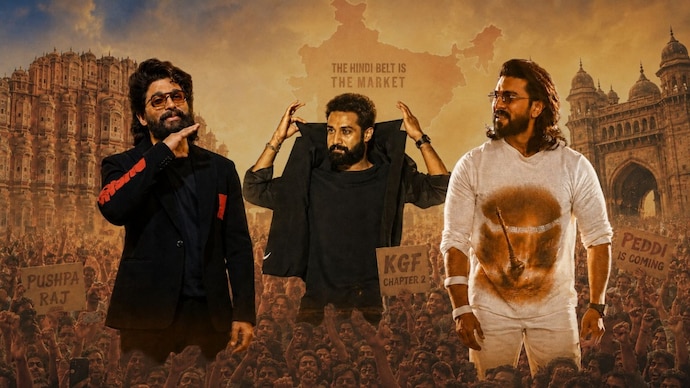
In Bhopal, not long ago, Ram Charan took the stage to promote his upcoming film Peddi. His Hindi was laboured, heavily accented, and sentences assembled with visible effort. At one point he called cricketer Jasprit Bumrah a footballer. The internet mocked it, as it does. But look past the easy joke, and what you are actually watching is a seismic shift in Indian cinema playing out in real time and Ram Charan is not the only one. There is a pattern.
Consider what happened in Patna. Four days' notice. No elaborate ticketing, months-long buildup, just a WhatsApp-speed rumour that the actor was coming to Bihar to launch his trailer, and two lakh people showed up. Not for the Khans or any Bollywood star. For a south Indian superstar, the Hindi belt had decided to claim as its own: Allu Arjun.
Stars from across south India are descending on Patna, Lucknow, Jaipur and beyond, each tour bigger and louder than the last. Because the Hindi belt is no longer a bonus market. It is the market. Without it, the staggering budgets of modern pan-Indian films simply cannot be recovered. The broken Hindi is not the embarrassing part of this story; it is the story. These stars are doing the hard work of showing up in places Bollywood has never bothered to be in years.
The old arrangement
For decades, the road to nationwide stardom in India had a single tollgate: Mumbai.
South Indian actors who wanted a national footprint started to make Bollywood films. And when the traffic moved in the other direction, when a Bollywood actor wanted to tap into southern audiences, they did the tour. A brief, highly publicised swing through Chennai. A few sentences of broken Tamil delivered with a charming grin, get applause and fly back home.
It was transactional and everyone understood the implicit message: Bollywood was the centre, and everything else was the periphery.
For a while, the next logical step seemed to be casting Bollywood actors in South Indian productions, betting that their visibility and stardom would travel, that audiences who recognised a familiar face might follow them into the theatre. It was a reasonable wager. It rarely paid off for a while. But over time, familiarity, it turned out, was not the same as belonging.
That arrangement no longer exists.
The blueprint
To understand how it collapsed, you have to start with one man and one film. SS Rajamouli had already changed the grammar of Indian filmmaking with the Baahubali films, with their scale, their spectacle, their unapologetically theatrical storytelling. But what Baahubali also did, quietly and strategically, was build a road.
Hindi-dubbed versions of many South Indian films have already reached North Indian audiences through television and digital platforms, doing the slow work of building familiarity with Telugu cinema and its stars. Rajamouli had observed something others had not yet acted on: the mass theatrical audience, single screens in smaller towns and families in Tier-2 and Tier-3 cities, was not being chased by anyone. Bollywood had drifted upmarket, towards multiplexes and urban sensibilities. The heartland was open.
With Baahubali and RRR, he moved aggressively. The team took Ram Charan and Jr NTR to Jaipur, staging a massive event at Hawa Mahal, using the visual grammar of Rajasthan's royal architecture to amplify the period grandeur of the film. It was not just a promotional stop, it was a statement that the film belonged to that audience.
The numbers made the argument impossible to ignore. RRR Hindi version collected over Rs 272 crore in India. After that, many South Indian actors and filmmakers identified the importance of the gap and went ahead with the same strategy.
Yash, Ram Charan, Allu Arjun also went to these cities and promoted their films and the result is as clear as day. KGF: Chapter 2’s Hindi version crossed the Rs 430-crore mark in India. And then came Pushpa 2, which returned over Rs 800 crore just with its Hindi version. The blueprint had been written. Everyone started following it.
The question Bollywood cannot answer
Which brings us to the most provocative question in the room: why cannot Bollywood, which actually speaks the language, crack what these actors with broken Hindi are managing to do?
Part of the answer lies in marketing. South Indian productions have understood that the world today is as much about what happens outside the theatre as what unfolds on screen.
Many South Indian film teams just don’t stop with pan-India tours. They wove brand partnerships, artist collaborations, appearances on Bigg Boss and The Kapil Sharma Show, influencer campaigns calibrated for north Indian YouTube and Instagram, and blanket radio and outdoor advertising into a single machine.
But the deeper answer is about the films themselves.
The audience in Bihar, UP, MP and Rajasthan, the single-screen audience, the family audience, the audience that does not read film reviews but does feel things intensely, has been watching a certain kind of cinema disappear from Bollywood's output. The big, unapologetic mass entertainers. The films where a hero stands for something visceral and simple. The films where you can take your entire family and feel something together.
Pushpa: The Rise gave them a man who would not bow down. KGF gave them a man clawing his way from nothing to everything. And Peddi is trying to give them a man who will go to any length for his people. These are not subtle character studies; they are elemental. The topics, themes and social messaging can be questionable, but the connection is undeniable. And they spoke to people who had not spoken for years.
Bollywood, meanwhile, has been making films increasingly calibrated for urban multiplex audiences. Smaller, more self-aware, more ironic. Critically interesting, perhaps. But the bitter truth is that its mass films no longer carry the emotional weight or the raw spark that these south Indian films do. Not for everyone, and increasingly, not for the people who matter most at the box office. The data, falling collections and shrinking single-screen footprints, have been making this argument for years.
The cracks in the template
None of this means the strategy is foolproof. Game Changer, Ram Charan's most recent release, launched its trailer at a global event in Dallas and held events in Lucknow, but collected only Rs 32 crore in Hindi. There are a few films that made it, but there are many that did not.
Which suggests what many in the industry quietly suspect: the template works brilliantly when the film earns it. Rajamouli himself seems to have understood this earlier than most. The north Indian market was never just a place to promote films. It is the content and the relationship being built carefully, over time, through stories that the audience in those towns and cities could see themselves in.
The new geography of Indian cinema
The power dynamics of Indian cinema have been rewritten. Bollywood attempts like Chhaava, Dhurandhar and Animal exist but largely South Indian films are now the primary engines of India's mass theatrical box office. The stars making that happen are the ones grinding through multi-city tours of the Hindi belt, speaking imperfect Hindi to packed stadiums, doing the work that no one from Bollywood is bothering to do any more.
Bollywood can still speak the language fluently. It has always been able to. What it seems to have forgotten, somewhere along the way, is who it was speaking to.
In Bhopal, not long ago, Ram Charan took the stage to promote his upcoming film Peddi. His Hindi was laboured, heavily accented, and sentences assembled with visible effort. At one point he called cricketer Jasprit Bumrah a footballer. The internet mocked it, as it does. But look past the easy joke, and what you are actually watching is a seismic shift in Indian cinema playing out in real time and Ram Charan is not the only one. There is a pattern.
Consider what happened in Patna. Four days' notice. No elaborate ticketing, months-long buildup, just a WhatsApp-speed rumour that the actor was coming to Bihar to launch his trailer, and two lakh people showed up. Not for the Khans or any Bollywood star. For a south Indian superstar, the Hindi belt had decided to claim as its own: Allu Arjun.
Stars from across south India are descending on Patna, Lucknow, Jaipur and beyond, each tour bigger and louder than the last. Because the Hindi belt is no longer a bonus market. It is the market. Without it, the staggering budgets of modern pan-Indian films simply cannot be recovered. The broken Hindi is not the embarrassing part of this story; it is the story. These stars are doing the hard work of showing up in places Bollywood has never bothered to be in years.
The old arrangement
For decades, the road to nationwide stardom in India had a single tollgate: Mumbai.
South Indian actors who wanted a national footprint started to make Bollywood films. And when the traffic moved in the other direction, when a Bollywood actor wanted to tap into southern audiences, they did the tour. A brief, highly publicised swing through Chennai. A few sentences of broken Tamil delivered with a charming grin, get applause and fly back home.
It was transactional and everyone understood the implicit message: Bollywood was the centre, and everything else was the periphery.
For a while, the next logical step seemed to be casting Bollywood actors in South Indian productions, betting that their visibility and stardom would travel, that audiences who recognised a familiar face might follow them into the theatre. It was a reasonable wager. It rarely paid off for a while. But over time, familiarity, it turned out, was not the same as belonging.
That arrangement no longer exists.
The blueprint
To understand how it collapsed, you have to start with one man and one film. SS Rajamouli had already changed the grammar of Indian filmmaking with the Baahubali films, with their scale, their spectacle, their unapologetically theatrical storytelling. But what Baahubali also did, quietly and strategically, was build a road.
Hindi-dubbed versions of many South Indian films have already reached North Indian audiences through television and digital platforms, doing the slow work of building familiarity with Telugu cinema and its stars. Rajamouli had observed something others had not yet acted on: the mass theatrical audience, single screens in smaller towns and families in Tier-2 and Tier-3 cities, was not being chased by anyone. Bollywood had drifted upmarket, towards multiplexes and urban sensibilities. The heartland was open.
With Baahubali and RRR, he moved aggressively. The team took Ram Charan and Jr NTR to Jaipur, staging a massive event at Hawa Mahal, using the visual grammar of Rajasthan's royal architecture to amplify the period grandeur of the film. It was not just a promotional stop, it was a statement that the film belonged to that audience.
The numbers made the argument impossible to ignore. RRR Hindi version collected over Rs 272 crore in India. After that, many South Indian actors and filmmakers identified the importance of the gap and went ahead with the same strategy.
Yash, Ram Charan, Allu Arjun also went to these cities and promoted their films and the result is as clear as day. KGF: Chapter 2’s Hindi version crossed the Rs 430-crore mark in India. And then came Pushpa 2, which returned over Rs 800 crore just with its Hindi version. The blueprint had been written. Everyone started following it.
The question Bollywood cannot answer
Which brings us to the most provocative question in the room: why cannot Bollywood, which actually speaks the language, crack what these actors with broken Hindi are managing to do?
Part of the answer lies in marketing. South Indian productions have understood that the world today is as much about what happens outside the theatre as what unfolds on screen.
Many South Indian film teams just don’t stop with pan-India tours. They wove brand partnerships, artist collaborations, appearances on Bigg Boss and The Kapil Sharma Show, influencer campaigns calibrated for north Indian YouTube and Instagram, and blanket radio and outdoor advertising into a single machine.
But the deeper answer is about the films themselves.
The audience in Bihar, UP, MP and Rajasthan, the single-screen audience, the family audience, the audience that does not read film reviews but does feel things intensely, has been watching a certain kind of cinema disappear from Bollywood's output. The big, unapologetic mass entertainers. The films where a hero stands for something visceral and simple. The films where you can take your entire family and feel something together.
Pushpa: The Rise gave them a man who would not bow down. KGF gave them a man clawing his way from nothing to everything. And Peddi is trying to give them a man who will go to any length for his people. These are not subtle character studies; they are elemental. The topics, themes and social messaging can be questionable, but the connection is undeniable. And they spoke to people who had not spoken for years.
Bollywood, meanwhile, has been making films increasingly calibrated for urban multiplex audiences. Smaller, more self-aware, more ironic. Critically interesting, perhaps. But the bitter truth is that its mass films no longer carry the emotional weight or the raw spark that these south Indian films do. Not for everyone, and increasingly, not for the people who matter most at the box office. The data, falling collections and shrinking single-screen footprints, have been making this argument for years.
The cracks in the template
None of this means the strategy is foolproof. Game Changer, Ram Charan's most recent release, launched its trailer at a global event in Dallas and held events in Lucknow, but collected only Rs 32 crore in Hindi. There are a few films that made it, but there are many that did not.
Which suggests what many in the industry quietly suspect: the template works brilliantly when the film earns it. Rajamouli himself seems to have understood this earlier than most. The north Indian market was never just a place to promote films. It is the content and the relationship being built carefully, over time, through stories that the audience in those towns and cities could see themselves in.
The new geography of Indian cinema
The power dynamics of Indian cinema have been rewritten. Bollywood attempts like Chhaava, Dhurandhar and Animal exist but largely South Indian films are now the primary engines of India's mass theatrical box office. The stars making that happen are the ones grinding through multi-city tours of the Hindi belt, speaking imperfect Hindi to packed stadiums, doing the work that no one from Bollywood is bothering to do any more.
Bollywood can still speak the language fluently. It has always been able to. What it seems to have forgotten, somewhere along the way, is who it was speaking to.

