Item songs in 2026? Ram Charan's Peddi and special tracks that don't feel special
Ram Charan's Peddi has released Hellallallo with Shruti Haasan and Janhvi Kapoor as a big promotional spectacle. The backlash to the song has renewed questions over repetitive choreography, the male gaze and the fading pull of special numbers.
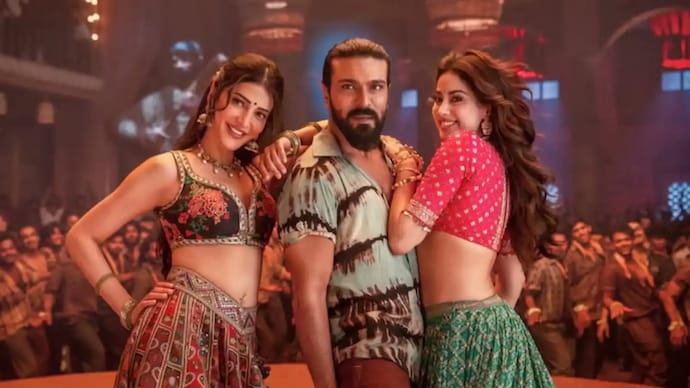
There is a particular kind of confidence, or perhaps stubbornness, required to drop a dance number in 2026 and expect it to become a chartbuster on its own. Ram Charan's Peddi has done exactly that with Hellallallo, featuring Shruti Haasan and Janhvi Kapoor alongside the actor in what is being positioned as the mass anthem of the season.
The song is big, loud and expensively mounted. AR Rahman composed it. Jani Master, who is currently facing a POCSO case, choreographed it. The team behind it boasts some of the biggest names in the industry.
Let's cut to the chase! Who still needs an "item number" in 2026? Why does a sports drama like Peddi, supposedly inspiring and educational on some level, need choreography designed for the male gaze? And why would Ram Charan, a megastar coming off the global success of RRR, like many other stars, resort to this for the film’s major promotional number?
Is there anything “special” about these special numbers any more? The choreography feels endlessly recycled: the same pelvic movements, the same gyrating hips, the same body thrusts — repetitive, redundant, and increasingly devoid of novelty.
Soon after the song dropped on YouTube and other streaming platfoms, social media subjected the makers to excessive trolling, bashing and backlash and rightly so. Many viewers feel Jani Master's choreography has become repetitive, pointing out similarities to movements seen not just in Ram Charan songs over the past decade, but across several songs he has choreographed recently.
That is the uncomfortable truth that Hellallallo has stumbled into — not because it is a bad song, but because it represents a formula that audiences have quietly outgrown while filmmakers failed to get the memo.
The special number, as a concept, was built on a simple transaction. A recognisable face, an energetic choreographer, a catchy hook and a promise of something extra — a treat outside the film's narrative, inserted to generate buzz and drive footfalls. Over the years, the budgets grew. The term "item song" was traded for a "special number." But the one thing that never changed was the gaze — and what it was directed at.
The camera in these songs has always known exactly where to look. Close-ups of midriffs, slow pans across bodies, choreography designed less for artistic expression and more for a specific kind of attention. The lyrics, meanwhile, have historically done the same work with words — reducing the women performing these songs to objects of desire, described in terms that would not survive scrutiny outside the context of a film song.
Hellallallo has drawn criticism on both counts, with viewers pointing out that the choreography and framing lean heavily into the same male gaze that has defined the format for decades. The women in the frame are not characters. They are spectacle — and the camera makes no attempt to pretend otherwise.
It worked for years because it gave audiences something they couldn't get anywhere else: voyeurism dressed as entertainment. The problem is that the transaction has changed or is still slowly changing. Audiences can access anything, anytime. The threshold for what counts as special — and what counts as acceptable — has shifted dramatically.
In recent years, special numbers featuring Samantha Ruth Prabhu and Sreeleela in the Pushpa: The Rise and Pushpa 2: The Rule franchise have clocked millions of views online. But popularity is hardly the point. The real question is: did these songs add anything meaningful to the films themselves? Would Pushpa have been any less successful without Oo Antava or Kissik? Would audiences have walked out of Pushpa 2 any less obsessed with the franchise without Sreeleela’s raunchy dance number? Probably not.
That is precisely the problem with many modern “special numbers.” They no longer emerge organically from storytelling, character, or atmosphere; they arrive as calculated interruptions designed for instant virality and voyeurism. In the process, they often chip away at the credibility and aesthetic consistency of the film itself. Where is the nuance? The taste? The effort to offer audiences something inventive or emotionally relevant instead of the same recycled grammar of pelvic thrusts, hip gyrations, and camera movements engineered around the male gaze?
A song can absolutely be sensual, playful, even provocative - Indian cinema has a long history of doing that with flair and imagination. But there is a difference between sensuality that enhances storytelling and choreography that feels mechanically inserted to generate clicks, reels, and whistles.
A few weeks ago, Sanjay Dutt and Nora Fatehi's provocative number in the Kannada film KD: The Devil came and went without helping the film's dismal box office performance. The song, Sarke Chunar, had everything a special number is supposed to have — a recognisable face, a high-energy performer in Nora Fatehi and a big-budget production. It moved nothing except some associations against them.
What both Hellallallo and Sarke Chunar reveal is that the special number's greatest weakness is now its own predictability. Audiences walk in knowing exactly what they are about to see — a song that exists outside the film's story, designed to be a spectacle in isolation. The element of surprise, which once made these numbers feel like a bonus, has been completely erased by repetition.
It doesn’t matter how many women are there, leading ladies or not, the idea is to say that they could have still mase the work without it, so whoever they rope in doesn’t matter. This never happens in the West - there are no item numbers in the Marvel movies, the Avatar saga, the Nolan entertainers and even the films that have done incredibly well in India. We want our stories to travel universally, to travel pan-world so to say, but how will they if we are still trusting these shortcuts, the idea of providing the audience short-term pleasure over narrative and quality?
What filmmakers seem reluctant to accept is that the audience's relationship with spectacle has fundamentally changed. A song goes viral today not because it was mounted on a big set with a big star, but because it made someone feel something unexpected. Hellallallo is trying to win an argument that audiences stopped having — and doing so with a format that has never fully reckoned with the cost it extracts from the women at its centre.
The format may survive. But filmmakers who keep greenlighting these songs and stars who keep signing up for them owe audiences — and the women performing in them — a more honest answer for why they still think this works.
There is a particular kind of confidence, or perhaps stubbornness, required to drop a dance number in 2026 and expect it to become a chartbuster on its own. Ram Charan's Peddi has done exactly that with Hellallallo, featuring Shruti Haasan and Janhvi Kapoor alongside the actor in what is being positioned as the mass anthem of the season.
The song is big, loud and expensively mounted. AR Rahman composed it. Jani Master, who is currently facing a POCSO case, choreographed it. The team behind it boasts some of the biggest names in the industry.
Let's cut to the chase! Who still needs an "item number" in 2026? Why does a sports drama like Peddi, supposedly inspiring and educational on some level, need choreography designed for the male gaze? And why would Ram Charan, a megastar coming off the global success of RRR, like many other stars, resort to this for the film’s major promotional number?
Is there anything “special” about these special numbers any more? The choreography feels endlessly recycled: the same pelvic movements, the same gyrating hips, the same body thrusts — repetitive, redundant, and increasingly devoid of novelty.
Soon after the song dropped on YouTube and other streaming platfoms, social media subjected the makers to excessive trolling, bashing and backlash and rightly so. Many viewers feel Jani Master's choreography has become repetitive, pointing out similarities to movements seen not just in Ram Charan songs over the past decade, but across several songs he has choreographed recently.
That is the uncomfortable truth that Hellallallo has stumbled into — not because it is a bad song, but because it represents a formula that audiences have quietly outgrown while filmmakers failed to get the memo.
The special number, as a concept, was built on a simple transaction. A recognisable face, an energetic choreographer, a catchy hook and a promise of something extra — a treat outside the film's narrative, inserted to generate buzz and drive footfalls. Over the years, the budgets grew. The term "item song" was traded for a "special number." But the one thing that never changed was the gaze — and what it was directed at.
The camera in these songs has always known exactly where to look. Close-ups of midriffs, slow pans across bodies, choreography designed less for artistic expression and more for a specific kind of attention. The lyrics, meanwhile, have historically done the same work with words — reducing the women performing these songs to objects of desire, described in terms that would not survive scrutiny outside the context of a film song.
Hellallallo has drawn criticism on both counts, with viewers pointing out that the choreography and framing lean heavily into the same male gaze that has defined the format for decades. The women in the frame are not characters. They are spectacle — and the camera makes no attempt to pretend otherwise.
It worked for years because it gave audiences something they couldn't get anywhere else: voyeurism dressed as entertainment. The problem is that the transaction has changed or is still slowly changing. Audiences can access anything, anytime. The threshold for what counts as special — and what counts as acceptable — has shifted dramatically.
In recent years, special numbers featuring Samantha Ruth Prabhu and Sreeleela in the Pushpa: The Rise and Pushpa 2: The Rule franchise have clocked millions of views online. But popularity is hardly the point. The real question is: did these songs add anything meaningful to the films themselves? Would Pushpa have been any less successful without Oo Antava or Kissik? Would audiences have walked out of Pushpa 2 any less obsessed with the franchise without Sreeleela’s raunchy dance number? Probably not.
That is precisely the problem with many modern “special numbers.” They no longer emerge organically from storytelling, character, or atmosphere; they arrive as calculated interruptions designed for instant virality and voyeurism. In the process, they often chip away at the credibility and aesthetic consistency of the film itself. Where is the nuance? The taste? The effort to offer audiences something inventive or emotionally relevant instead of the same recycled grammar of pelvic thrusts, hip gyrations, and camera movements engineered around the male gaze?
A song can absolutely be sensual, playful, even provocative - Indian cinema has a long history of doing that with flair and imagination. But there is a difference between sensuality that enhances storytelling and choreography that feels mechanically inserted to generate clicks, reels, and whistles.
A few weeks ago, Sanjay Dutt and Nora Fatehi's provocative number in the Kannada film KD: The Devil came and went without helping the film's dismal box office performance. The song, Sarke Chunar, had everything a special number is supposed to have — a recognisable face, a high-energy performer in Nora Fatehi and a big-budget production. It moved nothing except some associations against them.
What both Hellallallo and Sarke Chunar reveal is that the special number's greatest weakness is now its own predictability. Audiences walk in knowing exactly what they are about to see — a song that exists outside the film's story, designed to be a spectacle in isolation. The element of surprise, which once made these numbers feel like a bonus, has been completely erased by repetition.
It doesn’t matter how many women are there, leading ladies or not, the idea is to say that they could have still mase the work without it, so whoever they rope in doesn’t matter. This never happens in the West - there are no item numbers in the Marvel movies, the Avatar saga, the Nolan entertainers and even the films that have done incredibly well in India. We want our stories to travel universally, to travel pan-world so to say, but how will they if we are still trusting these shortcuts, the idea of providing the audience short-term pleasure over narrative and quality?
What filmmakers seem reluctant to accept is that the audience's relationship with spectacle has fundamentally changed. A song goes viral today not because it was mounted on a big set with a big star, but because it made someone feel something unexpected. Hellallallo is trying to win an argument that audiences stopped having — and doing so with a format that has never fully reckoned with the cost it extracts from the women at its centre.
The format may survive. But filmmakers who keep greenlighting these songs and stars who keep signing up for them owe audiences — and the women performing in them — a more honest answer for why they still think this works.

