The Cockroach Republic
Satirist Kamlesh Singh breaks down the Cockroach Janta Party phenomenon and points out that the Gen Z in India is not a monolith, like the ones in Nepal or Lanka.
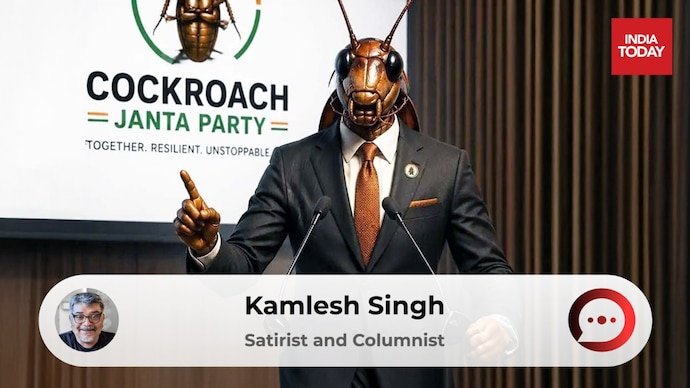
The cockroach has been around for 320 million years. It has survived things considerably more formidable than Justice Surya Kant’s remarks. It survived the dinosaurs. So, let us begin at the beginning. With the word itself. Cockroach comes from the Spanish cucaracha. The English, being the English, heard cucaracha, did not understand it, and did what the English do with things they do not understand: they partitioned it, anglicised the pieces, and called it their word. Cuca became cock. Racha became roach.
And thus a perfectly harmless cucaracha acquired a name that has been making ladies uncomfortable since the first roach emerged out of a crevice in her cave. Women prefer the word roach, for the sake of euphony. Without the prefix, it's delicate. Women are delicate.
Unlike scientists. They named the order Blattodea, from the Latin blatta: an insect that shuns the light. An insect that shuns the light. Remember that phrase. We will return to it.
In Hindi, the cockroach is a tilchatta or telchatta. I am not sure whether it licks sesame seeds or sesame oil to have two versions of its name. Telchatta is what my dadi called it before hitting it with her blue-sole Bata chappal. The word has a beautiful ugly rhythm to it, a word that sounds exactly like what it describes: something you would rather not say out loud in polite company. It is a word with no dignity and no apology for having none.
Justice Surya Kant, the Chief Justice of India, was not thinking about etymology when he said it. He was thinking about a new generation of lawyers filing contempt petitions, wasting court time, scurrying about in the corridors of the judiciary with all the purposefulness of creatures that emerge when the lights go out. Youngsters like cockroaches, he said. Some become media. Some become RTI activists. Some become social media. All of them, in his telling, become pests. Control, Justice, control. But exercising self-control is something Uday Shetty can, Chief Justice Surya can’t. He went on. The CJI birthed the CJP, unwittingly, and the BJP suffered all the labour pain.
Abhijeet Dipke, a Boston-based unemployed youth with an AAP-adjacent political flavour and the instincts of a man who went to the Kejriwal School of Issue-Spotting, did what any sensible opportunist would do. He picked up the slur, dusted it off, and put it on a banner. Overnight, there was a Cockroach Janta Party. Within a week, there was a meme movement. The youth of India, ever alert to the global grammar of protest, had their own Je suis Charlie moment. Main bhi tilchatta. I am also a cockroach. Say it with pride. Say it with an Instagram reel set to a trending audio listed as an anthem, made with AI.
The CJP and its manifesto are genuinely funny. As satire, it is well-constructed, instinctively targeted, and lands cleanly. As a political movement, it is about as consequential as the tilchatta in your kitchen: alarming to encounter, impossible to entirely ignore, but ultimately living in the pipe behind the sink. There is a serious condition called: Katsaridaphobia. This is an irrational fear of cockroaches. The heart begins pumping and the subject starts jumping.
That's what happened when the BJP, the clear target of the meme campaign, began panicking over a narrative this CJP was setting. The party is too experienced to overestimate its seriousness as a political alternative, but it's oversensitive to a shift in narrative. Since a section of the Instagram youth was taking it as a serious revolutionary symbol, the BJP got the blue-sole slippers out. Causing more consternation than required.
Here is the problem with the tilchatta as a revolutionary symbol. The cockroach is, by the frank testimony of its own scientific classification, an insect that shuns the light. It does not march. It does not occupy Durbar Square. It does not storm the Bastille or siege the presidential palace. It hides. It waits. It emerges when it thinks no one is looking, takes what it needs from the edges and the corners, and vanishes the moment the light comes on. This is an impressive survival strategy. It is a terrible revolution strategy.
The comparisons to Bangladesh, Nepal, Sri Lanka, have been made. They have been made breathlessly, excitedly, by people who would very much like India to be the next chapter in a compelling series. They are wrong, and here is why.
In Bangladesh, the quota reform movement was a spark in dry timber, but crucially, it was the same timber, uniformly dry, burning at the same temperature across the same landscape of grievance. In Sri Lanka, the misery was total and democratic: a Sri Lankan in Jaffna and a Sri Lankan in Colombo were both feeling the same crisis in the same wallet simultaneously. When you have one sky and one catastrophe, you can have one uprising.
India has 4,000 species of cockroach. This is not a metaphor. It is also a metaphor.
The generation supposedly born between 1997 and 2012 is described as Gen Z, as if being born in the same 15-year window makes people contemporaries in any meaningful sense. A boy born in 2000 in South Delhi and a boy born in 2000 in Kumhratari, Banka district, Bihar, share a birth year and approximately nothing else. The Delhi boy is worried about AI taking his desk job and whether his parents are sufficiently sensitive to LGBTQ+ issues. The Banka boy's aspiration, considerably more modest, is not to have a life in crime.
Between them is not merely geography. It is time. One thousand two hundred kilometres and roughly twenty years. The girl born the same year in a small town in Banka is 30 years behind the Delhi boy. A girl born in a village in Banka's Kumhratari block is a century behind. Her India hasn't even gained independence yet.
When you travel 6 kilometres from Chhatarpur in 2026, you are in Gurugram, that's in 2036. Travel 20 km further south to a village near Nuh, you will be in 18th century. Surface transport can make you time travel in this country.
This is how time works in India. It does not travel independently of space.
Kehne ko, they are all Gen Z youth.
A lot of these young people have no love lost for the BJP. A lot of them are what their critics call bhakts and what their supporters call believers. A lot of them are so profoundly silent that they barely exist as a political category at all, because their voice is only their own, and they are busy with the very practical business of survival.
The girl in Banka is happy making reels in Banka. The Bhagalpur boy has a local political calculus that has nothing to do with a Boston graduate's meme party. The Bengaluru boy is furious that his startup funding dried up and is blaming the government for a global phenomenon that Trump started.
They are all, technically, Gen Z. They are all, practically, different generations of Indians born in the same generation.
The Cockroach Janta Party's genius and its ceiling are the same thing. It is anti-BJP without being pro-anything else, which is excellent meme posture and terrible governing posture. It draws people together not around a shared vision but around a shared annoyance, which is very good raw material for a trending hashtag and very poor raw material for a movement that intends to go anywhere.
The BJP, Congress, or even AAP, whatever their many qualities, have one consistent superpower that functions regardless of what the government is doing or not doing: they can divide. Caste, religion, region, language, our political parties are master craftsmen of faultlines. The CJP's constituency, magnificently diverse in its discontents, is a standing invitation to that superpower. You do not need to defeat the cockroaches. You merely need to turn the light on.
The light is already coming on.
And a word of caution: The youth of India have been traversing in a dark alley for quite some time. India needs to break the ceiling to let some light in. The global economic crisis notwithstanding, the growth story has to broaden, exams like NEET got to be clean, and a whole generation needs to see the dawn long promised. Put the spotlight on the issues that matter to them, more than politics.
The tilchatta, remember, is blatta. The insect that shuns the light. The moment the lights go on in this kitchen, the scattering will begin, each cockroach retreating to its own crevice, its own cupboard, its own sink pipe, its own local concern, its own specific misery. Some will find their way into actual opposition politics and do something useful there. Some will simply go home. The Boston graduate will have his moment. The meme will age. And India will continue, as it always has, being too large, too various, and too stubbornly itself to erupt on someone else's schedule.
(Kamlesh Singh, a columnist and satirist, is Tau of the popular Teen Taal podcast)
The cockroach has been around for 320 million years. It has survived things considerably more formidable than Justice Surya Kant’s remarks. It survived the dinosaurs. So, let us begin at the beginning. With the word itself. Cockroach comes from the Spanish cucaracha. The English, being the English, heard cucaracha, did not understand it, and did what the English do with things they do not understand: they partitioned it, anglicised the pieces, and called it their word. Cuca became cock. Racha became roach.
And thus a perfectly harmless cucaracha acquired a name that has been making ladies uncomfortable since the first roach emerged out of a crevice in her cave. Women prefer the word roach, for the sake of euphony. Without the prefix, it's delicate. Women are delicate.
Unlike scientists. They named the order Blattodea, from the Latin blatta: an insect that shuns the light. An insect that shuns the light. Remember that phrase. We will return to it.
In Hindi, the cockroach is a tilchatta or telchatta. I am not sure whether it licks sesame seeds or sesame oil to have two versions of its name. Telchatta is what my dadi called it before hitting it with her blue-sole Bata chappal. The word has a beautiful ugly rhythm to it, a word that sounds exactly like what it describes: something you would rather not say out loud in polite company. It is a word with no dignity and no apology for having none.
Justice Surya Kant, the Chief Justice of India, was not thinking about etymology when he said it. He was thinking about a new generation of lawyers filing contempt petitions, wasting court time, scurrying about in the corridors of the judiciary with all the purposefulness of creatures that emerge when the lights go out. Youngsters like cockroaches, he said. Some become media. Some become RTI activists. Some become social media. All of them, in his telling, become pests. Control, Justice, control. But exercising self-control is something Uday Shetty can, Chief Justice Surya can’t. He went on. The CJI birthed the CJP, unwittingly, and the BJP suffered all the labour pain.
Abhijeet Dipke, a Boston-based unemployed youth with an AAP-adjacent political flavour and the instincts of a man who went to the Kejriwal School of Issue-Spotting, did what any sensible opportunist would do. He picked up the slur, dusted it off, and put it on a banner. Overnight, there was a Cockroach Janta Party. Within a week, there was a meme movement. The youth of India, ever alert to the global grammar of protest, had their own Je suis Charlie moment. Main bhi tilchatta. I am also a cockroach. Say it with pride. Say it with an Instagram reel set to a trending audio listed as an anthem, made with AI.
The CJP and its manifesto are genuinely funny. As satire, it is well-constructed, instinctively targeted, and lands cleanly. As a political movement, it is about as consequential as the tilchatta in your kitchen: alarming to encounter, impossible to entirely ignore, but ultimately living in the pipe behind the sink. There is a serious condition called: Katsaridaphobia. This is an irrational fear of cockroaches. The heart begins pumping and the subject starts jumping.
That's what happened when the BJP, the clear target of the meme campaign, began panicking over a narrative this CJP was setting. The party is too experienced to overestimate its seriousness as a political alternative, but it's oversensitive to a shift in narrative. Since a section of the Instagram youth was taking it as a serious revolutionary symbol, the BJP got the blue-sole slippers out. Causing more consternation than required.
Here is the problem with the tilchatta as a revolutionary symbol. The cockroach is, by the frank testimony of its own scientific classification, an insect that shuns the light. It does not march. It does not occupy Durbar Square. It does not storm the Bastille or siege the presidential palace. It hides. It waits. It emerges when it thinks no one is looking, takes what it needs from the edges and the corners, and vanishes the moment the light comes on. This is an impressive survival strategy. It is a terrible revolution strategy.
The comparisons to Bangladesh, Nepal, Sri Lanka, have been made. They have been made breathlessly, excitedly, by people who would very much like India to be the next chapter in a compelling series. They are wrong, and here is why.
In Bangladesh, the quota reform movement was a spark in dry timber, but crucially, it was the same timber, uniformly dry, burning at the same temperature across the same landscape of grievance. In Sri Lanka, the misery was total and democratic: a Sri Lankan in Jaffna and a Sri Lankan in Colombo were both feeling the same crisis in the same wallet simultaneously. When you have one sky and one catastrophe, you can have one uprising.
India has 4,000 species of cockroach. This is not a metaphor. It is also a metaphor.
The generation supposedly born between 1997 and 2012 is described as Gen Z, as if being born in the same 15-year window makes people contemporaries in any meaningful sense. A boy born in 2000 in South Delhi and a boy born in 2000 in Kumhratari, Banka district, Bihar, share a birth year and approximately nothing else. The Delhi boy is worried about AI taking his desk job and whether his parents are sufficiently sensitive to LGBTQ+ issues. The Banka boy's aspiration, considerably more modest, is not to have a life in crime.
Between them is not merely geography. It is time. One thousand two hundred kilometres and roughly twenty years. The girl born the same year in a small town in Banka is 30 years behind the Delhi boy. A girl born in a village in Banka's Kumhratari block is a century behind. Her India hasn't even gained independence yet.
When you travel 6 kilometres from Chhatarpur in 2026, you are in Gurugram, that's in 2036. Travel 20 km further south to a village near Nuh, you will be in 18th century. Surface transport can make you time travel in this country.
This is how time works in India. It does not travel independently of space.
Kehne ko, they are all Gen Z youth.
A lot of these young people have no love lost for the BJP. A lot of them are what their critics call bhakts and what their supporters call believers. A lot of them are so profoundly silent that they barely exist as a political category at all, because their voice is only their own, and they are busy with the very practical business of survival.
The girl in Banka is happy making reels in Banka. The Bhagalpur boy has a local political calculus that has nothing to do with a Boston graduate's meme party. The Bengaluru boy is furious that his startup funding dried up and is blaming the government for a global phenomenon that Trump started.
They are all, technically, Gen Z. They are all, practically, different generations of Indians born in the same generation.
The Cockroach Janta Party's genius and its ceiling are the same thing. It is anti-BJP without being pro-anything else, which is excellent meme posture and terrible governing posture. It draws people together not around a shared vision but around a shared annoyance, which is very good raw material for a trending hashtag and very poor raw material for a movement that intends to go anywhere.
The BJP, Congress, or even AAP, whatever their many qualities, have one consistent superpower that functions regardless of what the government is doing or not doing: they can divide. Caste, religion, region, language, our political parties are master craftsmen of faultlines. The CJP's constituency, magnificently diverse in its discontents, is a standing invitation to that superpower. You do not need to defeat the cockroaches. You merely need to turn the light on.
The light is already coming on.
And a word of caution: The youth of India have been traversing in a dark alley for quite some time. India needs to break the ceiling to let some light in. The global economic crisis notwithstanding, the growth story has to broaden, exams like NEET got to be clean, and a whole generation needs to see the dawn long promised. Put the spotlight on the issues that matter to them, more than politics.
The tilchatta, remember, is blatta. The insect that shuns the light. The moment the lights go on in this kitchen, the scattering will begin, each cockroach retreating to its own crevice, its own cupboard, its own sink pipe, its own local concern, its own specific misery. Some will find their way into actual opposition politics and do something useful there. Some will simply go home. The Boston graduate will have his moment. The meme will age. And India will continue, as it always has, being too large, too various, and too stubbornly itself to erupt on someone else's schedule.
(Kamlesh Singh, a columnist and satirist, is Tau of the popular Teen Taal podcast)

